
Mosaic AI
Recent items mentioning Mosaic AI across the Databricks ecosystem — releases, news, videos, and community Q&A. Updated hourly.
Databricks Unity AI Gateway introduced Smart Routing to automatically direct coding tasks across models and harnesses, achieving frontier-level quality at more than 30% lower cost per task 10. For governance and observability, administrators can now restrict models and model services using catalog tags paired with attribute-based access control (ABAC) grant policies 1, monitor LLM usage for data leaks via traces 8, and enforce spending budgets across users, groups, and workspaces 9.
Written September 2026 from the 10 most recent items mentioning Mosaic AI at that time. It refreshes when this topic next has enough new material. Click any [N] to jump to the source.
Balancing Model Agility and Centralized Governance with Mosaic AI Gateway
MLflow 3.15.0 introduces an MCP Registry for registering and sharing Model Context Protocol servers, enhances the Assistant with multi-provider LLM support and per-session token usage tracking, and enables proxy-less artifact transfers via presigned URLs to reduce server load and timeouts on large files. Additional improvements include sharable Runs table views, multi-modal image attachments for LLM judges to evaluate vision tasks, and numerous bug fixes across tracing, evaluation, gateway, and UI components.
Building an Enterprise RAG Chatbot with Databricks Mosaic AI and Vector Search
How ERGO Hestia reduced time-to-market with Lakebase and Mosaic AI Model Serving
ERGO Hestia modernized its real-time pricing engine with Databricks Lakebase and Mosaic AI Model Serving, reducing time-to-market by unifying data, features, and decisions for millisecond pricing. This eliminated extraction overhead and fragmented governance from their previous multi-hop architecture, enabling faster model deployment and instant market response.
Azure OpenAI v1 API support for External Model Serving / Mosaic AI Gateway?
Building a Real-Time Field Sales App on Databricks with Lakeflow, Lakebase, and Mosaic AI
Bring Databricks into Kiro IDE with the AI Dev Kit Power
The Databricks AI Dev Kit Power now offers a one-click setup to integrate Kiro IDE with the full Databricks platform, providing AI-assisted development grounded in your workspace's Unity Catalog metadata. This new path, alongside a lighter PAT-based option, ensures your AI assistant writes SQL with actual columns and respects all row, column, and tag-based grants.
I built a 54-minute hands-on RAG tutorial on Databricks — from PDF loading to retrieval and LLM answers
Hi Everyone I recently published a hands-on tutorial where I build a basic **RAG pipeline on Databricks** from scratch. The goal of the video is not just to use a high-level RAG framework, but to show what actually happens behind the scenes. In the video, I cover: * Loading PDF files inside Databricks * Extracting text from PDF pages * Splitting documents into chunks * Creating embeddings using Databricks embedding endpoints * Building a simple manual retrieval system using vector similarity * Creating prompts from retrieved chunks * Generating grounded answers using Databricks LLM endpoints * Using `databricks-langchain` for embeddings and chat models I intentionally kept the implementation simple so that beginners can understand the core mechanics of RAG before moving to more production-level tools like Vector Search, Unity Catalog, MLflow, etc. Here is the video: [https://youtu.be/7QY1iXPLgRg](https://youtu.be/7QY1iXPLgRg) Would love to hear feedback from people working with Databricks, RAG, LangChain, or enterprise GenAI systems. Also curious: for production RAG on Databricks, would you prefer starting with a simple manual implementation like this first, or directly using Mosaic AI Vector Search / Databricks Vector Search from the beginning?
 Tutorials
Databricks End-To-End Project | Zero-To-Expert | Streaming, AI, Lakeflow, Unity Catalog, AI/BI
This video demonstrates building an end-to-end restaurant analytics platform on Databricks, covering streaming and batch data ingestion, AI-powered sentiment analysis, and dashboard creation. It teaches how to use Unity Catalog, Lake Flow Connect for CDC, Spark declarative pipelines for real-time data from Event Hub, and how to construct a medallion architecture with fact and dimension tables.
 News
NewsGetting GenAI to Production with Mosaic AI Gateway in Databricks
The video demonstrates how to productionize GenAI applications using Databricks' Mosaic AI Gateway, highlighting features like usage tracking, inference tables, AI guardrails, rate limits, and model fallbacks. It shows how to configure these features through the Databricks UI and monitor application performance and costs using built-in dashboards.
 News
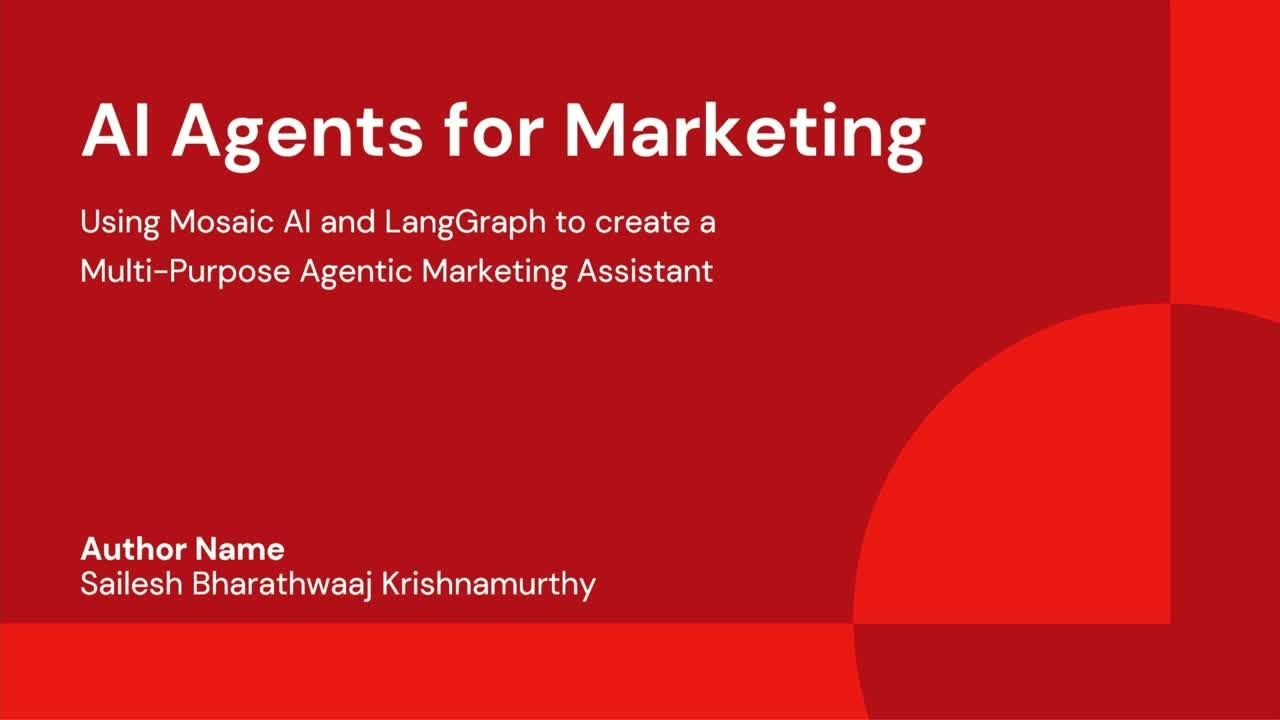
NewsAI Agents for Marketing: Leveraging Mosaic AI to Create a Multi-Purpose Agentic Marketing Assistant
7-Eleven built an internal AI marketing assistant using Mosaic AI and LangGraph that coordinates multiple specialized agents to generate campaign concepts, copy, and multichannel content for their marketing teams. The system uses a supervisor agent to orchestrate a creative campaign generator and copywriter, includes tools like web search and email, incorporates human-in-the-loop approval steps, and demonstrates measurable time savings.
 Events
Data + AI Summit Keynote Day 1
Databricks introduced Lakebase, a serverless Postgres database with storage-compute separation and instant branching designed for AI agents, alongside Databricks Apps for deploying secure production data applications with built-in governance. The company unified support for both Delta Lake and Apache Iceberg formats through Unity Catalog while emphasizing AI-driven democratization through natural-language data access and intelligent coding agents.
 Events
Product Launches from Data + AI Summit 2025 Day 1
Databricks launched a free tier requiring no credit card and introduced Lakebase, a new database architecture that separates compute and storage to reduce costs by storing transactional data in cheap data lakes. The company also announced Agent Bricks, production-ready AI agents pre-optimized on user data with built-in evaluation tools for balancing quality versus cost tradeoffs.
 Releases
Agent Bricks: Production AI Agents Auto-optimized on your Data | Live Demo
Databricks announced Agent Bricks, a platform that auto-optimizes production AI agents on customer data through automatic custom evaluations, technique optimization, and natural language feedback for continuous improvement. The demo showed building a knowledge assistant for R&D product questions, improving it with guided learning, then orchestrating multiple department agents into a supervisor system to generate cross-functional business analysis.
 Events
Databricks Product Announcements at Data + AI Summit 2024
Databricks launched Delta 4.0 with lakehouse federation and open-source Unity Catalog, plus Databricks AI BI for conversational business intelligence powered by a learning system called Genie. The company also expanded Mosaic AI with serverless GPUs, zero-code model fine-tuning, an agent framework, improved ML Flow tracing, and the Mosaic AI Gateway for governance and auditability.
 Events
Patrick Wendell, Co-founder and VP of Engineering on Building Production-Quality AI Systems
Databricks provides the Mosaic AI platform, which enables companies to transform general-purpose language models into customized data-intelligent applications. The system leverages tools such as zero-code fine-tuning, the Unity Catalog for data governance, vector search for retrieval-augmented generation, and MLflow for tracing and evaluation.
 Events
Ali Ghodsi, Databricks Co-founder and CEO Closes the Keynote with a Summary of Product Announcements
Databricks highlights its data intelligence platform updates, including Mosaic AI, high-performance data warehousing, and Genie for natural language business intelligence. The company also previews upcoming sessions focused on data engineering workflows, Unity Catalog, and open-source formats like Apache Iceberg.
 News
NewsAli Ghodsi, Databricks Co-founder and CEO on Data Intelligence
Databricks introduces data intelligence as a solution for building custom artificial intelligence using proprietary data while ensuring cost efficiency and privacy. The presentation features the introduction of Mosaic AI to demonstrate these capabilities on stage.
 Events
Data + AI Summit Keynote Day 1 - Full
The Databricks Data + AI Summit Day 1 keynote announces new features for the Data Intelligence Platform, including serverless execution, Delta-Iceberg interoperability via Project Uniform, and the open-sourcing of Unity Catalog. The event also highlights updates to Mosaic AI for building and governing custom generative AI agents, along with customer case studies from General Motors and Block.
 Events
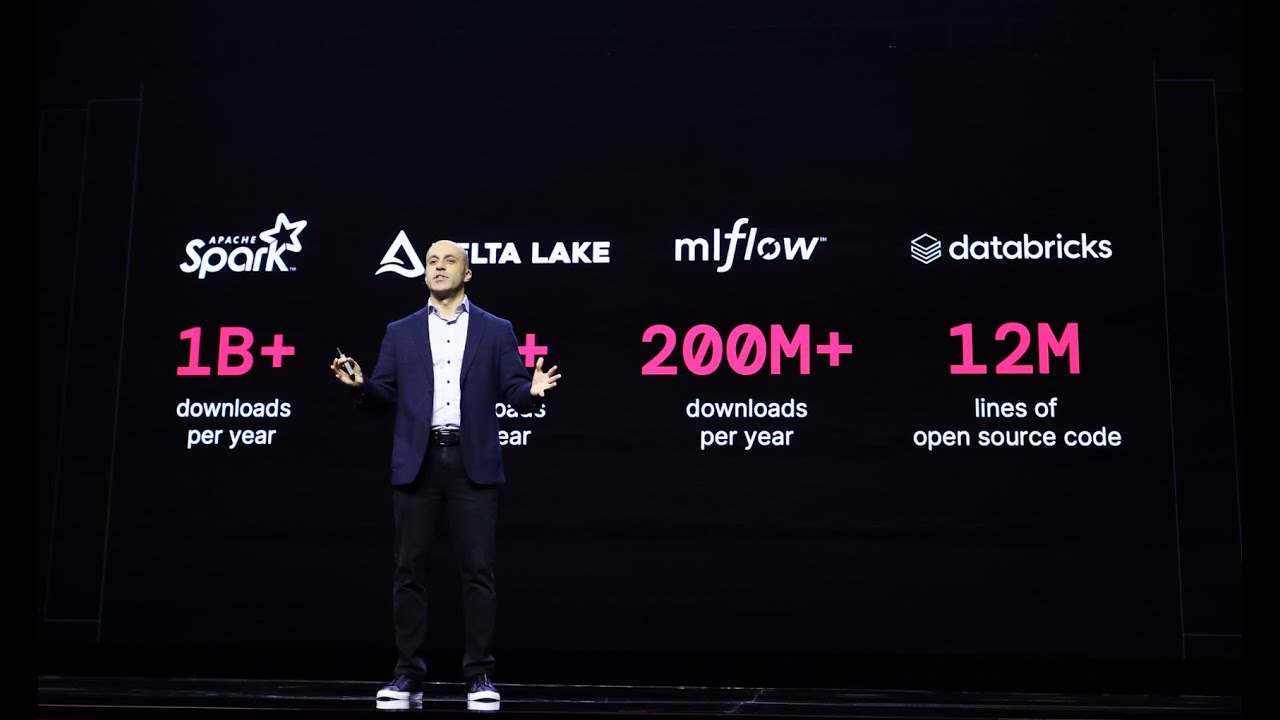
Data + AI Summit Keynote Day 1 - Ali Ghodsi, Co-founder and CEO of Databricks
The keynote announces the acquisition of Tabular and the open sourcing of Unity Catalog to unite the Delta Lake and Apache Iceberg data formats under an open standard. Additionally, the presentation introduces Databricks' data intelligence platform powered by Mosaic AI and announces the full availability of the platform in serverless mode.
 Tutorials
Master Databricks and Apache Spark Step by Step: Series Update - What's Changed?
The video reviews major updates and new features added to Databricks and Apache Spark since the original training series was published. It highlights key advancements such as Delta Lake lakehouses, Unity catalog governance, Mosaic AI integration, adaptive query execution, Photon engine performance, and enhanced workflows.
Get Tuesday's version of this
Tracking Mosaic AI? The Tuesday email carries what moved across the whole ecosystem, not just this topic. Free, one-click unsubscribe.