
OpenAI
Recent items mentioning OpenAI across the Databricks ecosystem — releases, news, videos, and community Q&A. Updated hourly.
Databricks is emphasizing multi-model governance with guidance on orchestrating enterprise AI agents 1 alongside MLflow 3.16.0's introduction of per-user AI Gateway budget policies and fail-closed authorization 5. In parallel, practitioners report operational friction around AI rate limits 2 and billing-related delays when provisioning access to OpenAI and Opus models 3.
Generated daily from the 5 most recent items mentioning OpenAI. Click any [N] to jump to the source.
 Events
How Enterprises Govern AI Agents Across Multiple Models
Databricks announced the general availability of the Unity AI gateway to provide centralized multi-model governance, cost controls, and end-to-end observability for enterprise AI agents. Panelists discussed how coding agents and harnesses are evolving beyond programming into long-running operations, personal software development, and automated organizational workflows.
Let's talk about AI rate limits
Databricks Unity Gateway is great and getting even better very quickly. It now has nearly everything we could hope for. New frontier models are usually available within 24 hours of release. But...the models aren't really available . They all come with extremely low rate limits, way too low to support a team of engineers in any sizable enterprise using the models. If you have a sizable agents.md even 1 person hits the limits. Why is it like this? Sure we can raise a ticket to request higher limits but that takes weeks and the highest we've gotten is 1M tok/min. We can (and do) go to Bedrock and get 5M+ tok/min by default, no special request needed. Is the expectation that we hook up other providers? Are the key frontier labs (OpenAI, Anthropic, Google) limiting Databricks as a whole? For such a great product this seems like a glaring limitation that's holding us back. Make it make sense. submitted by /u/degenbets [link] [comments]
I entered my credit card details 4 daysa go but i cant get access to openAI or Opus models
Show HN: Like LeetCode, but multi-file and multi-step
On LeetCode you write one function, it passes, and you're done. Most AI labs such as Anthropic and OpenAI, as well as some big tech companies such as Meta, Snowflake and Databricks, don't stop in one function and instead ask multi-step questions that are closer to real-world problems. Say you're building a key-value store. Step 1 is get, set, delete, count. Once your tests pass, Step 2 unlocks: expiring keys. Then nested transactions. Then atomic batches. I built this because I couldn't find a good place to practice for multi-step, multi-file questions. The questions are based on ones people have reported from those loops. Check it out at https://loopprep.dev. There are 24 questions, 3 free, and no signup to try them. Happy to answer questions. --- top comments --- [MiroslavPokorny] Writing code in a browser like this or leet code is wrong on so many levels its not funny.
datatf: Automate importing Databricks workspace into Terraform
DataTf , bring an existing Databricks Workspace into Terraform (IaC). generates dynamic terraform.tfvars + import code built on the Databricks Go SDK compatible with Terraform or OpenTofu compatible with Databricks Omnigent, Claude Code, opencode, OpenAI Codex and others native support for Azure, with GCP and AWS support upcoming Disclosure: I am the Author/Founder, 536 Technologies. submitted by /u/536tech [link] [comments]
Secrets in Unity Catalog
Secrets in Unity Catalog store credentials like API keys as governed objects named catalog.schema.secret: created, granted, rotated and audited with standard Unity Catalog privileges and redacted from notebook and job logs. This is a full end-to-end demo: 1)Create a secret with the REST API and in the Catalog UI 2)Read it in a notebook with dbutils.secrets.get 3)Use it to call the OpenAI API 4)Grant read/reference/write access to a user or group 5)Rotate it programmatically 6)Audit every access from a system table submitted by /u/Youssef_Mrini [link] [comments]
MLflow 3.16.0
MLflow 3.16.0 makes the redesigned trace explorer the default interface, introducing natural-language custom trace views via the MLflow Assistant, session grouping for multi-turn conversations, and span links. The update also adds Unity Catalog model service support for built-in evaluation judges, per-user AI Gateway budget policies, and fail-closed authorization by default.
External price control
In the Unity AI gateway, it is also possible to register an external model for which we pay the provider directly (OpenAI, Anthropic, etc.). In that case, Databricks now knows the prices for those models and can calculate, monitor usage, and alert or block based on budgets. more news https://medium.com/databrickscommunity/databricks-news-serverless-genie-code-ltap-lakeflow-61853d8e422a submitted by /u/hubert-dudek [link] [comments]
 News
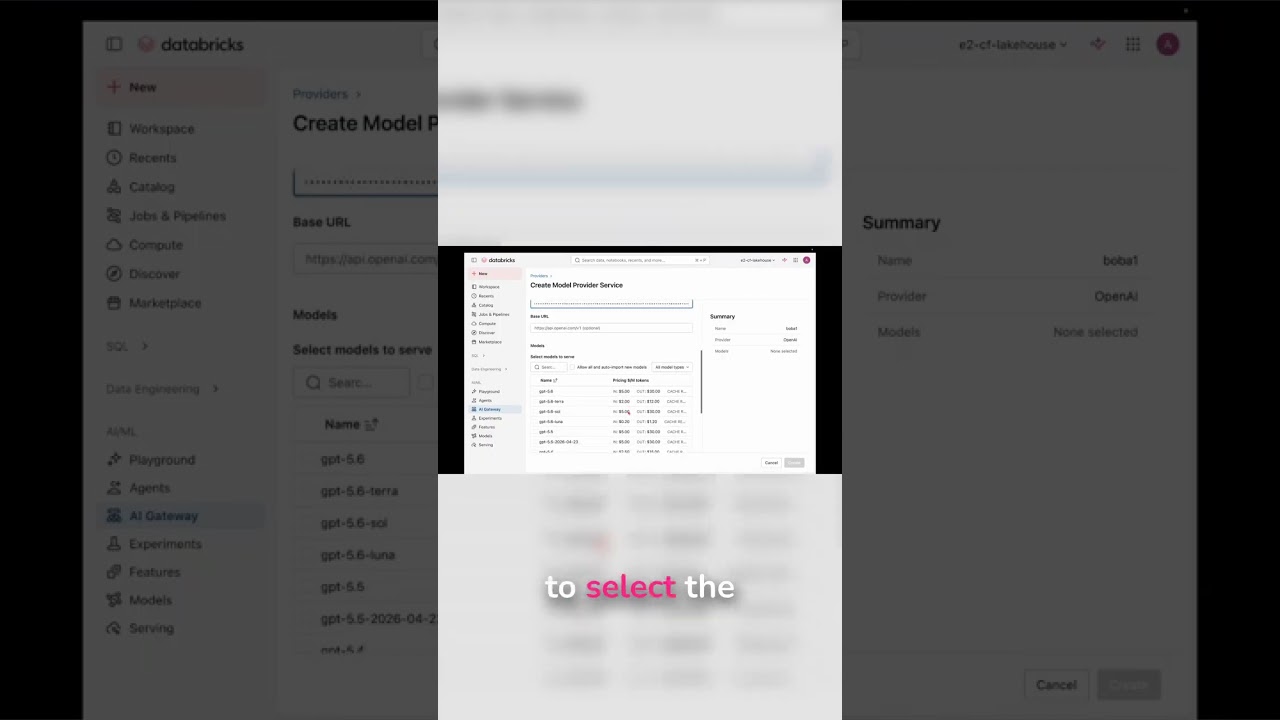
NewsIntegrating External AI Models with Databricks
The video demonstrates adding an external OpenAI endpoint to Databricks by entering a provider name, API key, and selecting a model version. Once created, the endpoint is ready for use within Databricks.
What are AI Hallucinations?
What are AI hallucinations, why does it matter, and what can enterprises do about it? Newer reasoning models from OpenAI and DeepSeek are actually hallucinating more than their predecessors, not less, making detection and prevention a must for any production deployment. Enterprises can curb the risk with retrieval-augmented generation, domain-specific fine-tuning, systematic evaluation frameworks, and strong data governance.
Managing AI Coding Costs at Scale
--- top comments --- [extr] I would be really curious to hear from devs at Databricks what the experience of development is like internally. I work at a small startup with essentially unlimited AI spend budget - the entire point is that I should be turning to it at every opportunity since our human labor is so expensive relative to tokens. So generally it's like: - Spend most time prioritizing/discussing what to do. - Once that's agreed, use Fable 5 High + 5.6 Sol XHigh come up with a design + plan. Agree on the high level plan. (Usually this just comes down to choosing where the change belongs on the spectrum between minimal patch <-> full redesign) - Use Opus 5 or Sol Med to execute - Auto-fix bugs and CI until green + thermonuclear review skill x3. - Manual interrogation of change/nits - Come up with QA plan and have Codex Computer Use execute on it - Manually spot check the final result (usually a sizable diff, thousands of lines, complete feature E2E, etc) I probably spend like $80 a day at least but I produce the output of 3 or 4 2022 engineers and probably at better quality. So it's easily worth it. Would I save money by switching to GLM 5.2 and such...perhaps? IDK. At our scale it's not worth the time spent building the eval harness to actually understand the performance tradeoff. [lbriner] There are a surprising number of articles like this along the lines of, "we started using AI tools and ended up spending millions per year". On what planet do people start paying for things without keeping an eye on the costs and no-one notices until you have spent a crazy amount? I don't understand. You are either paying a fixed amount which you are happy about in-advance or you are PAYG in which case you would ballpark how much it costs. Otherwise it reads a bit like a fake problem, because it didn't really happen, you just foresaw it (as you should) and added a few guide rails. [sashank_1509] I suspect that when it comes to hard complex software products, you’re better off ignoring agents and doing “trad coding”. What you lose in short term speed you gain in manageable complex codebases. If you have a 500k line codebase and even > 50% is written by agents, you are in a world of pain that won’t justify the costs longer term. Now of course, there are products that just involve lots of code but are not actually complex. This is generally the project with like hundreds or thousands of features but most of the features are separate and don’t actually interact in complex ways. Think a task management app with hundreds of features like calendar, email integration etc. there I think agents gives you more bang for the buck. Just my thought, using agents at work. [platinumrad] Careful. If you admit to using models that weren't trained by OpenAI or Anthropic then you might hauled in front of Congress: https://www.scmp.com/news/china/diplomacy/article/3362616/us... [dgellow] What I take from this is that models are already commoditized, and it’s pretty clear nobody has a moat: routing for the models, they can be swapped whenever new models are released, AI labs will have to continue to run on the treadmill non stop or be replaced. Long term I cannot imagine that business will be high margin. Routing for the harness, so anything that differentiate a provider vs another isn’t exposed to the user and isn’t too relevant. One more datapoint for the thesis that OpenAI and anthropic aren’t viable, sustainable businesses, and cannot justify their $1T valuation and the level of compute commitment (reminder that OpenAI committed to >$750B in infra spending for 2030)
 News
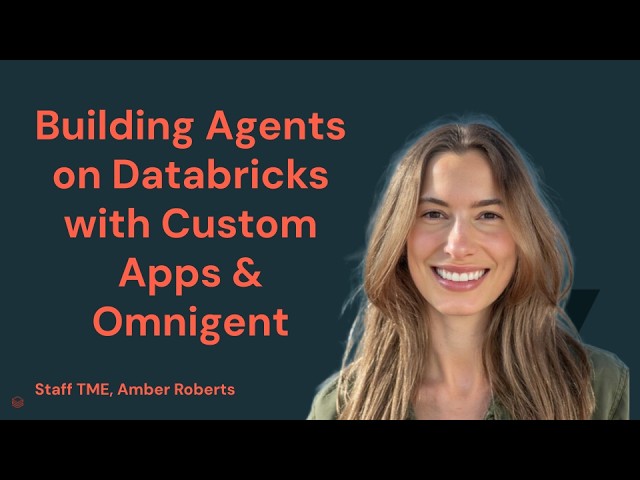
NewsBuilding Agents on Databricks with Custom Apps and Omnigent
This video demonstrates how to build, update, and govern custom AI agents on Databricks using Agent Bricks, Databricks Apps, and Omnigent. The tutorial shows how to integrate Model Context Protocol servers, track execution with MLflow traces, schedule automated agent tasks, and manage security policies through Unity AI Gateway.
 Tutorials
Building Agents on Databricks with Custom Apps and Omnigent
The video demonstrates how to build, update, and govern a store operations AI agent on Databricks using Model Context Protocol servers and custom apps. It shows how to use Omnigent and CodeX to add new context and tools, redeploy the application, and manage governance and traces through the Unity AI gateway.
MLflow 3.15.0 introduces an MCP Registry for registering and sharing Model Context Protocol servers, enhances the Assistant with multi-provider LLM support and per-session token usage tracking, and enables proxy-less artifact transfers via presigned URLs to reduce server load and timeouts on large files. Additional improvements include sharable Runs table views, multi-modal image attachments for LLM judges to evaluate vision tasks, and numerous bug fixes across tracing, evaluation, gateway, and UI components.
 Tutorials
Build Your First AI Agent + LLM Tool Calling Explained | Chapter 09
Agents operate through tool-calling loops where the LLM requests specific tool execution with arguments, code executes the tools, and observations return for the LLM to process. The video demonstrates building a Python agent using Grok API with two tools that execute sequentially: retrieving weather for a city and suggesting an activity based on temperature.
The Go SDK adds AwsAccessKey authentication for Amazon Bedrock model providers and EntraServicePrincipal authentication for Azure OpenAI and Microsoft Foundry providers. These new configuration options enable additional credential management methods when integrating external AI models through Databricks.
The SDK adds support for AWS Bedrock access key authentication in the model provider service configuration. New Microsoft Entra service principal authentication fields are now available for Azure OpenAI and Microsoft Foundry provider configurations.
Show HN: Dex – Cost-aware analytics engineering skills for agents
Hi I’m Marco, co-founder of Exmergo. Me and my team created Dex to help Analytics Engineers do real work with Claude Code (and any other coding agent). We’ve found that Data and Analytics teams are stuck between a rock and a hard place cost-wise: - On one side, they are using some of the most expensive consumption-billed software on the planet (Snowflake, Databricks etc.). - On the other side, Anthropic and Open AI want you to tokenmax (and with data analytics it’s very easy to burn your context window). So we created Dex, our open source skills plugin (Apache-2.0), to solve both of these problems: - Dex forces the agent to use a cost guard when performing exploration queries and transformations. - Dex uses a set of tooling that makes it hard to get burned when transforming data. It achieves these things with tight control scripts that the SKILL.md files are pointed towards when using /dex:explore, /dex:transform and /dex:maintain. Bonus: Dex makes agents really good data exploration, building sql and dbt models and detecting drift. 76% performance on ade-bench with Claude Sonnet 5 (and, per our measures, 2.5x cheaper than Fable 5). Install on any agent with this command in your terminal: npx skills add exmergo/dex Install on Claude Code running these commands (separately): /plugin marketplace add exmergo/exmergo-agent-plugins /plugin install dex@exmergo If you want to see more visual examples you can go through the README or browse here: https://www.exmergo.com/dex Let me know if this helps your analytics workflow and makes your agents more cost-aware.
OpenAI and Databricks at DAIS 2026: Making enterprise AI real
Databricks and OpenAI are partnering to make enterprise AI real, combining Databricks' data and AI infrastructure with OpenAI's advanced intelligence. This collaboration helps organizations move from prototypes to production-ready agents, with a joint webinar on August 4-6 to showcase what's next for agentic AI at scale.
MLflow 3.14.0 adds one-command agent setup with Databricks support and durable low-latency Claude Code tracing, Review Queues for trace annotation and feedback collection, and @mlflow.test pytest markers for regression testing. Default model serialization formats change for sklearn to skops, PyTorch to pt2, and LightGBM to skops.
 Events
Data + AI Summit Keynote 2026 | Day 1
The Data + AI Summit Keynote 2026 introduces major updates to Databricks, including enhanced open data integration, automated context generation via the Genie Ontology, and the Unity AI Gateway for managing enterprise AI governance, security, and costs. The presentation also demos practical use cases for data-driven agents and announces new tools like Genie 1, Genie agents, and LakeBase Postgres.
Azure OpenAI v1 API support for External Model Serving / Mosaic AI Gateway?
Official databricks-openai package fails to import after resolving databricks-vectorsearch
 News
NewsHow LLMs Understand your Prompts: Tokenization & Embeddings | Chapter 05
The video explains how Large Language Models (LLMs) understand text by converting it into numerical representations through tokenization and embeddings. It demonstrates how text is broken into tokens, assigned unique IDs, and then transformed into dense vectors (embeddings) that capture semantic meaning and positional information for LLM processing.
MLflow 3.13.0 introduces Role-Based Access Control with Admin UI, automatic trace archival to S3, and one-click observability for Claude Code and other coding agents. Breaking changes include a redesigned permission system (legacy APIs removed), MLServer removal from pyfunc serving, and requirement for MLFLOW_ALLOW_FILE_STORE=true flag for local file-based stores.
 Tutorials
How Large Language Models (LLMs) Work - Full Explanation | Chapter 04
Large Language Models (LLMs) are text-based neural networks trained on massive data to predict the next word (token), operating through tokenization, vector embeddings, and a transformer architecture. LLMs undergo pre-training, supervised fine-tuning, and reinforcement learning from human feedback to become helpful, safe, and aligned, with concepts like context length, knowledge cut-off, and hallucination defining their capabilities and limitations.
Tutorial: joining Lakebase OLTP and Unity Catalog Delta in one federated SQL query, with a text-to-SQL agent
I wanted to answer one natural-language question that crosses two stores: "Show me orders from high-value customers that shipped last week." The order status is live in Postgres (OLTP). The customer-segment definition lives in a Delta gold table (OLAP). For years this was a two-system query — pull from one, dump to CSV, join in pandas, regret your life. With Lakebase (managed Postgres) sitting in the same Databricks workspace as Unity Catalog, Lakehouse Federation makes that a single SQL statement. And once it's a single statement, you can put a text-to-SQL agent on top of it and stop writing the query by hand. This post walks the whole thing end-to-end: data setup, federation wiring, the agent pipeline, the safety guardrail, and three swappable LLM backends (Gemini via Google AI Studio, GPT-4.1 / o4-mini via GitHub Models, and self-hosted vLLM on a Shadeform H100). The data setup I used the Olist Brazilian e-commerce dataset (Kaggle, \~100MB). Loaded twice on purpose: data/raw/\*.csv (customers, orders, items, products, payments) │ ├─► load\_oltp.py ─────► Lakebase Postgres │ (5 normalized tables — the live source-of-truth) │ └─► data/processed/\*.csv (cleaned, dedup'd) │ └─► UC Volume → build\_olap.py ─► Unity Catalog Delta (gold aggregates: customer\_segments, category\_performance, revenue\_aggregates) The OLTP side is what your app would write to in production. The OLAP side is what your analytics jobs would build nightly. We want to query both from the same agent without it knowing or caring which is which. Wiring Lakehouse Federation Three steps from a clean workspace. * Create the connection in Unity Catalog. `CREATE CONNECTION lakebase_olist` `TYPE postgresql` `OPTIONS (` `host 'YOUR-LAKEBASE-INSTANCE.database.cloud.databricks.com',` `port '5432',` `user 'chandank@becloudready.com',` `password secret('lakebase', 'pat-token'),` `trustServerCertificate 'true'` `);` * Create the foreign catalog. This is where the database option lives — not on the connection. (This trips up most people first time, including me.)`CREATE FOREIGN CATALOG lakebase_olistUSING CONNECTION lakebase_olistOPTIONS (database 'olist');` I wanted to answer one natural-language question that crosses two stores: The order status is live in Postgres (OLTP). The customer-segment definition lives in a Delta gold table (OLAP). For years this was a two-system query — pull from one, dump to CSV, join in pandas, regret your life. With Lakebase (managed Postgres) sitting in the same Databricks workspace as Unity Catalog, Lakehouse Federation makes that a single SQL statement. And once it’s a single statement, you can put a text-to-SQL agent on top of it and stop writing the query by hand. This post walks the whole thing end-to-end: data setup, federation wiring, the agent pipeline, the safety guardrail, and three swappable LLM backends (Gemini via Google AI Studio, GPT-4.1 / o4-mini via GitHub Models, and self-hosted vLLM on a Shadeform H100). # The data setup I used the Olist Brazilian e-commerce dataset (Kaggle, \~100MB). Loaded twice on purpose: data/raw/*.csv (customers, orders, items, products, payments) │ ├─► load_oltp.py ─────► Lakebase Postgres │ (5 normalized tables — the live source-of-truth) │ └─► data/processed/*.csv (cleaned, dedup'd) │ └─► UC Volume → build_olap.py ─► Unity Catalog Delta (gold aggregates: customer_segments, category_performance, revenue_aggregates) The OLTP side is what your app would write to in production. The OLAP side is what your analytics jobs would build nightly. We want to query both from the same agent without it knowing or caring which is which. # Wiring […truncated]
MLflow 3.13.0rc0 completely overhauls Role-Based Access Control with unified permission APIs and a new Admin UI, and integrates Claude Code, OpenAI, Ollama, and OpenClaw as native assistant providers in the AI Gateway. The release adds trace archival with seamless retrieval, GenAI agent stress-testing, Kubernetes Helm chart support, and database replica routing for horizontal scaling.
Databricks brings OpenAI GPT‑5.5 to enterprise agent workflows
MLflow 3.12.0 adds multimodal tracing with artifact attachments supporting rich rendering, extends coding agent tracing to Codex/Gemini/Qwen platforms, and introduces gateway guardrails for input/output safety. Trace table pagination improves performance, third-party scorer registration enables custom evaluations, and new provider support expands AI Gateway integration options.
Show HN: Mljar Studio – local AI data analyst that saves analysis as notebooks
Hi HN, I’ve been working on mljar-supervised (open-source AutoML for tabular data) for a few years. Recently I built a desktop app around it called MLJAR Studio. The idea is simple: you talk to your data in natural language, the AI generates Python code, executes it locally, and the whole conversation becomes a reproducible notebook (*.ipynb file). So instead of just chatting with data, you end up with something you can inspect, modify, and rerun. What MLJAR Studio does: - Sets up a local Python environment automatically, runs on Mac, Windows, and Linux - Installs missing packages during the conversation - Built-in AutoML for tabular data (classification, regression, multiclass) - Works with standard Python libraries (pandas, matplotlib, etc.) - Works with any data file: CSV, Excel, Stata, Parquet ... - Connects to PostgreSQL, MySQL, SQL Server, Snowflake, Databricks, and Supabase. For AI: use Ollama locally (zero data egress), bring your own OpenAI key, or use MLJAR AI add-on. I built this because I wanted something between Jupyter Notebook (flexible but manual) and AI tools that generate code but don’t preserve the workflow. Most tools I tried either hide too much or don’t give reproducible results and are cloud based Demos: - 60-second demo: https://youtu.be/BjxpZYRiY4c - Full 3-minute analysis: https://youtu.be/1DHMMxaNJxI Pricing is $199 one-time, with a 7-day trial. Curious if this is useful for others doing real data work, or if I’m solving my own problem here. Happy to answer questions. --- top comments --- [MSaiRam10] Notebooks as the output format is funny because notebooks are famously bad for reproducibility. Out of order execution, hidden state, etc. You're solving "chat isn't reproducible" with a format that also isn't really [hasyimibhar] How does this compare to open source Deepnote[0]? We use the cloud version (BYOC) at my previous company to replace self-hosted Jupyter notebooks, and it's pretty great. [0] https://github.com/deepnote/deepnote [2ndorderthought] This is one of those product areas I would call high-risk without a human in the loop. So I am glad you kept a person in the loop. It's really easy to lose tons of money making decisions based on bad statistics or models. Anyone remember how much money zillow lost because of automatic time series models? I do have concerns about the workflow. Data people aren't usually the best programmers. Models hallucinate and make mistakes sometimes subtle sometimes not. Can you think of a way to prevent data scientists from having to be expert code reviewers? I feel like taking away the code gives them the chance to find and fix mistakes in their reasoning but I have no evidence for that. [amirathi] Really cool. If somebody doesn't want to adopt a new platform, take a look at open source Jupyter MCP Server[1]. Once integrated with Claude, it can execute code on the live notebook kernel. I just let Claude write notebooks, run top to bottom, debug & fix errors & only ping me when everything is working. [1] https://github.com/datalayer/jupyter-mcp-server [trymamboapp] "AI saves analysis as notebooks" is fighting the wrong fight ig. The reproducibility issue with notebooks isn't the format. it's out-of-order cell execution and silent kernel state llm generation makes that worse: the model has no memory of what state existed when it wrote cell 7, and neither does the user.
MLflow 3.12.0rc0 adds automatic tracing for multiple AI coding assistants (Claude Code, Codex, Qwen Code, Gemini CLI, OpenClaw) through installable TypeScript plugins, and introduces guardrails for production agent safety in the AI Gateway. The release also supports multimodal trace attachments for images, audio, and files with UI visualization, plus a new mlflow.diffusers flavor for diffusion models with LoRA adapters.
Serverless Notebooks and Jobs Environment Variables [let's design this together]
**Quick scenario**: you spend time getting your notebook working. `OPENAI_API_KEY` is set, `PIP_EXTRA_INDEX_URL` is pointing to your private registry, everything runs. You click Schedule. The job fails. Env var not found. Should these be set at the workspace, folder, or user? Sound familiar? If so, we should be friends. It's Justin Breese (PM at Databricks) and I am back to chat about dependency management - researching how to make environment variables work seamlessly across serverless notebooks and jobs - so clicking Schedule just works, no extra config, no surprises. Want them to work cross workspace, project, etc.? **I want to talk to you if:** * 🔁 You re-set env vars every session because they don't persist * 💥 You've had a notebook-to-job failure caused by a missing env var * 🔐 Managing API keys or credentials in notebooks feels more manual than it should * 🏢 You're a workspace admin who wants to set shared config (pip registry, endpoints) once for everyone Options: 1. 30 minutes, no prep needed. Grab time here: [https://calendar.app.google/CxxpHKBWvxRVQM7i9](https://calendar.app.google/CxxpHKBWvxRVQM7i9) 2. Email me direct feedback and tons of context: [j@databricks.com](mailto:j@databricks.com) 3. Messenger pigeon: Send one to me? 4. Or just drop a comment - even a "yes this is a pain" tells me something useful. Thanks!
OpenAI GPT-5.5 + Codex, now available and fully-governed in Databricks
OpenAI GPT-5.5 + Codex, now available and fully-governed in Databricks
GPT-5.5 and Codex are now natively available in Databricks, fully governed by Unity AI Gateway for permissions, cost controls, guardrails, and observability. This enables agent building with GPT-5.5 and natural language querying of enterprise data via Genie.
 Releases
How OpenAI and Databricks are working together
Databricks and OpenAI are partnering to help enterprises deploy and adopt AI, with Databricks focusing on secure data access and management for AI applications through products like Genie and AI Gateway. The video highlights GPT 5.5's enhanced planning capabilities and its leading performance in office knowledge work benchmarks, demonstrating its impact beyond coding to automate internal business processes.
Unity Catalog AI 0.4.0
DatabricksFunctionClient now accepts an optional warehouse_id parameter to execute functions via the Statement Execution API when serverless compute is unavailable, while serverless remains the default execution path. The release requires Python 3.10 or later and fixes issues with Gemini toolkit, LangGraph integration, OSS client function creation, and dependency declarations.
Databricks partners with OpenAI on GPT-5.5
GPT-5.5 and Codex are coming soon to Databricks, governed by Unity AI Gateway, and cut OfficeQA Pro errors nearly in half. This partnership with OpenAI brings advanced models directly to Databricks users.
Connecting to Databricks API (hosted LLM in model-serving) via PAT
I'm running code in my local IDE that connects to Databricks's API to pas text into an LLM that is hosted on Databricks. I'm using Personal Access Tokens to get up and running quickly. I'm able to get it working when I add "all scopes" to the PAT, but that is WAAY too much access, and I want to give it just the right access for the task it needs. BUT, I can't figure out which scopes are actually needed. Additional Context: The app is written in Python. It retrieves text from the open internet and then formats it. I want to use an LLM to summarize the content. I would prefer to use an LLM that is hosted on Databricks, via the Databricks API (as opposed to, for instance, using the OpenAI API or Claude API) because I want to use multiple APIs and evaluate them, which Databricks allows. Some of the things I have tried. Databricks lists what the different scopes are and what they do here .: mlflow and model-serving clusters, commang-execution, custom-llms, dashboards, dataclassification, dataquality, environments, files, forecasting, genie, global-init-scripts, instance-pools, instance-profiles, jobs, knowledge-assistants, libraries, mlflow, model-serving, notifications, pipelines apps, clusters, custom-llms, dataclassification, files, genie, global-init-scripts, jobs, knowledge-assistants, marketplace, mlflow, model-serving, secrets, sql, unity-catalog, workspace Initially, I used the OpenAI SDK (as recommended by an LLM), and then switched to the Databricks SDK (because I had hoe that would resolve my issues). Currently, my requirements.txt is: python-dotenv>=1.0.0 openai>=1.0.0 databricks-sdk>=0.49.0
MLflow 3.11.1 introduces AI-powered issue detection in traces, AI Gateway budget alerts and spending controls, trace graph visualization, native Databricks gateway provider, and pickle-free model serialization. TypeScript SDK packages are now @mlflow-scoped and LiteLLM is no longer required for GenAI evaluation.
 Releases
Databricks Genie Code, Carl, Bull**** Bench & more! | AI Newsround - March '26 | Advancing Analytics
The video discusses Databricks' new AI tools, Genie Code for autonomous data work and Carl for faster, cost-efficient enterprise knowledge agents using custom reinforcement learning. It also covers the Bench V2 for evaluating AI models' ability to detect and push back on nonsense, along with updates to various models like Qwen 3.5, Gemini 3.1 Flashlight, and OpenAI's GPT-5.3 Instant, 5.4, Mini, and Nano, highlighting their focus on agent capabilities and cost-efficiency.
This release introduces AI-powered issue identification for agent traces, budget alerts and limits for AI Gateway spending, and an interactive graph view for trace hierarchies. It also includes native OpenTelemetry GenAI convention support, Opencode tracing integration, UV package manager support, and pickle-free model serialization options for enhanced security.
 News
NewsOpenClaw, Databricks Agentic Data Monitoring & more! | AI Newsround - February 2026 | Advancing AI
The video discusses OpenClaw, an open-source framework for AI agents, and Databricks' new agentic data quality monitoring solution. It also introduces Advancing Analytics' Lake Forge and Pantheon, a framework and AI layer for developing scalable Lake Flow pipelines, and highlights new model releases from Anthropic, Google, and OpenAI.
Delta Lake 4.1.0
Delta Lake 4.1.0 supports Apache Spark 4.1.0 and introduces conflict-free enablement of Deletion Vectors and Column Mapping on existing tables without blocking concurrent writes. The release requires Java 17 and Spark 4.0.1 or higher (dropping Spark 3.5), adds full catalog-managed table support in Delta Kernel for Unity Catalog integration, and fixes MERGE/INSERT struct expansion bugs.
v.3.9.0
MLflow 3.9.0 introduces an in-product MLflow Assistant chatbot and a Trace Overview Dashboard for GenAI experiments, enhancing debugging and performance insights. The AI Gateway is revamped for direct tracking server integration, alongside new LLM judge features for online monitoring and custom prompt building.
 News
NewsDatabricks: What’s new in October 2025 #databricks news
Databricks introduces Databricks One, a new business-focused experience with consumer access for dashboards and Genie, alongside updates to Genie for defining relations and extended API endpoints. The platform also adds features like easy conversion of external to managed tables, enhanced Databricks Asset Bundles with policy integration and script execution, and new system tables for MLflow tracking and data classification results.
Unity Catalog AI 0.3.0
Functions in Unity Catalog AI 0.3.0 now execute in a sandbox by default rather than the main process, with local and legacy execution modes available. The release adds callable and source retrieval APIs for functions, fixes serverless credential issues, and streamlines toolkit initialization for Databricks compute.
Unity Catalog AI 0.1.0
The initial release of Unity Catalog AI introduces the unitycatalog-ai client package, enabling Databricks practitioners to manage and execute Unity Catalog functions as GenAI tools. This release also delivers dedicated integration packages to seamlessly use these functions within LangChain, LlamaIndex, OpenAI, Anthropic, CrewAI, and AutoGen.
 News
NewsLarge Language Models in Healthcare: Benchmarks, Applications, and Compliance
The video explores the current state of large language models in healthcare, focusing on benchmarks, application use cases, and accuracy gaps compared to traditional NLP methods. It demonstrates open-source optimization tools and a retrieval-augmented generation architecture designed for secure, scalable medical data processing.


Get Tuesday's version of this
Tracking OpenAI? The Tuesday email carries what moved across the whole ecosystem, not just this topic. Free, one-click unsubscribe.