
48 Databricks GIT Folders | Configure GIT repository with Databricks using Azure DevOps Repo
Description
Azure Databricks | Git Folders | Azure DevOps Setup | Git Integration Video explains - What are Databricks GIT folders? How to configure GIT repo with Databrick? How to configure Azure DevOps repo with Databricks? How to configure GIT credentials on Databricks? How to Push, Pull and maintain Version changes on Repo using Databricks? How to setup Azure DevOps with Databricks? Chapters 00:00 - Introduction 01:01 - Azure DevOps Setup 02:26 - Azure DevOps Repo setup 03:55 - Databrick Git/Repo Folder Setup 07:38 - Databricks Git Folder Operations Databricks Website: www.databricks.com Databricks Git Folders - https://learn.microsoft.com/en-us/azure/databricks/repos/ Azure DevOps - https://dev.azure.com Complete Databricks Playlist - https://www.youtube.com/playlist?list=PL2IsFZBGM_IGiAvVZWAEKX8gg1ItnxEEb Complete PySpark Playlist - https://www.youtube.com/playlist?list=PL2IsFZBGM_IHCl9zhRVC1EXTomkEp_1zm Data Warehousing Playlist - https://youtube.com/playlist?list=PL2IsFZBGM_IE-EvpN9gaZZukj-ysFudag&si=V3RiyxZ_fNBKj8dS The series provides a step-by-step guide to learning Databricks, a popular unified Data Intelligence Platform. New video in every 3 days ❤️ Follow Subham Khandel…
Description from YouTube. Full content on the video page.
More from Ease With Data

 Tutorials
✅ How Transformers Work - Attention Explained Step by Step | Chapter 06
The video explains the Transformer architecture, detailing how it processes text input through tokenization, embedding, and a stack of Transformer blocks to generate the next token. It breaks down the attention mechanism, multi-head attention, and feed-forward layers within a Transformer block, highlighting the differences between encoders and decoders.
 News
NewsHow LLMs Understand your Prompts: Tokenization & Embeddings | Chapter 05
The video explains how Large Language Models (LLMs) understand text by converting it into numerical representations through tokenization and embeddings. It demonstrates how text is broken into tokens, assigned unique IDs, and then transformed into dense vectors (embeddings) that capture semantic meaning and positional information for LLM processing.
 Tutorials
How Large Language Models (LLMs) Work - Full Explanation | Chapter 04
Large Language Models (LLMs) are text-based neural networks trained on massive data to predict the next word (token), operating through tokenization, vector embeddings, and a transformer architecture. LLMs undergo pre-training, supervised fine-tuning, and reinforcement learning from human feedback to become helpful, safe, and aligned, with concepts like context length, knowledge cut-off, and hallucination defining their capabilities and limitations.
 News
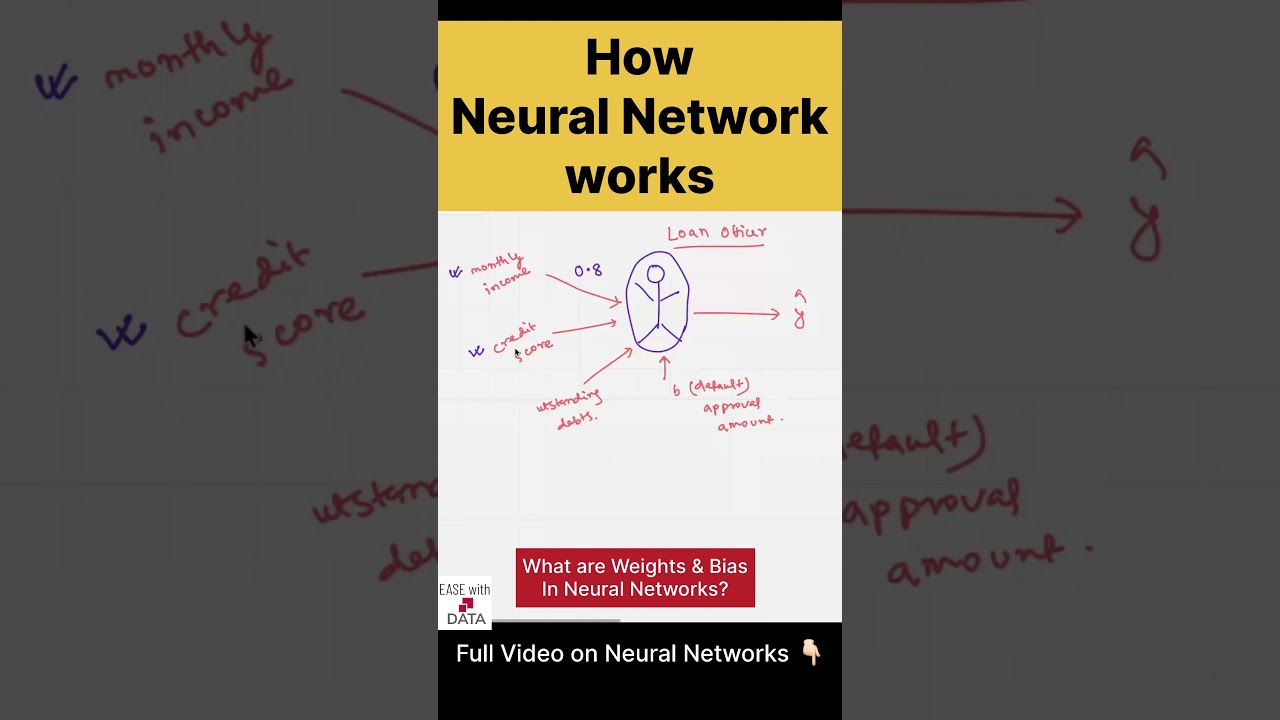
NewsHow Neural Network works | Weights and Bias #dataengineering #neuralnetworks #genai
A neural network's neuron processes input signals by assigning weights to each, reflecting its importance (e.g., monthly income has a high positive weight, outstanding debts a negative weight). These weighted inputs are summed with a bias, and the result is passed through an activation function to produce an output decision.
 Tutorials
Neural Networks Explained - How They Work & Are Trained | Chapter 03
This video explains how artificial neural networks (ANNs) work, detailing the components of a neuron (inputs, weights, bias, activation function) and how they form layers in a network. It also covers the training process, including forward propagation, loss calculation, and backpropagation using gradient descent to adjust weights and biases.