
How To Make Apache Spark on Kubernetes Run Reliably on Spot Instances
Description
Since the general availability of Apache Spark’s native support for running on Kubernetes with Spark 3.1 in March 2021, the Spark community is increasingly choosing to run on k8s to benefit of containerization, efficient resource-sharing, and the tools from the cloud-native ecosystem. Data teams are faced with complexities in this transition, including how to leverage spot VMs. These instances enable up to 90% cost savings but are not guaranteed to be available and face the risk of termination. This session will cover concrete guidelines on how to make Spark run reliably on spot instances, with code examples from real-world use cases. Main topics: • Using spot nodes for Spark executors • Mixing instance types & sizes to reduce risk of spot interruptions - cluster autoscaling • Spark 3.0: Graceful Decommissioning - preserve shuffle files on executor shutdown • Spark 3.1: PVC reuse on executor restart - disaggregate compute & shuffle storage • What to look for in future Spark releases Connect with us: Website: https://databricks.com Facebook: https://www.facebook.com/databricksinc Twitter: https://twitter.com/databricks LinkedIn: https://www.linkedin.com/company/data... Instagram:…
Description from YouTube. Full content on the video page.
More from Databricks
 News
NewsHow AI and Data Keep 2.3 Million Lawns Healthy | TruGreen & Databricks
TruGreen uses Databricks Genie and Lakehouse to manage 2.3 million lawns with AI that optimizes service timing and predicts customer churn using weather, soil, and service data. The system enables non-technical branch managers to take daily actions through customized reports without requiring data expertise.
 News
NewsHow FOX Sports Uses AI to Power Search
Fox Sports rebuilt their search system on Databricks to handle rapidly changing sports information by continuously streaming player, team, and content data into the index while computing real-time trends. The system uses semantic vector search with time-weighted ranking to surface fresh content higher, doubling the rate at which users find what they're looking for.
 News
NewsHow AI Helps Match Doctors With Communities in Need | Databricks for Good
Databricks provides pro bono services and compute discounts to help nonprofits stay lean through its Databricks for Good program. The video demonstrates the Virtue Foundation agent, which uses Genie and interactive hex maps to identify underserved populations and medical facility distribution in Kenya.
 News
NewsOmnigent: Open-Source Meta-Harness for AI Agents | Matei Zaharia
Omnigen is an open-source meta-harness developed by Databricks that acts as an orchestration and control layer to wrap, manage, and combine multiple AI coding agents. The platform introduces contextual security policies, cost controls, multi-agent task routing, and sandbox integrations to enable collaborative workflows and centralized governance.
 News
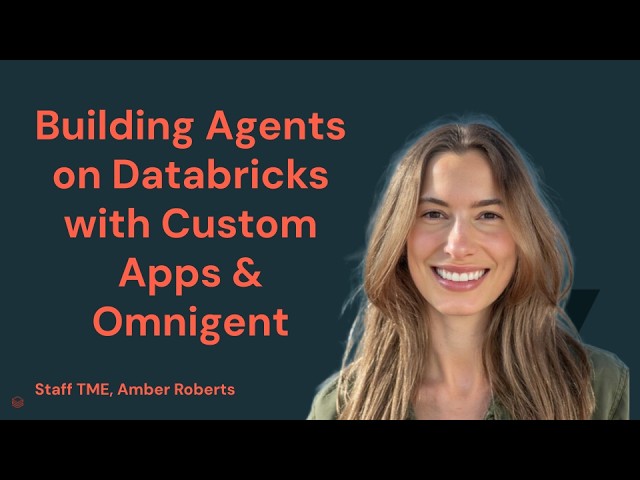
NewsBuilding Agents on Databricks with Custom Apps and Omnigent
This video demonstrates how to build, update, and govern custom AI agents on Databricks using Agent Bricks, Databricks Apps, and Omnigent. The tutorial shows how to integrate Model Context Protocol servers, track execution with MLflow traces, schedule automated agent tasks, and manage security policies through Unity AI Gateway.
 News
NewsGoverning AI Strategy with Unity AI Gateway
The Unity AI gateway provides centralized monitoring, cost tracking, and governance for enterprise AI models, MCP servers, and coding agents. Administrators can use the platform to set budget limits, configure external providers, and enforce input policies that block personally identifiable information.