
Delta Sharing
Recent items mentioning Delta Sharing across the Databricks ecosystem — releases, news, videos, and community Q&A. Updated hourly.
Credential rotation and lifecycle management have become primary operational requirements when scaling Delta Sharing to non-Databricks recipients 3. In broader architecture patterns, open sharing protocols are now being applied to enable multi-region model serving on Databricks 2, while community implementations demonstrate integrating new datasets directly into Databricks Genie tutorials 1.
Generated daily from the 3 most recent items mentioning Delta Sharing. Click any [N] to jump to the source.
Time to Swap the Cookies for Jetfuel - New Dataset & New Databricks Genie Tutorial
Most of you know samples.bakehouse . Great for a first query. Perfect for a quick demo. But after years of cookie sales, it's a little overbaked. Time to swap the cookies for jet fuel. ✈️ Together with the OpenSky Network , I brought a full day of global air traffic to Databricks Marketplace: 696 million real ADS-B position reports, messy just like real life. Myself, I used Genie for the whole journey: EDA, data exploration, a Apache Spark Declarative Pipeline, and a Lakeflow Job. Then I went a step further and read the same Marketplace data with open-source tools only, using OpenSharing and pandas. The result is this hands-on tutorial: Marketplace + Unity Catalog: get the data as a governed table Genie Agents: find anomalies in plain English Genie Agents: explore and visualize with maps and charts Genie Code: a Spark Declarative Pipeline, bronze to gold, with data quality rules Genie Code: a Lakeflow Job with schedule, retries, and email alerts Databricks Apps: your coding agent, governed by Unity Catalog OpenSharing: the open-source client in VS Code with pandas Everything runs on Databricks Free Edition (free, no credit card). 📖 Tutorial: Databricks Genie for Data Engineers and Data Scientists 💻 GitHub: databricks/tmm/DSDE-Genie-Tutorial 🛫 Dataset: OpenSky Network full-day dataset on Marketplace What's the first thing you'd query in a day of global air traffic? P.S. For the record, we still love bakehouse! 🍪❤️ [Disclaimer: I'm one of the two people who baked it.] submitted by /u/CompetitiveBet8978 [link] [comments]
Multi-region model serving on Databricks with OpenSharing
Scaling Delta Sharing across Non-Databricks Recipients: Handling Credential Rotation and Lifecycle
Using Delta Sharing to hold ISV entitlement data outside the customer's metastore — reasonable fit?
Automatic change data feed is now generally available!
With automatic CDF, Databricks computes row-level changes at read time using row tracking, rather than materializing those changes during every write. Use change data feed on Databricks | Databricks on AWS Why does that mattre? - Better write performance for MERGE INTO and UPDATE workloads - No need to enable CDF individually on every eligible table - Lower storage overhead compared with legacy CDF - The same familiar APIs still work: table_changes() and readChangeFeed - Works with batch processing, Structured Streaming, and Databricks-to-Databricks Delta Sharing For Delta Lake, the main requirements include: • Databricks Runtime 19 LTS+ • A managed table or external table in Delta Lake format with row tracking enabled And if you’re already using legacy CDF, migration is really simple.Once the table meets the requirements, disable legacy CDF: https://preview.redd.it/0dddizd442oh1.png?width=710&format=png&auto=webp&s=fddc536d6aeca423b2e418f4856ae06843393749 submitted by /u/szymon_dybczak [link] [comments]
How to do cross-cloud sharing with OpenSharing with added security (demo)
Hey folks! In this demo, Akram from Databricks' product team shares how you can leverage SecureConnect to better your security posture when doing cross-cloud sharing on OpenSharing! If you have no idea what OpenSharing is, how it applies to you, or how we got from Delta Sharing to OpenSharing, also encourage you to watch this video: https://youtu.be/0mfuNybtmdE Hope you find this helpful! submitted by /u/JosueBogran [link] [comments]
Databricks and OpenSharing questions
This my first time looking into use OpenSharing to share data externally and would to get some idea on if I am on the right path. My current idea is as follow: ETL my datasets using CDF from source to a catalog_curated, multiple tables In a catalog_shared, create views for each that apply filters (rows or joins) and these are what will be published and shared with external. I understand when sharing a view via OpenSharing, pushdown will not work and the whole views will get materialized temporarily when query, which I know may be an issue when external uses one of our watermark column. However, our dataset is not that big and access to the data is not going to be frequent, sharing a persisted version of the views will solve that, but is the added complexity worth it? I also could add the filters as part of the ETL config, but I am thinking it might be too complex for my current need. And when we need to expand the filters, all we have to do is change the views. I think the goal for me right now is simplicity and maintainability over complex ETL work, unless there is a reason to do so. As stated, this is my first time working with OpenSharing/DeltaSharing. Any comments, suggestions, or best practices are greatly appreciated. Thanks submitted by /u/Hungry-Tax6101 [link] [comments]
Who pays cross-cloud egress for Delta Sharing from GCP to Azure?
Databricks OpenSharing: How Global Distribution Reduces Egress Costs & Improves Performance (Demo with Databricks Product Lead)
If you are a data provider on Databricks, OpenSharing (formerly Delta Sharing) is a fantastic tool for distributing data to your customers. During my time at a former job, there was nothing better than to work with customers that were able to consume data from Delta Sharing. On at least two occasions though, we received unpleasant surprises: egress fees from our cloud providers. Those egress fees were most often times avoidable. For example, we would make sure that our customers and our company agreed on the cloud/region combination we would serve from/to, allowing us to build one-off pipelines, etc. But, that required manual work, created staleness issues, etc. While in our situation, we could sometimes overcome the same cloud vendor but different region situation, distributing to a region we just didn't have anything setup for OR a completely different cloud was a no-go. All that to say, Global Distribution aims to solve this and more. No need to have an account with another cloud vendor to serve cross-cloud. No need to have have data distributed to multiple regions within your AWS/Azure/GCP. No need to build/maintain pipelines. Just use Global Distribution. Check out the video and see Akram Chetibi who leads OpenSharing explain/demo it, and love to hear your thoughts. submitted by /u/JosueBogran [link] [comments]
Got error using Opensharing Get Table API to foreign iceberg table
Databricks OpenSharing Explained: Delta Sharing for the AI Era (w/ Databricks Product Leader)
Hey everyone! In this video, a Databricks product leader joins me to explain what OpenSharing, and what happened to Delta Sharing! Delta Sharing is one of the features I used often at a previous role to provide data to multiple customers, so it will be interesting to see how the journey with the expanded focus (data + AI sharing) goes. submitted by /u/JosueBogran [link] [comments]
Delta Lake 4.4.0
Delta Lake 4.4.0 supports Apache Spark 4.2 and adds identity columns and generated-column support in SQL DDL. The release expands UC Delta API integration to Delta Kernel and the experimental Flink connector for catalog-managed tables, introduces Flink upsert mode with merge-on-read updates, and improves VOID-column and partition handling.
Delta Lake 3.3.3
Delta 3.3.3 fixes transaction log retention bugs that broke time travel and CDF reads, and a Delta Sharing deletion vector cache bug causing long-running queries to fail. It adds opt-in RANDOMIZE_FILE_PREFIXES to spread S3 object keys for high-throughput workloads and upgrades Delta Sharing client for improved OAuth and retry handling.
Bringing real-time fraud prevention to government benefits
Databricks is helping federal agencies move fraud detection for benefit programs from after-the-fact reviews to real time, building on techniques honed with banks, credit card companies, and insurers. With over 80% of federal executive departments already on the platform, tools like OpenSharing and Clean Rooms let agencies share fraud signals across silos without exposing raw data, surfacing schemes no single agency could catch alone.
Workspace ID validation for unified-provider resources shifted from plan time to apply time, reducing unnecessary API calls and eliminating false positives for restricted credentials and dynamic workspace IDs. The release adds a databricks_recipients data source for Delta Sharing, trace_location support for MLflow experiment traces in Unity Catalog, and fixes for VIEW column comment updates and access control rule set drift detection.
Delta Lake 4.3.1
Delta Lake 4.3.1 fixes OAuth authentication failures in the Delta REST Catalog caused by incorrect key lowercasing and enables S3A fast listing when using OSS UnityCatalog's CredScopedFileSystem wrapper. It also prevents the reserved is_managed_location property from persisting into managed table metadata.
 Events
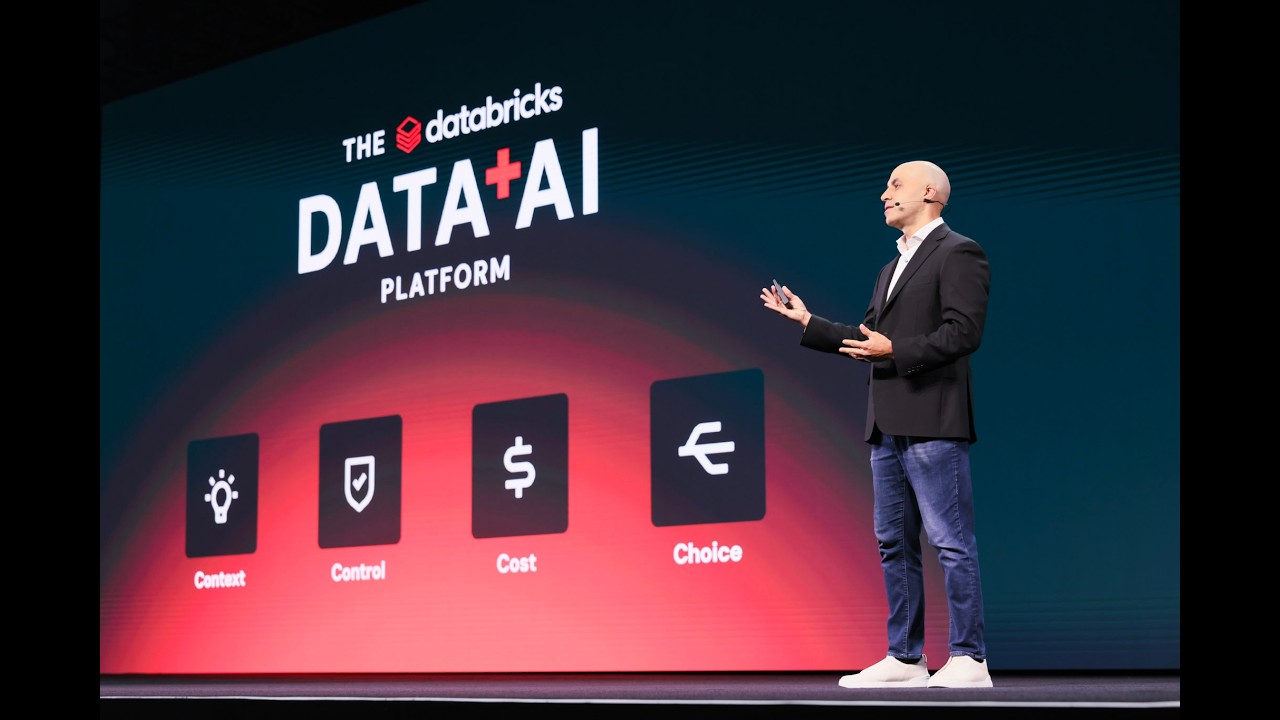
What it takes to scale agents in the enterprise: context, control and choice
Databricks CEO Ali Ghodsi outlines enterprise AI scaling strategies centered on organizational context, open choice, security control, and cost management. The session demonstrates developer tools like Agent Bricks, the Omnigent open source project, and Genie code alongside enterprise partnerships.
 Events
Ali Ghodsi, Co-founder and CEO, Databricks kicks off Data + AI Summit 2026
Ali Ghodsi kicked off the Data + AI Summit 2026 by announcing new Databricks features and architectural layers focused on open data formats, unified governance, cost controls, and enterprise context. He also detailed platform updates including Genie ontology and agents, LakeBase Postgres, Unity AI Gateway, and the acquisition of security platform Panther Labs.
Announcement | OpenSharing, Marketplace Apps, and SecureConnect for the AI Era
Delta Lake 4.3.0
Delta 4.3.0 deepens Unity Catalog integration by making it the source of truth for managed table operations via the UC Delta REST API, introduces replaceOn/replaceUsing DataFrame APIs for selective row-level data replacement, and improves UniForm with atomic Iceberg conversion and incremental metadata updates. Delta Sharing gains streaming support, Change Data Feed capabilities, and Trigger.AvailableNow, plus performance improvements like better V2 checkpoint parallelization and variant column statistics for data skipping.
 Events
Recap of product announcements from Data + AI Summit 2026 | Day 1
Databricks announced several new products and features at the Data + AI Summit 2026, Day 1, including the Genetic Data Foundation, Lakehouse RT, Lake Base with disaster recovery, Lake Flow, Genie Ontology, Unity AI Gateway, Omnigent, and various Genie agents (Genie 1, Genie Code, Genie Agents). They also introduced new applications like Lake Watch for SIM and Customer Lake for CP.
Becoming the most comprehensive data & AI ecosystem on earth
Databricks is expanding its Data and AI partner ecosystem with new Marketplace, Apps, OpenSharing, and Genie Agent capabilities for building, distributing, sharing, and monetizing solutions. These updates accelerate deal velocity, provide access to 20,000+ Databricks customers, and unlock new AI-era business models like pay-per-question.
Introducing OpenSharing: the Next Evolution of Delta Sharing for the Agentic Era
Databricks has introduced OpenSharing, a Linux Foundation-hosted evolution of Delta Sharing that expands zero-copy sharing beyond tabular data to models, agents, and semantic context across Delta Lake, Apache Iceberg, and Parquet. The enterprise implementation on Databricks enables governed sharing of Genie Agents via Unity Catalog, automated private networking with SecureConnect, and low-latency multi-cloud access via Global Distribution.
Introducing OpenSharing SecureConnect
OpenSharing SecureConnect introduces a Databricks-managed proxy for storage access, eliminating the need for data providers to configure network for each recipient. Providers can optionally leverage NCC for private link connectivity between the proxy and their storage.
Sciene AI Companion: building an autonomous Customer Success platform on Databricks
Sciene built an autonomous Customer Success platform on Databricks, enabling AI-powered CSMs to standardize and scale work with context-aware emails, meeting decks, and account diagnostics. This end-to-end Databricks solution, leveraging Delta Sharing, Lakebase, and SQL Warehouses, significantly improved productivity and saved up to 6x time on key workflows.
Databricks Hands Delta Sharing to the Linux Foundation and Levels It Up
Geospatial Unbounded: Spatial SQL GA with AI/BI Maps, Delta Sharing, and Iceberg v3
Spatial SQL is now Generally Available on Databricks, bringing native geospatial data types, 90+ ST_* functions, and AI/BI Dashboards that render maps natively. This release also includes major performance improvements, open lakehouse support via Delta Sharing and Iceberg v3, and Apache Spark 4.2 compatibility for geo columns.
Announcing the Databricks storage ecosystem: Governing the enterprise data estate, wherever it lives
The Databricks Storage Ecosystem now natively connects hybrid and on-premises storage platforms to Databricks via OpenSharing, enabling centralized data governance and GenAI scaling across your entire hybrid infrastructure. Run Databricks Serverless Compute, Genie, and LLMs directly on your on-premises datasets with a zero-copy architecture, instantly turning isolated data into active, AI-ready assets.
Got error when access delta sharing table with iceberg endpoint
[Passed] Databricks DEA Exam today
https://preview.redd.it/z6mcmrgvmjyg1.png?width=474&format=png&auto=webp&s=28e010f62635d49af3a815998011125d8f2cfa0f Just walked out of the exam and I’m glad to say I passed. I was sweating a bit because the exam content changes on the 4th, so I really didn't want to fail and have to deal with a new syllabus. I've had Databricks at work since late 2023. I’ve been using it because, well, it’s there, but I was mostly just "vibe coding"—picking up some Python and Spark here and there without any real depth. I ran jobs using whatever cluster settings the company gave me without actually knowing what they meant. If you’ve never touched Databricks, this exam is going to be a pain. Even if you’re good at coding, the internal components and the way everything fits together are hard to grasp just by reading. You really need to get your hands dirty in the workspace to get a "feel" for it. **Study Routine** I started with the Databricks Academy stuff, but since I’m juggling work and a toddler, I could only study on weekends. This was a disaster because by the next Saturday, I’d already forgotten what I learned the week before. One month before the exam, I ditched the theory and just hammered Mock Exams. * Udemy is your friend: I bought practice exams from Derar and Santosh. * I snagged them at discounted price. Just wait for the sale if you are not in a hurry. Personally, Santosh’s exams felt closer to the real thing. I saw maybe 5-6 questions that were almost word-for-word. Derar is also solid; honestly, just solve as many problems as possible. Since my study time was limited, I focused on reviewing the questions I got wrong. I realized pretty early that Productionizing Data Pipelines was my weak spot. I didn't try to become an expert in it. I just aimed for a 60% "pass" in that section and doubled down on the areas I was actually good at. Don't completely ignore your weak areas though. If you bomb one section too hard, a couple of silly mistakes in other sections will kill your score. **What's on the exam** The questions are mostly scenario-based. You have to read the prompts carefully. Some things I remember: * Autoloader: This came up a lot. * DLT (now called Lakeflow Spark Declarative Pipelines): should understand what it actually does * Unity Catalog: Permissions (Granting minimum access) and the actual SQL code for it. * Delta Sharing: Knowing the difference between sharing with Databricks vs. non-Databricks users. * Egress Costs: How to avoid them in cross-cloud sharing (Cloudflare R2 was the answer for one). * SQL Warehouses: Classic vs. Pro vs. Serverless. Know when to use which. * DABs (Databricks Asset Bundles): I got at least 3 questions on this. Don't skip it. * Medallion Architecture: It’s not just "what is Bronze/Silver/Gold." They’ll give you a scenario and ask which layer the data should go to next. Also, those "select two" questions are the absolute worst, super confusing. I know the syllabus is changing on the 4th, so I’m not sure how much of this will still apply. But honestly, if you have some background and get familiar with the core concepts, it’s a very doable exam. I’ve learned a lot through this process. Good luck to everyone preparing!
Here are 5 topics that showed up much more than I expected in my DEA exam
I took the Databricks Data Engineer Associate exam recently and wanted to share what actually came up because it was quite different from what I spent most of my time studying. I went in thinking Delta Lake theory and platform architecture would be the big topics. They weren't. The exam is way more practical than I expected. **The first thing** that caught me off guard was how heavily they test Auto Loader. Not just the basics but real scenarios. One question described a pipeline receiving 50,000 new files per day and asked which ingestion method to use and why. You need to understand when Auto Loader makes sense versus COPY INTO, how schema evolution works with mergeSchema, and the difference between directory listing and file notification mode. I probably got six or seven questions just on this one topic. **The second thing** was lazy evaluation. I knew the concept but I wasn't prepared for how they test it. They give you a block of code with four or five DataFrame transformations and ask what happens when you run the cell. The answer is nothing happens because there is no action at the end. But the way they frame the questions makes you second guess yourself if you only memorized the definition without really understanding it. **Third** was Lakeflow expectations. The old name was Delta Live Tables but they use Lakeflow in the exam now. You need to know the three expectation types and when to use each one. They gave me a scenario where the pipeline should log bad records but never drop them and I had to pick the right expectation decorator. Also know the difference between streaming tables and materialized views because that came up more than once. **Fourth** was Unity Catalog permissions. Not just the three level naming pattern but actual grant scenarios. Something like a data analyst needs to read tables in the sales schema but should not be able to create new tables and you have to pick the correct grant statement. I got at least three or four questions like this. **Fifth** was MERGE INTO. They really love this command. Upsert scenarios, deduplication, slowly changing dimensions. If you cannot write a MERGE statement from memory with the WHEN MATCHED and WHEN NOT MATCHED clauses you should spend an hour practicing just that before you sit for the exam. What surprised me about what was not heavily tested. Cluster configuration was maybe one question. The architecture diagrams with control plane and data plane were one or two questions at most. Delta Sharing was one question. Spark internals like shuffle details were barely mentioned. The biggest thing I wish I had done differently is spend less time reading documentation and more time actually running code. When you have actually executed a MERGE INTO on a real table and seen the results, the exam question feels like something you have done before instead of something you read about once. I used Databricks Free Edition for all my practice and it was more than enough. Hope this helps someone who is preparing right now. Feel free to ask anything about the exam in the comments and I will try to answer.
Unlocking SAP Business Context in Databricks with Semantic Metadata Delta Sharing
SAP Business Data Cloud now automatically syncs semantic metadata, including descriptions and key relationships, into Unity Catalog, making SAP data instantly AI-ready and more discoverable. SAP PersonalData governance tags are also automatically available in Unity Catalog, enabling fine-grained access controls with ABAC.
Stripe data now available on Databricks via Databricks Marketplace
Stripe data is now available on Databricks Marketplace, enabling you to activate a Stripe data pipeline with Delta Sharing in minutes and instantly power AI applications. Share Stripe payment and business data directly into Unity Catalog to create a single source of truth and query live payment data for models, agents, and Genie workspaces.
Passed the Databricks Data Engineer Associate last week and here with sharing what worked and a free practice test.
Got my DEA cert last week with 82%. Figured I'd write up what I did since I wasted a lot of time early on trying to figure out what was worth studying and what wasn't. I've been using Databricks at work for about a year. PySpark and Delta Lake stuff mostly. But I had real gaps in Unity Catalog, Lakeflow Declarative Pipelines, and Databricks Asset Bundles because my team doesn't touch those much. Started with the official exam guide. The November 2025 one from Databricks. Honestly this should be the first thing anyone reads. It breaks down exactly how much of the exam comes from each section. I had no idea 18% was about productionizing and DABs until I read it. Did some Databricks Academy stuff. It's fine. If you already use Databricks every day you can skip the intro material and just hit the areas you're shaky on. But the thing that helped the most was taking practice tests. Reading is one thing. Sitting down with a timer and actually answering questions is completely different. I found a free one at [bricksnotes.com](http://bricksnotes.com) that matched the format pretty well. 45 questions, 90 minute timer, same five sections. Took it three times over two weeks and went from 58% to 71% to 84%. It breaks your score down by section so you can see exactly what you're bad at instead of guessing what to study next. The real exam was a bit harder but the format was the same. Scenarios, code to read, answers that all sound reasonable if you don't really know the material. Some stuff I wish someone told me before: Actually read the code in the questions. Don't just glance at it. Some questions have small things in the code that completely change the answer. Unity Catalog permissions come up a lot. GRANT vs ownership vs inheritance. What a metastore admin can do vs a catalog owner. External locations and storage credentials. Know this cold. Delta Sharing is tested more than I expected. Not just "what is it" but internal vs external sharing, cost stuff, limitations, what recipients can actually do. Medallion Architecture questions aren't "what are the three layers." They're more like "should this transformation happen in silver or gold and why." They test your judgment not your memory. Lakeflow Declarative Pipelines questions focus on why you'd use it and how expectations work. You don't need to have built a complex pipeline. You need to understand the advantages over traditional ETL and how streaming tables vs materialized views differ. DABs came up more than I expected. Know the basic structure and why you'd use them over manually deploying notebooks. 90 minutes is plenty of time. I had 25 minutes left. If you're finishing practice tests comfortably you'll be fine. I prepped for about 3 weeks. Couple hours a day after work. If you use Databricks already that's enough. If you're starting fresh probably give yourself 6 to 8 weeks. Happy to answer questions if anyone's prepping right now.
Delta Lake 4.2.0
Delta 4.2.0 enables atomic REPLACE TABLE, RTAS, and DPO for catalog-managed tables, enhances streaming capabilities, and adds a Kernel-based Flink connector. The release makes Variant generally available, adds geospatial and collation support, and includes comprehensive security hardening.
Delta Lake 4.1.0
Delta Lake 4.1.0 supports Apache Spark 4.1.0 and introduces conflict-free enablement of Deletion Vectors and Column Mapping on existing tables without blocking concurrent writes. The release requires Java 17 and Spark 4.0.1 or higher (dropping Spark 3.5), adds full catalog-managed table support in Delta Kernel for Unity Catalog integration, and fixes MERGE/INSERT struct expansion bugs.
SQL warehouses now support "5X-Large" cluster sizes and a higher maximum of 40 clusters. This release also fixes permanent drift for external model credentials in databricks_model_serving and improves dashboard file content change detection.
Ensure two queries in a Spark declarative pipeline process the same rows when using the availableNow trigger
I'm using Spark declarative pipelines in Databricks. My pipeline runs in triggered mode. My understanding is that in triggered mode, the streaming uses the availableNow=True option to process all data that was available at the time of the trigger. I have an external Delta live table that I access via Delta Sharing. This table is continuously updated with new events. Some of the events indicate a state change in the entities generating them. I want to enrich all events with the current state. So what I do is: Use auto CDC to create a type 2 slowly changing dimension table tracking the state history. Elsewhere in my pipeline, I join the state from the dimension table with each event. The pipeline runs in triggered mode. Because the pipeline understands the dependencies between tables, the query for (1) completes before the query for (2) starts. This is good. The problem comes because while the query for (1) was running using the availableNow trigger, new events are being added to the external table. So when the query for (2) starts, it sets its own end offset for availableNow , which means the update includes state change events that are not reflected in the state dimension table! I'm effectively using an out of date version of the dimension table at this point. Really I need both these queries to operate on identical rows, one after another. The cheapest thing to do would be to use the same end offset for the availableNow trigger for both queries. Is there a way to achieve this with Spark declarative pipelines? Or failing that, is there a way to make two Spark streaming reads in a regular job use the same end offset? I'm aware I could insert a buffer table to store a consistent and unchanging copy of the input events during the run time of the pipeline trigger, but managing storage and retention for such a table is expensive and annoying. So I am looking for other solutions. An illustration: Incoming data: t event 1 entity 1 has changed to state A 2 entity 1 has even […truncated]
 Tutorials
De-Risking Investment Decisions: QCG's Smarter Deal Evaluation Process Leveraging Databricks
Quantum Capital Group utilizes the Databricks intelligence platform and Delta Sharing to clean, validate, and enrich energy sector data for improved private equity investment decisions. Partnering with Tiger Analytics, the firm migrated its data infrastructure to Unity Catalog to scale deal flow, automate economic modeling workflows, and provide secure data access across portfolio companies.
 News
NewsMaximize Retail Data Insights in Genie with DeltaSharing via Crisp’s Collaborative Commerce Platform
The video demonstrates how to ingest and normalize retail data using Crisp and share it into Databricks via Delta Sharing. It then shows how to use Databricks AI blueprints and Genie to analyze this data through natural language queries and custom applications.
 News
NewsFrom Code to Insights: Leveraging Advanced Infrastructure and AI Capabilities
Insulet migrated its data infrastructure from Azure to Databricks, implementing a data mesh architecture with medallion layers, Unity Catalog governance, and Delta Sharing for partner data access. The company achieved real-time analytics, GXP-compliant deployments, and FinOps cost optimization, demonstrating how to balance innovation with operational efficiency.
Delta Lake 4.0.0
Delta Lake 4.0.0 introduces Delta Connect for Spark Connect connectivity, catalog-managed tables in preview for catalog-controlled commits, full Variant data type support for semi-structured storage, and graduates Type Widening to enable column type changes without rewriting data. The release requires Apache Spark 4.0 and discontinues active development of Delta Standalone and related connectors (Flink, Hive) in 4.x, shifting them to maintenance-only mode.
Delta Lake 3.3.1
Delta Lake 3.3.1 includes a fix allowing user-specified schemas on read when consistent with table schema and documentation updates for Row Tracking Backfill. Delta Kernel 3.3.1 fixes handling of non-uniform value types in map fields within delta commit files.
Delta Lake 3.3.0
Delta Lake 3.3.0 adds Identity Columns for automatic unique keys, VACUUM LITE for faster transaction log-based cleanup, and enables Row Tracking backfill on existing tables for row-level lineage tracking. UniForm Iceberg can now be enabled on existing Delta tables without data rewriting, and Type Widening is now supported in Delta Kernel for reading type-evolved tables.
Delta Lake 3.2.1
Delta Lake 3.2.1 adds RESTORE support for clustered tables and enables Uniform Iceberg on existing tables via ALTER TABLE, eliminating costly data rewrites. Key fixes include string comparison with Unicode surrogate pairs, decimal and timestamp encoding in Parquet, and S3DynamoDB VACUUM throttling issues.
 Releases
Announcing Databricks Clean Rooms with Live Demo. Presented by Matei Zaharia and Darshana Sivakumar
Databricks Clean Rooms enables two parties to securely collaborate on private data, unstructured assets, and machine learning models without exposing sensitive information. The platform utilizes Delta sharing and Lakehouse Federation to allow cross cloud and cross platform joint analysis using Python, R, or SQL.
 Events
Data Sharing and Cross-Organization Collaboration. Presented by Matei Zaharia at Data + AI Summit
Cross-organization data sharing and collaboration is increasingly critical for streamlining business processes across industries. Databricks addresses this need through Delta sharing, an open protocol that allows secure data exchange across different platforms and clouds without requiring recipients to use the same data warehouse.
Delta Lake 3.2.0
This release introduces Liquid clustering for incremental optimization and preview support for Type Widening to alter column types without data rewrites. It also adds preview support for Apache Hudi in Delta UniForm tables and improves VACUUM operations with inventory tables and writer protocol checks.
 News
NewsJet Streaming Data & Predictive Analytics: How Collins Aerospace to Keep Aircraft Flying
Collins Aerospace uses the Databricks lake house platform and Apache spark to power Essentia, a predictive health monitoring product designed to prevent unscheduled aircraft maintenance and reduce flight delays. The platform processes massive multi-source aviation datasets using Delta tables and Delta sharing to streamline data engineering, analytics deployment, and multi-cloud interoperability.
 News
NewsMulticloud Data Governance on the Databricks Lakehouse
Databricks presents multi-cloud data governance on the lakehouse using Unity Catalog to manage users, security, and data lineage across AWS, Azure, and Google Cloud. The session demonstrates how to implement this architecture using Delta sharing and Terraform to securely share data and synchronize entitlements across different cloud regions and business units.
 News
NewsData Architecture: IQVIA's Migration to Databricks Lakehouse for High-Performance Analytics
Iqvia migrated its global health data workloads to the Databricks Lakehouse, achieving an eighty percent reduction in runtimes and cutting processing costs by sixty percent. The company also used Delta sharing on Databricks to deliver pre-integrated data directly to clients via the Databricks Marketplace, reducing customer infrastructure costs and data delivery times.

 News
NewsData Democratization with Lakehouse: An Open Banking Application Case
Bradesco implements an open banking and data democratization architecture using the Databricks lake house platform. The solution uses delta sharing, medallion layers, and Unity Catalog to ingest, transform, and securely share financial data across business units and partners.


Get Tuesday's version of this
Tracking Delta Sharing? The Tuesday email carries what moved across the whole ecosystem, not just this topic. Free, one-click unsubscribe.