
Financial Services
Recent items mentioning Financial Services across the Databricks ecosystem — releases, news, videos, and community Q&A. Updated hourly.
Databricks introduced native regex-style row pattern matching in SQL through the public preview of MATCH_RECOGNIZE, targeting event-level fraud detection and anomaly analysis directly within queries 4. In parallel, new reference architectures unify end-to-end Solvency II reporting across actuarial reserving and capital calculations 7, complementing production blueprints like Discovery Bank's 20x data pipeline acceleration for real-time behavioral AI models 8.
Generated daily from the 8 most recent items mentioning Financial Services. Click any [N] to jump to the source.
CUSTOMER STORY | ANA Seguros turns insurance data into faster decisions with AI/BI and Genie
Financial data agents are going to play a vital role in modern banking systems.
submitted by /u/ConstantNo2668 [link] [comments]
Property & Casualty Insurance Lakehouse
"Regex for Rows": Simplifying Pattern Detection in SQL with MATCH_RECOGNIZE
MATCH_RECOGNIZE brings regex-style pattern matching to SQL, now in Public Preview, letting you detect sequences and patterns directly in event data. It's built for use cases like fraud detection in financial services, threat detection in cybersecurity, funnel analysis in e-commerce, and anomaly detection in manufacturing and IoT.
Community BrickTalk | Real-Time Data & AI: Tripwise Demo
Hey r/Databricks ! Join us for community BrickTalk on Thursday, September 24 , focusing on real-time data streaming, AI agents, and governance using Databricks. BrickTalks is a community event series where Databricks experts share real-world use cases, demos, and practical insights for building with Data and AI, giving customers a direct line to the people behind the products. In this session, we'll walk through a live demonstration of the Tripwise Demo , featuring: Sub-Second Transactions & Streaming: Device registration into Lakebase with sub-second reads/writes, plus telemetry streaming via Zerobus through a governed Medallion architecture. AI-Generated Offers & Pricing: Generating real-time agent offers using Foundation Model APIs and scoring behavioral data for usage-based renewal pricing. Natural Language Analytics: Enabling underwriters, product managers, and marketing teams to query governed insurance data in seconds using AI/BI Dashboards and Genie. Unified Governance: Managing safety, compliance, and control end-to-end with Unity Catalog. This is a great chance to see real-world architecture in action and ask questions directly to Databricks experts. When: Thursday, September 24 9:00 AM PT 12:00 PM ET 5:00 PM BST (London) 9:30 PM IST Register here and save your spot submitted by /u/Subject_Ant1789 [link] [comments]
Five AI Questions We're Hearing from Financial Services Leaders
Transitioning financial services AI from pilot projects to governed production deployments hinges on addressing five key questions shaping the industry. Learn how Databricks unifies data, AI, and governance across financial crime, banking, and wealth-management workflows, and connect with leaders at Sibos 2026 in Miami.
A practical approach to end-to-end Solvency II reporting in Databricks
Databricks now supports Solvency II end to end, connecting data ingestion, reserving, capital calculation, governance, and disclosure into a single workflow instead of fragmented systems and teams. A demo shows how this unified approach delivers one control view, governed automation, AI-assisted review, and faster scenario analysis for reporting readiness.
How Discovery Bank delivers hyper-personalized banking at scale: behavioral AI, governed data, and real-time decisioning
Discovery Bank achieved a 40% uplift in client engagement impact by building reusable, AI-driven data products and real-time next-best action models on Databricks. Their architecture accelerates data pipeline workflows by 20x and data product creation by 5x while ensuring AI agents operate within existing governance controls.
Insurance Intelligence Copilot – Powered by Databricks Genie
Vertical Advantage: Transforming Industries with Lakebase and Agentic AI
Databricks Lakebase partners are shipping production-ready, industry-specific solutions—from fraud and regulatory-change agents to real-time claims, prior authorization, dynamic pricing, and grid intelligence—built on a single governed foundation for operational data, analytics, and AI. Powered by Lakebase's serverless Postgres, sub-10ms operational serving, zero-copy branching, and agent-native memory, these solutions are deployable today and designed to turn platform capability into measurable business value.
Data Mesh vs. Data Fabric: Key Differences and How the Lakehouse Resolves the Debate
Lakehouse architecture ends the mesh-versus-fabric tradeoff by pairing domain-owned data products with centralized governance enforcement, so teams ship analytics and ML products fast without fragmenting compliance. The result, per examples from financial services, healthcare, and retail, is better data quality and lower integration overhead alongside the accountability gains mesh ownership brings.
Relational vs Non-Relational Database: Choosing the Right Data Store
Relational databases enforce schemas and ACID transactions with vertical scaling and strong consistency, making them the right fit for mission-critical systems like banking, healthcare, and e-commerce; non-relational databases trade that for flexible schemas and horizontal scaling with eventual consistency, suited to high-volume workloads like social media, real-time analytics, and IoT. The post breaks down these tradeoffs to help practitioners match the data store to the workload rather than defaulting to one model.
AI Applications in Finance: A Practical Use Case Guide
Scaling AI across core financial operations like credit scoring and fraud detection requires disciplined governance, including explainable models, documented data lineage, and human-in-the-loop checkpoints. A phased framework centered on two prioritized pilots, a 90- to 120-day evaluation window, and rigorous ROI measurement provides teams with a low-risk path to enterprise-wide deployment.
Launch HN: Parsewise (YC P25) – Reason Across Documents with an API
Hi all, it’s Greg and Max, founders of Parsewise here (https://www.parsewise.ai/api). Parsewise transforms a bucket of unstructured data into schema compliant data, retaining lineage for values resolved across documents. Imagine giving Claude a bunch of files and asking for a CSV or JSON output. If you have tried this, you know both the system limitations (number of files, type of inputs, cost, latency) but also the human-facing challenge of having no way to validate the results quickly. We solve both. We help tech teams simplify their unstructured data ETL, and loop in business experts for the definitions and for instant validation. Here is a video with a few use cases: https://www.youtube.com/watch?v=dbRllnnh47w Parsewise in the words of someone coming to us: ”I need to extract information from insurance policy PDFs, phone calls that have been transcribed, emails, etc. I am NOT looking for something that would just extract data point by data point, page by page into a structured well-defined schema but more something more agentic that can understand that information might be across documents and that it should reason over what to extract.” We started the company based on a decade of experience (and pain) in complex data transformation and data analysis / synthesis. Greg was building both classical ETL and implemented AI workflows at Palantir. At Bain, Max did highly complex data analysis in the financial sector, similar to many of our customers. Parsewise works by taking in a bucket of data (think hundreds or thousands of pdfs, excels etc.), and outputting schema compliant data where every single value is traceable down to word level citations across multiple documents in the bucket. We provide API customers with ways to show the lineage in their own applications, or they can use our platform for internal operations. At the core of the data processing we have self-improving agent definitions. They define the acceptable sources, the logic for resolving or combining values, and the rule for highlighting uncertainty to the end user. The underlying tech is model and cloud agnostic and can be deployed in private networks. We have seen the best results with Gemini models for visual reasoning, achieving SOTA (beating Claude Fable) on the strongest grounded reasoning benchmark we have found (Databricks OfficeQA). Notably, we focused more on the “human harness” rather than the model harness, leaning into the actual friction we saw in uptake, which is around verifiability. That means optimizing the time and clicks required to trust the outcomes. We use vLLMs for parsing, and then we use small models for efficient large scale exhaustive search. Unlike RAG, we do not sample; instead, we exhaustively find all relevant values for a given query. We use larger models for decision making around resolutions and flagging inconsistencies to users. This exhaustiveness and explicit value sourcing is unique to our platform, and it goes beyond the first step of data parsing that many existing providers cover. We would love to welcome builders and tinkerers to try Parsewise on your complex document challenges. We have a ton of ideas on how we can expand the product and make it better, but would appreciate feedback and ideas from the community! --- top comments --- [whinvik] Document parsing is top of my mind lately because in some of the areas we work on the bottleneck is starting to become being able to query documents the same way one queries an api. I keep thinking the most obvious analogue is we need some way to represent documents the same way we can represent structured data in parquet. Parquet allows easy range bases queries and there is so much tooling built around Arrow. But for documents I keep hitting a wall to figure out what the right abstractions are. Parquet allows filterable metadata. But what such metadata is there for documents. Then there is the arbitrrariness of chunking, vectorization. If we could just do this in a […truncated]
 Events
How Mastercard standardizes on Lakebase to power agentic operations
Mastercard uses Lakebase to standardize its agentic operations, creating a shared foundation for services like the "virtual C-suite" for small businesses and secure multi-tenant solutions for thousands of issuing banks. This standardization enables rapid development of AI agents with embedded governance and trust, allowing them to learn from each other and scale effectively.
Announcing the 2026 Databricks Customer Awards Industry winners
The 2026 Databricks Customer Awards Industry winners have been announced, recognizing ten organizations across diverse sectors like financial services, healthcare, and manufacturing. These winners showcase compelling data and AI stories, demonstrating how they've leveraged Databricks to solve complex challenges and achieve measurable results.
Data + AI Summit 2026: Insider’s Guide for Financial Services Leaders
Data + AI Summit 2026 offers a financial services executive guide to key banking, insurance, payments, and capital markets sessions. Learn how leading organizations like Morgan Stanley and JPMorganChase are approaching AI transformation, responsible AI, and operational modernization, with practical strategies for maximizing summit value.
How Databricks Genie democratizes data access in financial services
How Databricks Genie democratizes data access in financial services
Databricks Genie now democratizes data access for financial services business leaders by enabling natural language querying of governed data. This eliminates the "Last Mile of Data Democratization" by removing the need for SQL skills or BI tool training.
Transforming industries with conversational AI: Partner solutions built on Databricks Genie
Databricks Genie now powers innovative, industry-specific conversational AI solutions from leading consulting and SI partners. These ready-to-deploy offerings accelerate enterprise AI transformation across financial services, healthcare, retail, and other key sectors.
Agent Bricks in Action: Automating Insurance Underwriting with a Supervisor Agent-Led Architecture
Have a phone screening tomorrow with the recruiter for the RSA position. Anything I should know?
I applied to the RSA position within Financial Services and Public Sector (currently holding a secret clearance) and not sure which department the screening is for. As it’s just a screening is there anything I need to do to prep? I’m currently a senior consultant with the Big4 in the public sector and I’ve used Databricks in the past and enjoyed the tool and would love to get immersed in the tool. Databricks is on my list of dreams companies to work for. If I get past the screening I’ll use the community edition over the weekend to get refreshed with the platform.
 News
NewsAI for Data Intelligence Demo: Real-time fraud Detection with Databricks
Databricks demonstrates a real-time fraud detection solution for identifying mule accounts in banking, leveraging a unified data architecture, advanced AI/ML, and graph analytics to uncover complex fraud networks. The solution provides investigators with a single pane of glass application and AI-powered querying (Genie) to analyze risk scores, transaction patterns, and shared device access for efficient fraud investigation and reporting.
 News
News2026 & Beyond: Agentic Future in Finance
Databricks emphasizes that an "agentic future" in finance requires organizations to leverage their unique, proprietary data to provide context to AI models, which is the true competitive advantage. The video demonstrates how Databricks' platform centralizes and governs enterprise data, enabling AI agents to make informed, secure, and differentiated business decisions.
Peril Predicts: Precision Payouts for a Volatile World
Databricks now helps insurers operationalize parametric insurance workflows, enabling faster catastrophe payouts using objective event triggers. The Geospatial Lakehouse facilitates ingesting catastrophe data and analyzing exposure at scale, essential for reducing basis risk and defining accurate payout triggers with geospatial analytics and catastrophe modeling.
Model Risk Governance Is Not the Same as Risk Intelligence
Databricks AI/BI Genie for Enterprise Risk Intelligence now enables conversational interrogation of governed risk data, providing instant, accurate answers for real-time risk management. This closes the intelligence gap for CROs who previously navigated complex model outputs and data systems to get specific answers on credit concentration or stress test sensitivity.
 News
NewsHow Techcombank Scales AI Banking to 16M Customers with Databricks
Techcombank uses Databricks to power its AI banking platform, serving 16.2 million customers and processing 8 billion daily transactions with a 12,000-plus feature store. This enables the bank to make data-driven decisions, automate lead allocation with over 8,000 features, and achieve a 3x conversion uplift, improving both productivity and customer experience.
Beyond the spreadsheet: how Databricks is delivering the modern CFO in Financial Services
Databricks now offers a unified architecture for Financial Services CFOs, integrating real-time data, AI modeling, and governance to eliminate data fragmentation and slow reporting. This enables a shift from reactive reporting to strategic finance, with benefits like drastically reduced regulatory reporting times and AI-powered natural language querying of complex financial data.
 News
NewsSponsored: EY | Business Value Unleashed: Real-World Accelerating AI & Data-Centric Transformation
Ernst and Young demonstrates two real world databricks use cases for accelerating AI and data transformation, including a retail inventory optimization and demand forecasting model that saved a client over one hundred million dollars in working capital. The presentation also highlights an emerging generative AI solution that processes satellite imagery to make geospatial data searchable through natural language for business users.
 News
NewsData Democratization with Lakehouse: An Open Banking Application Case
Bradesco implements an open banking and data democratization architecture using the Databricks lake house platform. The solution uses delta sharing, medallion layers, and Unity Catalog to ingest, transform, and securely share financial data across business units and partners.
 News
NewsSponsored: dbt Labs | Modernizing the Data Stack: Lessons Learned From Evolution at Zurich Insurance


 News
NewsProductionizing Ethical Credit Scoring Systems with Delta Lake, Feature Store and MLFlow


 Events
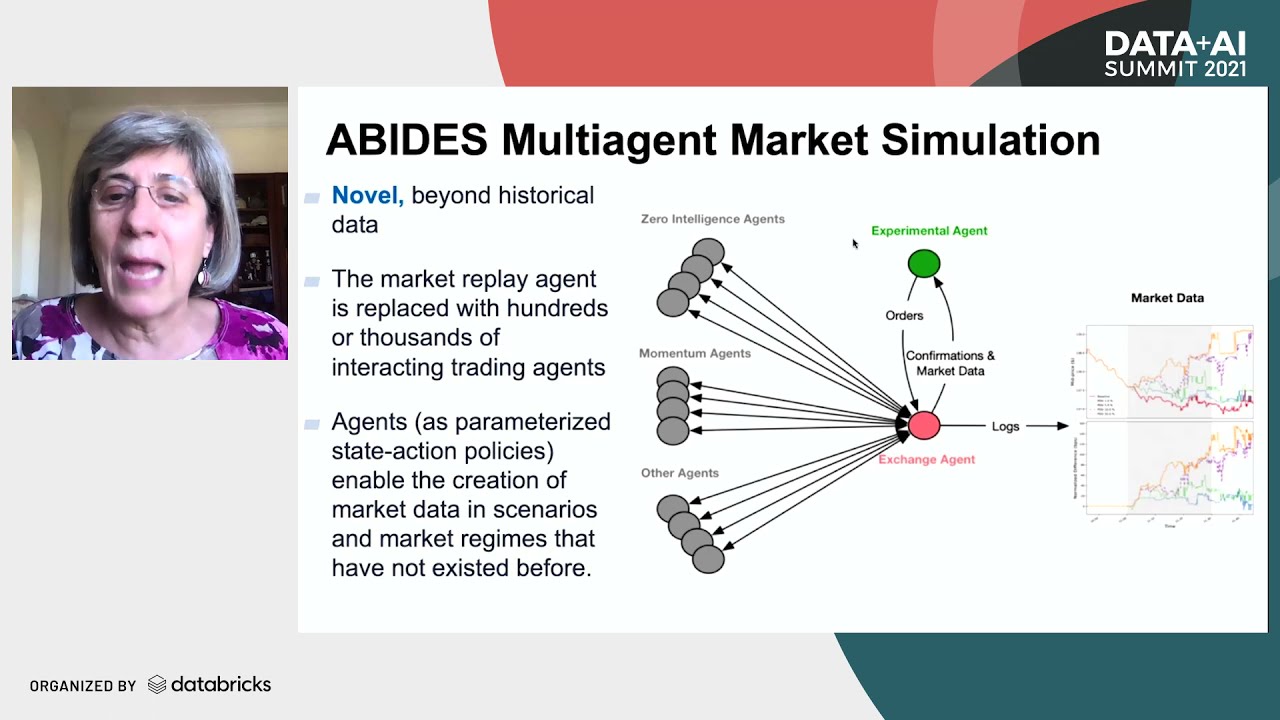
AI for Intelligent Financial Services | Manuela M Veloso | Keynote Data + AI Summit NA 2021


Get Tuesday's version of this
Tracking Financial Services? The Tuesday email carries what moved across the whole ecosystem, not just this topic. Free, one-click unsubscribe.