
Structured Streaming
Recent items mentioning Structured Streaming across the Databricks ecosystem — releases, news, videos, and community Q&A. Updated hourly.
Databricks now lets teams resize live stateful Structured Streaming queries via on-demand state repartitioning, redistributing state to a new partition count on DBR 18+ without rebuilding the checkpoint 1. Community discussion is meanwhile digging into streaming fundamentals, from checkpoint mechanics 5 to Streaming Tables behavior in Lakeflow Spark Declarative Pipelines 2, as automatic change data feed reaches general availability 4.
Written September 2026 from the 7 most recent items mentioning Structured Streaming at that time. It refreshes when this topic next has enough new material. Click any [N] to jump to the source.
Announcing On-Demand State Repartitioning for Apache Spark™ Structured Streaming on Databricks
Databricks now supports on-demand state repartitioning for stateful Structured Streaming queries: set spark.sql.streaming.stateStore.partitions and restart on DBR 18+ with the RocksDB state store provider to redistribute state to a new partition count without rebuilding the checkpoint. This lets you resize long-running streams to match workload demands and monitor each resize through query progress metrics.
Read this if you use Streaming Tables in Lakeflow Spark Declarative Pipelines
🚀 We’re excited to announce that Lakeflow Spark Declarative Pipelines (SDP) now supports creating “vanilla” (i.e., non STREAMING) MANAGED TABLES and writing to them via one or more append flows , using the new CREATE TABLE ... FLOW ( SQL ) and create_table() (Python) APIs . What is this Beta? This Beta allows creating a managed table that is populated by append flows: CREATE TABLE ... FLOW (SQL) / create_table() + @append_flow (Python) create a managed table written by one or more flows. Fan multiple sources into one table — declare several flows targeting the same managed table. Full table surface works: partitioning, liquid clustering, expectations, row filters, table properties, and private (pipeline-local) tables. import_checkpoint on append_flow , which migrates an existing Structured Streaming workload into a pipeline without reprocessing the source — the flow imports the query's existing checkpoint and resumes from the last committed offset with state intact. Example (Python): from pyspark import pipelines as dp dp.create_table("combined") dp.append_flow(target="combined") def from_a(): return spark.readStream.table("source_a") u/dp.append_flow(target="combined") def from_b(): return spark.readStream.table("source_b") Example (SQL): CREATE TABLE events PARTITIONED BY (bucket) FLOW INSERT BY NAME SELECT id, bucket FROM STREAM read_files('abfss://my_path', format => 'json'); Where do we need help? We are in Beta, so there might be some rough edges. Please take this for a spin and share your feedback here . What’s next? Managed Tables support for other flow types (AutoCDC, Replace Using, and Replace Where) is coming soon! Learn more CREATE TABLE ... FLOW (SQL reference) — https://docs.databricks.com/aws/en/ldp/developer/ldp-sql-ref-create-table-flow create_table (Python reference) — https://docs.databricks.com/aws/en/ldp/developer/ldp-python-ref-create-table import_checkpoint on append_flow — https://docs.databricks.com/aws/en/ldp/developer/ldp-python-ref-append-flow Questions, feedback, or help: comment below or share feedback in the form: https://forms.gle/7bGP5FYN7P1Z4WP27 submitted by /u/SlightImagination250 [link] [comments]
Do small companies actually use Databricks?
Sometimes I feel like Databricks is way too expensive. It feels like using a huge truck to move a single grain of sand. My company needs real-time data, but our data volume simply does not justify the use of Spark Structured Streaming. Despite this, they are insisting we move to Databricks. I'm worried our data infrastructure costs will jump from $1,000/month to $5,000/month or more due to the running costs of Databricks SQL Warehouses. Currently, I use Azure Container Apps with KEDA and Python, which helps me manage scaling and keep costs low. We ingest into Event Hubs, use ADX (Azure Data Explorer) as our OLAP warehouse, and archive cold data in a data lake. With this setup, I manage to process all our data with very low latency. When I tested this on Databricks Structured Streaming, I actually got higher latency and much higher costs. Would love to know what you guys think. submitted by /u/Puzzled-Mail-9092 [link] [comments]
Automatic change data feed is now generally available!
With automatic CDF, Databricks computes row-level changes at read time using row tracking, rather than materializing those changes during every write. Use change data feed on Databricks | Databricks on AWS Why does that mattre? - Better write performance for MERGE INTO and UPDATE workloads - No need to enable CDF individually on every eligible table - Lower storage overhead compared with legacy CDF - The same familiar APIs still work: table_changes() and readChangeFeed - Works with batch processing, Structured Streaming, and Databricks-to-Databricks Delta Sharing For Delta Lake, the main requirements include: • Databricks Runtime 19 LTS+ • A managed table or external table in Delta Lake format with row tracking enabled And if you’re already using legacy CDF, migration is really simple.Once the table meets the requirements, disable legacy CDF: https://preview.redd.it/0dddizd442oh1.png?width=710&format=png&auto=webp&s=fddc536d6aeca423b2e418f4856ae06843393749 submitted by /u/szymon_dybczak [link] [comments]
What is a Checkpoint in Structured Streaming?
What are you guys using for data ingestion in Databricks?
I've mostly been using Auto Loader for file-based ingestion in Databricks, especially when there are continuously arriving files. It's been working pretty well so far, but I'm curious what others are using in their projects. For example, are you mainly using: 1.Auto Loader 2.Copy INTO 3.Structured Streaming 4.Batch jobs 5.Some external ingestion tool One thing I'm trying to understand better us where the trade-offs are. For a large number of files, does Auto Loader still make the most sense, or are these cases where something like COPY INTO is simplet and more cost-effective? Also, how are you handling things like schema evolution, duplicate files, failed records, and reprocessing? I'm mainly interested in what people are actually using in production. If you've tried multiple approaches, which one ended up being the best balanceof performance, reliability and cost for you? submitted by /u/Delulu62134 [link] [comments]
Building for the AI Era: Lakebase, Streaming, and Lakehouse Innovations at VLDB 2026
Databricks is bringing Lakebase, Structured Streaming, and Lakehouse optimizations to VLDB 2026, spotlighting Lakebase as a third-generation cloud database that decouples transactional compute from storage to support agentic workflows. The company's Engineering and Recruiting teams will also be on-site at the conference.
why micro-batching matters so much in Databricks Auto Loader and Structured Streaming
Scaling Security Alert Triage With Specialized Agents on Databricks
Databricks AI now enables automated, real-time triage of high-volume, low-severity security alerts using 17 specialized agents on Spark Structured Streaming. This approach achieved a 10x higher true-positive rate and saved over 6,500 analyst hours in the first month by ensuring every low-severity alert is investigated.
Delta Lake 4.3.0
Delta 4.3.0 deepens Unity Catalog integration by making it the source of truth for managed table operations via the UC Delta REST API, introduces replaceOn/replaceUsing DataFrame APIs for selective row-level data replacement, and improves UniForm with atomic Iceberg conversion and incremental metadata updates. Delta Sharing gains streaming support, Change Data Feed capabilities, and Trigger.AvailableNow, plus performance improvements like better V2 checkpoint parallelization and variant column statistics for data skipping.
Building a Spark Streaming Real-Time Mode (RTM) Pipeline — Millisecond Streaming with Kafka
I recently built a fully working real-time transaction enrichment pipeline using PySpark RTM paired with Kafka, achieving end-to-end latency in the milliseconds. The article covers: \- Real-Time Mode (RTM) fundamentals \- Kafka integration with Spark Structured Streaming \- Millisecond-latency pipeline architecture \- Real-time transaction enrichment patterns Blog: https://blog.devgenius.io/building-a-spark-streaming-real-time-mode-rtm-pipeline-millisecond-streaming-with-kafka-dda74e9ef284
Best practice for creating SQL views on top of continuously running Spark Structured Streaming jobs
If your Lakeflow SDP pipeline broke with DIFFERENT_DELTA_TABLE_READ_BY_STREAMING_SOURCE, here's a recovery script
I ran into this recently and wanted to share. A Delta table I was streaming from got dropped and recreated by an upstream team. Same name, same schema, but the new table has a fresh internal ID. Spark Structured Streaming checkpoints bind to that ID, so the next pipeline run error with: `[DIFFERENT_DELTA_TABLE_READ_BY_STREAMING_SOURCE] The streaming query was reading from an unexpected Delta table...` In open-source Spark you'd delete the checkpoint directory. Lakeflow SDP manages those paths internally, so that's not an option. The fix is the Pipelines API parameter `reset_checkpoint_selection` (added in `databricks-sdk` 0.100): pass a list of FQN flow names and start an update that clears only those checkpoints. Bronze/Silver/Gold targets stay untouched. I packaged the recovery as a sub-template in my Databricks bundle template repo. One CLI call ships the script (with a `--dry-run` flag), a workspace notebook variant, and a README: `databricks bundle init https://github.com/vmariiechko/databricks-bundle-template --template-dir assets/sdp-checkpoint-recovery` It also includes a fallback for environments where you can't pip-upgrade the SDK (for me it was the case when using the Databricks serverless runtime, which bundles its own SDK). Repo: https://github.com/vmariiechko/databricks-bundle-template/tree/main/assets/sdp-checkpoint-recovery Two gotchas worth knowing: - Flow names must be three-part Unity Catalog FQNs (`catalog.schema.table`), or you hit `IllegalArgumentException`. - Resetting checkpoints triggers a pipeline update; the API has no "reset only" mode. If you want the pipeline stopped after, cancel from the UI as soon as the call returns. Happy to answer questions or hear how you have handled this situation. P.S. Feel free to submit issues or PRs.
 Tutorials
Apache Spark Streaming Real-Time Mode - Latency Demo
The video demonstrates how to deploy and run Apache Spark Streaming in Real-Time Mode (RTM) using a declarative automation bundle. It shows that RTM significantly reduces P50 and P95 latencies compared to microbatch mode, achieving 26ms and 50ms respectively in a simplified setup without an external messaging bus.
 Tutorials
Air Traffic Control with Apache Spark Structured Streaming Real-Time Mode
The video demonstrates building a real-time air traffic control application using Apache Spark Structured Streaming Real-Time Mode, Lakehouse, and Databricks Apps. This system processes live flight telemetry, detects congestion, and generates alerts with sub-second end-to-end latency, all within a single Databricks platform.
Coinbase Scales Real-Time Security
By leveraging Real-Time Mode in Spark Structured Streaming, we’ve achieved an 80%+ reduction in end-to-end latencies, hitting sub-100ms P99s, and streamlining our real-time ML strategy at massive scale. This performance allows us to compute over 250 ML features all powered by a unified Spark engine.
 News
NewsBuilding Real-Time Sport Model Insights with Spark Structured Streaming
Spark Structured Streaming powers a real-time dashboard at DraftKings that streams simulation counter data from their sports betting model, letting traders instantly see how player rating changes affect odds predictions across all 300+ markets. This improved pricing speed by 30% and reduced errors by eliminating manual review of affected markets.
 Tutorials
Unlock Your Use Cases: A Deep Dive on Structured Streaming’s New TransformWithState API
TransformWithState is Spark 4.0's new API for custom stateful streaming operations, supporting flexible state variables (value, list, map) and timers that replace the older flatMapGroupWithState methods. The presentation demonstrates implementing sensor data forward-fill to enable accurate windowed aggregations, plus features including checkpoint-based state initialization, TTL eviction, Avro schema evolution support, and real-time sub-200ms latency mode.
 News
NewsA Comprehensive Guide to Streaming on the Data Intelligence Platform
Databricks provides two incremental processing engines: Structured Streaming for low-latency streaming operations and Enzyme for batch queries, which automatically optimizes SQL without manual complexity. New features include real-time mode for subsecond latency, Transform with State API for simplified state handling, and expanded materialized view support for complex SQL patterns.
 News
NewsCrypto at Scale: Building a High-Performance Platform for Real-Time Blockchain Data
Elliptic and Databricks built a real-time platform processing blockchain data from 50+ cryptocurrencies (300+ terabytes) to power cryptocurrency compliance and risk detection. They migrated from a fragmented architecture to a unified Databricks stack using Delta Lake, Liquid Clustering, and dynamic file pruning to achieve scalable near-real-time analytics.
 News
NewsSupercharging Sales Intelligence: Processing Billions of Events via Structured Streaming
Digisert built a Databricks pipeline processing 28 billion daily certificate events using medallion architecture with Spark Structured Streaming, demonstrating solutions for reliable multi-API ingestion with exponential backoff rate limiting, large-scale deduplication using partitioned merge operations, and batch size tuning to prevent resource exhaustion. The system enables real-time sales intelligence and compliance monitoring while minimizing costs through optimized data access patterns and zero reprocessing of ingested records.
 Tutorials
Real-Time Mode Technical Deep Dive: How We Built Sub-300 Millisecond Streaming Into Apache Spark™
Databricks introduces Real-Time Mode for Apache Spark, achieving sub-100 millisecond latency by replacing microbatch sequential processing with long-duration batches where stages run concurrently and data streams continuously without intermediate buffering. Users enable it by changing a single trigger parameter, delivering approximately 100x lower latency than existing Spark streaming modes, as demonstrated with an environmental monitoring pipeline reading from and writing to Kafka.
 News
NewsScaling Identity Graph Ingestion to 1M Events/Sec with Spark Streaming & Delta Lake
Adobe scaled identity graph ingestion to 1 million events per second using Spark Structured Streaming and Delta Lake, a 10x improvement over their previous architecture. Key techniques included microbatching with 80% deduplication of redundant writes, repartitioning to eliminate data skew, asynchronous execution for 2x faster latency, and in-memory metadata caching using Netflix Hollow.
 Community
PDF Document Ingestion Accelerator for GenAI Applications
Databricks released a solution accelerator that enables scalable batch ingestion and parsing of high-volume unstructured documents into structured formats for GenAI applications. The accelerator uses a pluggable parser framework supporting OCR, object detection, and AI parsing models, with intelligent bucketing that separates large files to optimize performance and prevent processing bottlenecks.
 News
NewsDelivering Sub-Second Latency for Operational Workloads on Databricks
Databricks launched Real-Time Mode for Spark Structured Streaming to deliver millisecond-level latency for operational workloads using fixed-duration batches and concurrent stage execution. Customers achieved P99 latencies of 50-152 milliseconds for fraud detection, feature store updates, and device tracking—orders of magnitude lower than existing Spark streaming modes.
 Releases
Introducing Simplified State Tracking in Apache Spark™ Structured Streaming
Apache Spark Structured Streaming introduces simplified state tracking using the state reader API change feed to inspect historical state changes across batches. This feature helps developers debug and troubleshoot stateful streaming pipelines by identifying performance bottlenecks and inefficient state updates.
 Tutorials
Race to Real-Time: Low-Latency Streaming ETL With Next-Gen OLTP-DB
The video demonstrates building a low-latency streaming ETL solution using Databricks and Lakebase, achieving sub-two-second end-to-end latency for operational workloads. It teaches key performance optimization techniques, including controlling microbatch sizes, leveraging broadcast joins, enabling dynamic file pruning, and utilizing liquid clustering to minimize data movement and object storage costs.
 Tutorials
Pass PROFESSIONAL Databricks Certified Data Engineer Exam
The video outlines preparation strategies and essential study materials for passing the Databricks Certified Data Engineer Professional exam. It details specific technical topics covered on the test, including Delta Lake architecture, structured streaming best practices, change data feed, slowly changing dimensions, and access controls.
 News
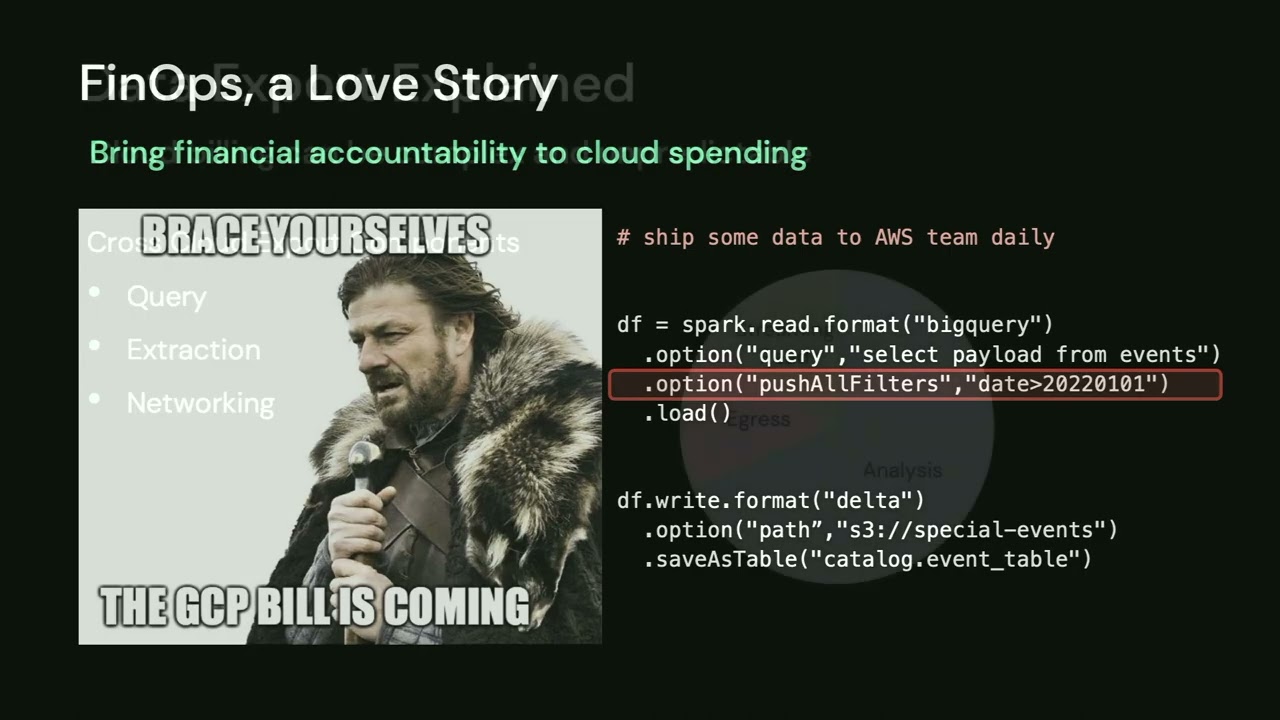
NewsThe Future is Open: Data Streaming in an Omni-Cloud Reality
The video teaches how to build a multi-cloud data streaming architecture using open formats, Apache Spark, and Delta Live Tables to avoid expensive proprietary data extractions. It demonstrates two infrastructure-as-code methods for managing data pipelines across clouds using the dbx project and the Databricks Terraform provider.
 Releases
Nebula: The Journey of Scaling Instacart’s Data Pipelines with Apache Spark™ and Lakehouse
Instacart migrated its large-scale advertising and data pipelines from a traditional data warehouse to a Databricks lake house powered by Apache Spark and Delta Lake. The presenters demonstrate how this transition unified batch and streaming data processing, reduced storage and compute costs for over 40 petabytes of data, and improved developer productivity through Scala-based modular pipelines and local unit testing.
 News
NewsMaking Travel More Accessible for Customers Bringing Mobility Devices
American Airlines built a real-time data streaming pipeline using Databricks and Spark Structured Streaming to process reservation messages and track mobility devices for passengers. This data is delivered via mobile apps and reports to airport managers, resulting in a significant reduction in damaged and delayed wheelchairs.
 News
NewsLabcorp Data Platform Journey: From Selection to Go-Live in Six Months
LabCorp migrated nearly one petabyte of enterprise data from Hadoop to Databricks within six months. The implementation utilized automated data comparison tools, Spark structured streaming, and Terraform-managed Unity Catalog governance.
 News
NewsOptimizing Batch and Streaming Aggregations
Apache Spark evaluates batch and structured streaming aggregations using three physical operators, where hash aggregate exec performs the fastest, object hash aggregate exec handles custom objects, and sort aggregate exec runs the slowest. Developers can optimize performance by expressing queries in SQL instead of custom code, using primitive data types for grouping keys, avoiding user-defined aggregate functions, and monitoring the number of sort fallback tasks metric.


 News
NewsUS Army Corp of Engineers Enhanced Commerce & National Sec Through Data-Driven Geospatial Insight
 News
NewsHigh Volume Intelligent Streaming with Sub-Minute SLA for Near Real-Time Data Replication
 Community
Sponsored by: Avanade | Enabling Real-Time Analytics with Structured Streaming and Delta Live Tables
 News
NewsHow We Made a Unified Talent Solution Using Databricks Machine Learning, Fine-Tuned LLM & Dolly 2.0


 News
NewsImproving Apache Spark Application Processing Time by Configurations, Code Optimizations, etc.







Get Tuesday's version of this
Tracking Structured Streaming? The Tuesday email carries what moved across the whole ecosystem, not just this topic. Free, one-click unsubscribe.