
Description
Databricks SQL (DB SQL) allows customers to leverage the simple and powerful Lakehouse architecture with up to 12x better price/performance compared to traditional cloud data warehouses. Analysts can use standard SQL to easily query data and share insights using a query editor, dashboards or a BI tool of their choice, and analytics engineers can build and maintain efficient data pipelines, including with tools like dbt. While SQL is great at querying and transforming data, sometimes you need to extend its capabilities with the power of Python, a full programming language. Users of Databricks notebooks already enjoy seamlessly mixing SQL, Python and several other programming languages. Use cases include masking or encrypting and decrypting sensitive data, complex transformation logic, using popular open source libraries or simply reusing code that has already been written elsewhere in Databricks. In many cases, it is simply prohibitive or even impossible to rewrite the logic in SQL. Up to now, there was no way to use Python from within DBSQL. We are removing this restriction with the introduction of Python User Defined Functions (UDFs). DBSQL users can now create, manage and use …
Description from YouTube. Full content on the video page.
Topics
More from Databricks
 News
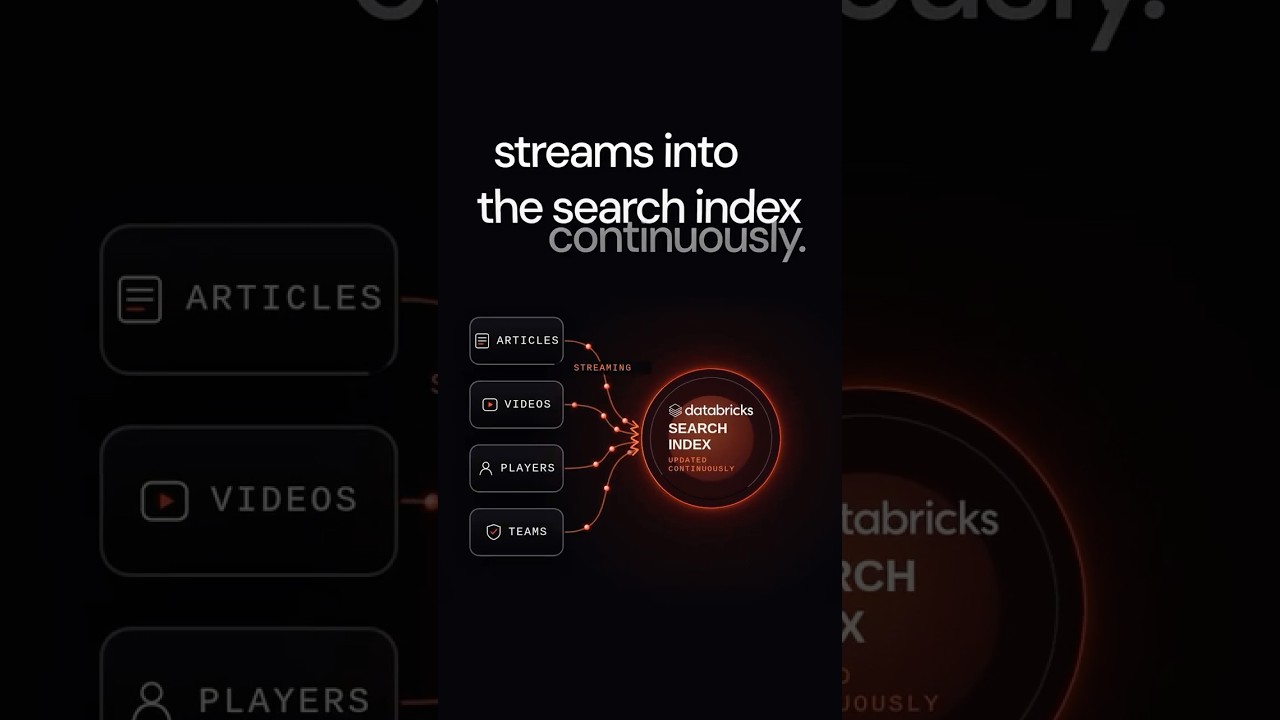
NewsHow FOX Sports Uses AI to Power Search
Fox Sports rebuilt their search system on Databricks to handle rapidly changing sports information by continuously streaming player, team, and content data into the index while computing real-time trends. The system uses semantic vector search with time-weighted ranking to surface fresh content higher, doubling the rate at which users find what they're looking for.
 News
NewsHow AI Helps Match Doctors With Communities in Need | Databricks for Good
Databricks provides pro bono services and compute discounts to help nonprofits stay lean through its Databricks for Good program. The video demonstrates the Virtue Foundation agent, which uses Genie and interactive hex maps to identify underserved populations and medical facility distribution in Kenya.
 News
NewsOmnigent: Open-Source Meta-Harness for AI Agents | Matei Zaharia
Omnigen is an open-source meta-harness developed by Databricks that acts as an orchestration and control layer to wrap, manage, and combine multiple AI coding agents. The platform introduces contextual security policies, cost controls, multi-agent task routing, and sandbox integrations to enable collaborative workflows and centralized governance.
 News
NewsBuilding Agents on Databricks with Custom Apps and Omnigent
This video demonstrates how to build, update, and govern custom AI agents on Databricks using Agent Bricks, Databricks Apps, and Omnigent. The tutorial shows how to integrate Model Context Protocol servers, track execution with MLflow traces, schedule automated agent tasks, and manage security policies through Unity AI Gateway.
 News
NewsGoverning AI Strategy with Unity AI Gateway
The Unity AI gateway provides centralized monitoring, cost tracking, and governance for enterprise AI models, MCP servers, and coding agents. Administrators can use the platform to set budget limits, configure external providers, and enforce input policies that block personally identifiable information.
 News
NewsAI for Mental Health: Crisis Text Line and Databricks
Crisis Text Line provides 24/7 text-based mental health support to millions of individuals facing crises like anxiety, bullying, and financial hardship. The organization uses the Databricks platform to safely analyze anonymized conversation data and improve how researchers understand and serve people in need.