
44 Databricks SQL Alerts | Configure Alert Schedule and Destinations
Description
Databricks SQL Alerts | Azure Databricks Alerts | Schedule and Destinations for Alerts Video explains - What is Alerts in Databricks? How to configure Databricks SQL Alerts? How to configure different destinations in Databricks for Alerts? What are the different types of Destinations available with Databricks? Chapters 00:00 - Introduction 01:19 - Create Query to evaluate condition for Alerts 03:33 - How to create Databricks SQL Alerts? 06:55 - How to add Alert schedule and destinations in Databricks? 07:48 - What type of Alert destinations are available in Databricks? Databricks Website: www.databricks.com Databricks SQL Alerts - https://learn.microsoft.com/en-us/azure/databricks/sql/user/alerts/ The series provides a step-by-step guide to learning Databricks, a popular unified Data Intelligence Platform. New video in every 3 days ❤️ Follow Subham Khandelwal on LinkedIn and Don't forget to Share - https:// www.linkedin.com/in/subhamkharwal/ Disclaimer: This series is meant only to learning and teaching purpose. The host/tutor can not be held responsible for any misuse or any comments. The thoughts and views are of the tutor, it has nothing to do with the employer. #databr…
Description from YouTube. Full content on the video page.
More from Ease With Data
 Tutorials
Databricks All Purpose vs Serverless Computes #databricks #databrickstutorial
Databricks all-purpose compute provides traditional persistent clusters with manual configuration and continuous uptime costs. Serverless compute offers fully managed infrastructure that boots in seconds, scales dynamically, and bills only for active execution time.
 Tutorials
LangChain Tutorial - Build an AI Agent with Tools | Chapter 10
This video teaches how to build AI agents using the LangChain framework in Python. It demonstrates initializing a model, registering Python functions as structured tools, and creating both single agents and supervisor-sub-agent architectures.
 News
NewsSpark vs SDP, What the difference? #spark #pyspark #dlt
Traditional Apache Spark requires developers to manually write complex procedural code for processing steps, state management, and checkpoints. Spark declarative pipelines allow users to define the desired final data state in SQL or Python while the engine automatically handles execution order, dependencies, and incremental processing.
 News
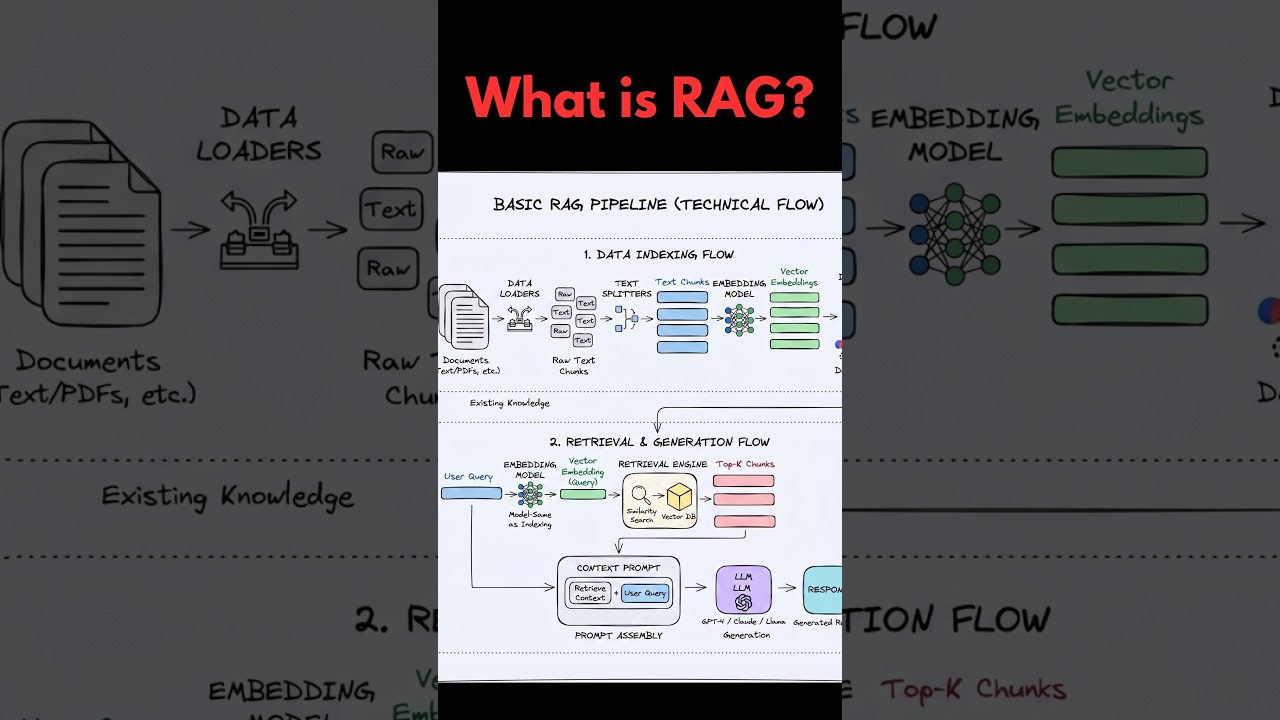
NewsWhat is RAG and How it Works? #genai #llm #generativeai #coding
RAG solves AI hallucination by chunking large private documents into searchable segments and retrieving relevant context for each user query. The system then augments the user's question with the retrieved context before sending it to the AI, enabling factually accurate answers without guessing.
 Tutorials
Build Your First AI Agent + LLM Tool Calling Explained | Chapter 09
Agents operate through tool-calling loops where the LLM requests specific tool execution with arguments, code executes the tools, and observations return for the LLM to process. The video demonstrates building a Python agent using Grok API with two tools that execute sequentially: retrieving weather for a city and suggesting an activity based on temperature.
 News
NewsHow Distillation Works? #claude #kimik3
Knowledge distillation trains a smaller student AI model by using prompts and reasoning outputs from a larger, more advanced teacher model. This process allows the cheaper student model to replicate the expensive teacher's advanced capabilities at a fraction of the computational cost and without accessing its source code.