


Foundation Models
Recent items mentioning Foundation Models across the Databricks ecosystem — releases, news, videos, and community Q&A. Updated hourly.
Databricks AI Runtime now supports tabular foundation models, enabling practitioners to benchmark and fine-tune zero-shot predictive workflows using managed GPUs, MLflow, and Unity Catalog 2. Meanwhile, developers can distill 120B LLMs into efficient 0.8B models using Foundation Model APIs and Serverless GPUs 3, while centralizing governance and routing across multi-provider deployments via Unity Gateway 1.
Generated daily from the 4 most recent items mentioning Foundation Models. Click any [N] to jump to the source.
How AUMOVIO centralized AI access with Databricks Unity Gateway
AUMOVIO consolidated fragmented LLM access across the enterprise by implementing Databricks Unity Gateway as a centralized, governed entry point for all AI workloads. Managed via Terraform, the architecture routes vendor-neutral model aliases across multiple foundation model providers while unifying access controls and chargeback tracking using Databricks system tables.
Tabular foundation models on Databricks AI Runtime
Tabular foundation models accelerate predictive ML workflows by generating predictions on new datasets without requiring task-specific training. Databricks AI Runtime enables teams to benchmark and fine-tune these models against existing baselines using managed GPUs, MLflow tracking, and Unity Catalog integration.
 News
Distill a 120B LLM into a 0.8B Model on Databricks
LLM distillation teaches a smaller student model on answers from a larger teacher model using a narrow task at high volume, saving cost and improving speed while maintaining accuracy. This Databricks tutorial uses Foundation Model APIs, Serverless GPUs, MLflow evaluate, and Model Serving to build and deploy the smaller model end to end.
 News
Databricks MemCurrent, Genie Agents, Azure MPC Server & Feature Views | AI Newsround - October 2026
Databricks announced the beta release of MemCurrent for persistent agent memory, along with Genie Flash mode for faster agent responses and general availability of Feature Views. Azure MCP Server 3.0 reached general availability, and several new AI models including Anthropic Claude Haiku 5.5 and Microsoft Decision 1 were introduced.
🚀 Massive updates came to Databricks Unity Gateway this past September!
Enterprise teams gained access to an expanded, multi-provider model hub managed directly through Foundation Model APIs . Whether you needed cutting-edge enterprise reasoning, lightning-fast inference or lightweight task processing, Unity Gateway expanded its lineup with the latest releases from OpenAI, Anthropic, xAI and DeepSeek. Here is a recap of the foundation models that landed on Unity Gateway throughout September 2026: 🤖 OpenAI GPT-6.1 Sol GPT-6 Sol & GPT-6 Luna GPT-6 Astra ⚡ xAI & DeepSeek xAI Grok 4.7 DeepSeek V4.1 Flash 🧠 Anthropic Claude Opus 5.5 Claude Fable 5.1 submitted by /u/Youssef_Mrini [link] [comments]
Gemini Foundation Model endpoint unavailable in 14-day commercial trial
How I built agent-based security reviews on Databricks
An agent-based security review layer on Databricks automates predictable evaluations while routing ambiguous or high-risk cases to human reviewers. Built using Unity Catalog, Lakeflow Jobs, Databricks Apps, and hosted foundation models, this governed architecture improves review cycle times and consistency without removing human authority.
The Web Search Your Agent Inherited Isn't Good Enough
Omnigent lets you define an agent once—model, tools, policies, limits—and deploy it across Claude Code, Codex, or the raw API instead of rebuilding it per harness, with model calls routed through Databricks Foundation Model APIs for unified cost tracking and governance. Swapping in Nimble for web search lifted benchmark accuracy from 46% to 71% while cutting search costs in half.
Feature enablement for Foundation Model Unity Catalog permissions
Community BrickTalk | Real-Time Data & AI: Tripwise Demo
Hey r/Databricks ! Join us for community BrickTalk on Thursday, September 24 , focusing on real-time data streaming, AI agents, and governance using Databricks. BrickTalks is a community event series where Databricks experts share real-world use cases, demos, and practical insights for building with Data and AI, giving customers a direct line to the people behind the products. In this session, we'll walk through a live demonstration of the Tripwise Demo , featuring: Sub-Second Transactions & Streaming: Device registration into Lakebase with sub-second reads/writes, plus telemetry streaming via Zerobus through a governed Medallion architecture. AI-Generated Offers & Pricing: Generating real-time agent offers using Foundation Model APIs and scoring behavioral data for usage-based renewal pricing. Natural Language Analytics: Enabling underwriters, product managers, and marketing teams to query governed insurance data in seconds using AI/BI Dashboards and Genie. Unified Governance: Managing safety, compliance, and control end-to-end with Unity Catalog. This is a great chance to see real-world architecture in action and ask questions directly to Databricks experts. When: Thursday, September 24 9:00 AM PT 12:00 PM ET 5:00 PM BST (London) 9:30 PM IST Register here and save your spot submitted by /u/Subject_Ant1789 [link] [comments]
 Tutorials
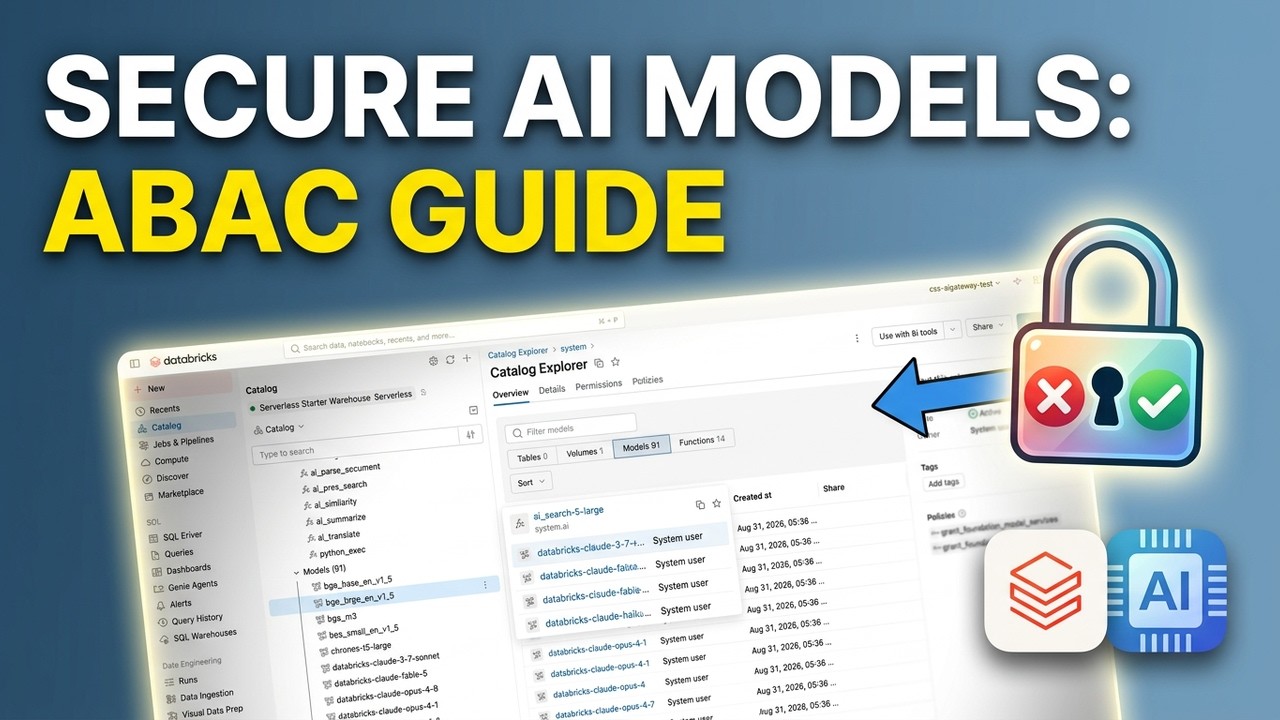
Govern Models and Model Services Using ABAC Grant Policies
Databricks models and model services can be opted out of using catalog tags combined with attribute-based access control grant policies. Executing this setup requires applying tags to specific models, writing programmatic policies with exclusion statements, and revoking schema-level permissions.
How to enable guardrails to an existing LangGraph agent deployed on a Databricks Serving Endpoint?
I have a LangGraph agent deployed as a Unity Catalog model on a Databricks Serving Endpoint. User : -> Databricks Serving Endpoint: -> UC Model: ai_workspace.agent.agent: -> LangGraph Agent: -> LLM + Tools The serving endpoint shows AI Gateway enabled , but its configuration currently only shows usage tracking. I would like to apply Unity AI Gateway guardrails to this agent. When I go to AI Gateway → Model Service → Create Model Service , I can configure guardrails, but my existing UC model: ' ai_workspace.agent.agent' does not appear in the Destination list. The available destinations appear to be Databricks-hosted foundation models and other supported model providers. My questions are: Can Unity AI Gateway guardrails be applied directly to an existing LangGraph agent deployed on a Databricks Serving Endpoint? If not, can I configure the LangGraph agent to use a Model Service as its underlying LLM endpoint, so that the LLM requests are governed by AI Gateway guardrails? Would those guardrails apply only to the LLM request/response, or can they also govern the LangGraph agent's tool calls and overall execution? What is the recommended Databricks architecture for applying AI Gateway guardrails to a custom LangGraph agent? Is the AI Gateway enabled option on a custom/agent serving endpoint different from the newer Unity AI Gateway Model Service functionality?
Databricks-hosted Foundation Model APIs blocked by workspace rate limit of 0
Kimi K3 from Moonshot AI is now available on Databricks through Unity AI Gateway
Moonshot AI’s most capable open-weight model, Kimi K3, is now available on Databricks through the Foundation Model API with full governance via Unity AI Gateway. Initially hosted in the US with comprehensive Zero Data Retention, the model integrates directly with your existing unified API, cost controls, guardrails, and observability workflows.
Enable Foundation Model APIs for AWS Marketplace trial workspace
Request to Enable Foundation Model Endpoint Rate Limits
Foundation Models API blocked — "Databricks-set rate limit of 0" even after adding payment method
 News
AI Stack Explained in 3 Layers (LLM, Agent Harness, Omnigent)
The AI stack now includes a third layer, the meta harness, which sits above individual agent harnesses. This meta harness, exemplified by Databricks' open-sourced Omnigent, allows for routing queries to appropriate agents and orchestrating tasks across multiple agents, enabling seamless interaction and context sharing between them.
How Ecolab rebuilt retail intelligence on Databricks and Anthropic Claude
Ecolab rebuilt retail intelligence on Databricks and Anthropic Claude, converting 700-page FDA manuals into real-time answers for frontline staff using Foundation Model APIs and cutting compliance report compilation from two weeks to under two minutes. The solution, a native Databricks App with Lakebase Postgres and Unity Catalog, unifies nine siloed data sources and employs a multi-agent orchestration framework with Judge LLMs and MLflow tracing for personalized, continuously refined intelligence.
Beyond parsing X12: Closing the gap for revenue cycle workflows in healthcare
Healthcare billers now have an operational workbench built on Unity Catalog gold views, providing a purpose-built UI with a denials queue, remittance drawer, and timely-filing age alerts directly on their fully parsed 835/834/837 EDI data. This solution integrates GenAI via Databricks Foundation Model APIs to auto-draft appeal letters, moving billers beyond manual spreadsheet and SQL work to review and approve instead of writing from scratch.
 News
Govern MCP servers in Databricks #databricks #mcp #aigovernance
Databricks Unity AI Gateway now governs MCP servers, centralizing their management alongside built-in foundation models and LLMs. This integration allows for easier governance and orchestration of various AI components and agents within Databricks.
 Events
Patrick Wendell, Co-founder and VP of Engineering on Building Production-Quality AI Systems
Databricks provides the Mosaic AI platform, which enables companies to transform general-purpose language models into customized data-intelligent applications. The system leverages tools such as zero-code fine-tuning, the Unity Catalog for data governance, vector search for retrieval-augmented generation, and MLflow for tracing and evaluation.
 News
Sponsored by: Labelbox | Unlocking Enterprise AI with Your Proprietary Data and Foundation Models
Labelbox announces Model Foundry, a platform for experimenting with and applying hundreds of foundation models to proprietary enterprise data. The video also demonstrates how Labelbox pipelines and annotation tools orchestrate data curation, model evaluation, and human-in-the-loop workflows.
 News
AI Regulation is Coming: The EU AI Act and How Databricks Can Help with Compliance
The video outlines the risk-based approach of the upcoming EU AI Act, detailing its compliance obligations, self-conformity assessments, and challenges regarding foundation models. It also highlights Databricks platform tools, such as Unity catalog, ML flow, and lake house AI, designed to assist with AI governance and regulatory compliance.
 News
Testing Generative AI Models: What You Need to Know
Artificial intelligence risks are classified into operational, ethical, and security categories that require pre-production validation, real-time firewalls, and post-production assessments. Red teaming and automated testing engines help mitigate these vulnerabilities by algorithmically detecting and blocking prompt injections, data poisoning, and hallucinations.
 News
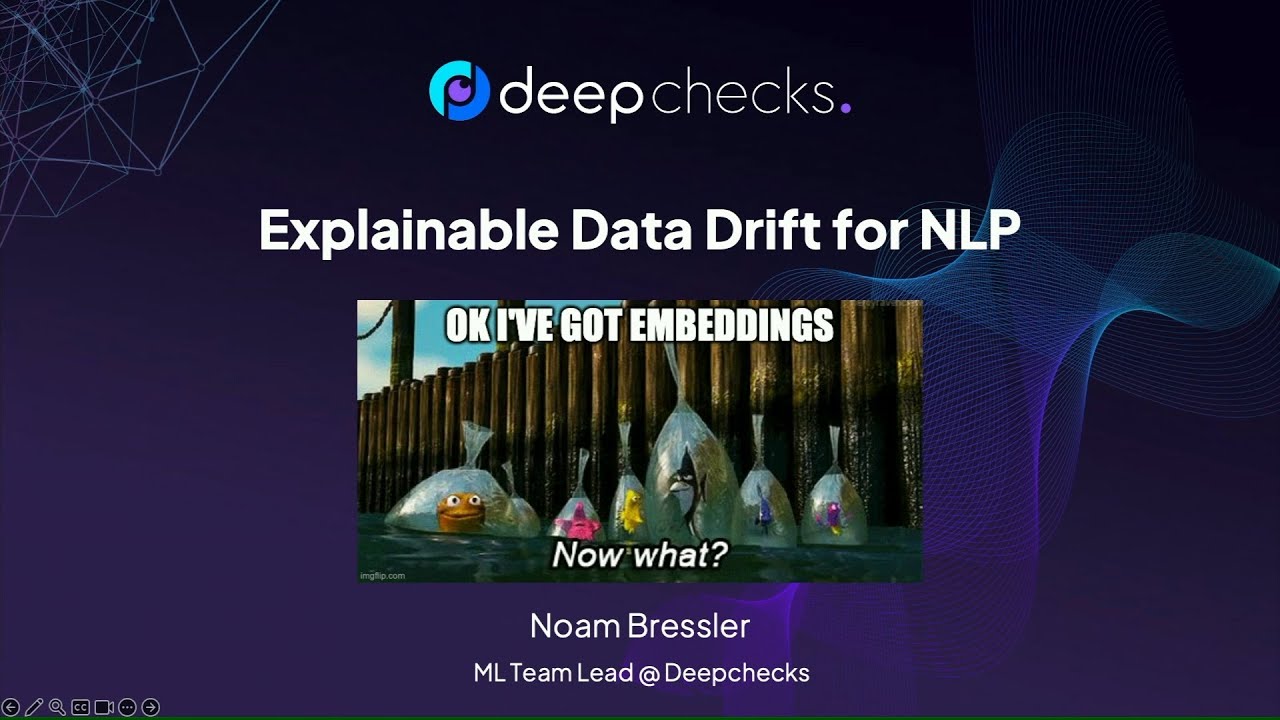
Explainable Data Drift for NLP
This video teaches data scientists how to detect and explain data drift in unstructured NLP text using metadata, properties, and embeddings. The speaker demonstrates using the open-source library Deep Checks to identify drift, automatically extract topic clusters via GPT, and trace model performance drops.
 News
Building AI-Powered Products with Foundation Models
The video demonstrates a data-centric development approach using programmatic weak supervision to fine-tune foundation models for enterprise applications. It also explains how to iteratively identify model error hot spots and build high-quality custom training data instead of relying solely on manual labeling.
 News
Demonstrate-Search-Predict: Composing Retrieval and Language Models for Knowledge-Intensive NLP
The video introduces the Demonstrate Search Predict programming model and compiler designed for building knowledge-intensive NLP pipelines with foundation models. It demonstrates how DSP uses primitives and compilers to automatically optimize, prompt, and fine-tune complex multi-hop question-answering systems.
 News
Foundation Models in the Modern Data Stack
Foundation models are applied to structured data tasks within the modern data stack to automate data workflows such as SQL generation, data cleaning, and entity resolution. Production deployment challenges like processing scale, prompt brittleness, and a lack of domain-specific knowledge are addressed using techniques like model distillation, prompt ensembling, and retrieval-augmented generation.
Get Tuesday's version of this
Tracking Foundation Models? The Tuesday email carries what moved across the whole ecosystem, not just this topic. Free, one-click unsubscribe.