
Description
You’ve successfully built your data lakehouse. Congratulations! But what happens when your operational data stores, streaming systems like Apache Kafka or data ingestion systems produce bad data into the lakehouse? Can you be proactive when it comes to preventing bad data from affecting your business? How can you take advantage of automation to ensure that raw data assets become well maintained data products (clear ownership, documentation and sensitivity classification) without requiring people to do redundant work across operational, ingestion and lakehouse systems? How do you get live and historical visibility into your entire data ecosystem (schemas, pipelines, data lineage, models, features and dashboards) within and across your production services, ingestion pipelines and data lakehouse? Data engineers struggle with data quality and data governance issues constantly interrupting their day and limiting their upside impact on the business. In this talk, we will share how data engineers from our 3K+ strong DataHub community are using DataHub to track lineage, understand data quality, and prevent failures from impacting their important dashboards, ML models and features. The tal…
Description from YouTube. Full content on the video page.
More from Databricks
 News
NewsParallel Coding Agents with Lakebase | Claude Code + GitHub Actions
This video demonstrates how to run multiple coding agents in parallel by combining git worktrees, GitHub Actions, and Lakebase database branching. It shows how each agent automatically receives an isolated database branch for safe experimentation and schema migrations, followed by dedicated preview environments for pull requests.
 Events
How Enterprises Govern AI Agents Across Multiple Models
Databricks announced the general availability of the Unity AI gateway to provide centralized multi-model governance, cost controls, and end-to-end observability for enterprise AI agents. Panelists discussed how coding agents and harnesses are evolving beyond programming into long-running operations, personal software development, and automated organizational workflows.
 Events
Demo: Building a Governed AI Agent with Unity AI Gateway
This video demonstrates how to build, update, and govern a store operations AI agent using Databricks Agent Bricks and the Unity AI Gateway. The tutorial highlights integrating custom Model Context Protocol servers, recording execution traces with MLflow, and enforcing security policies and budget controls.
 News
NewsHow ModMed Transforms Healthcare AI and Agentic Workflows with Databricks
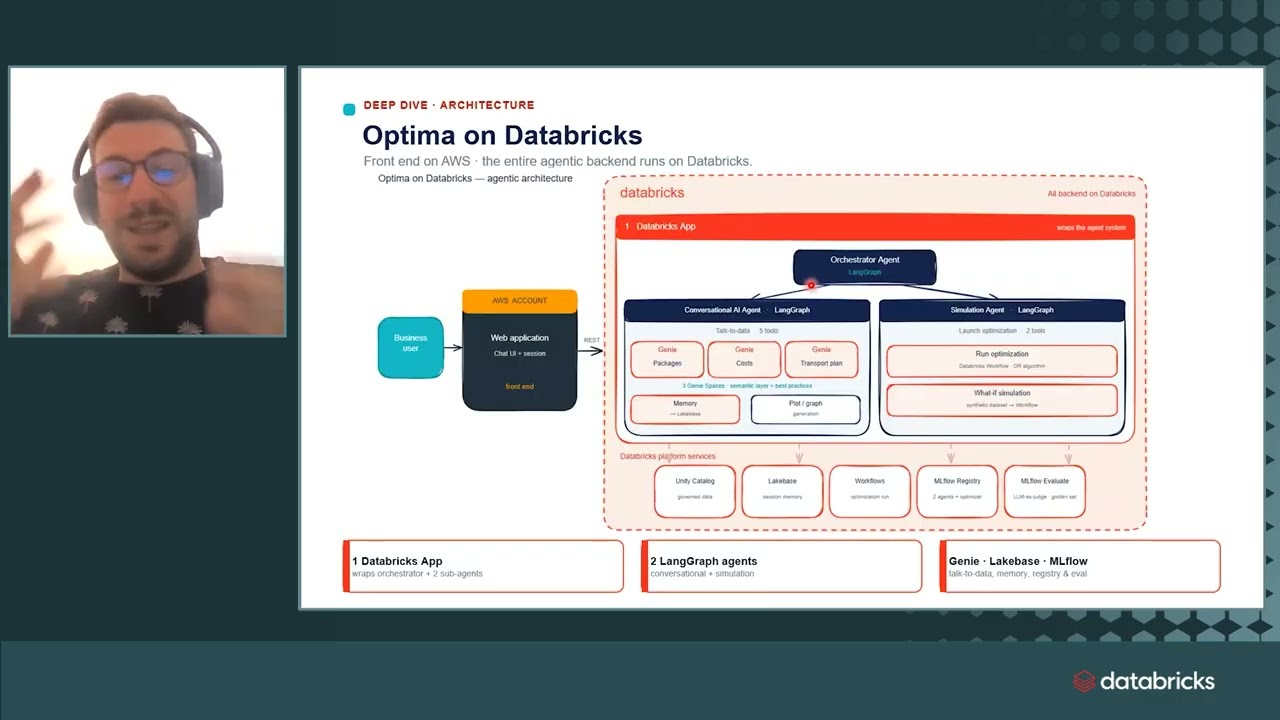
ModMed uses the Databricks Lakehouse platform and Unity Catalog to build secure AI-enabled healthcare applications and agentic workflows. The integration of these tools allows both technical and non-technical users to access near real-time data insights and solve complex problems efficiently.
 News
NewsTeach AI how your business actually runs
Model intelligence is no longer the bottleneck for enterprise AI adoption because modern frontier models easily handle complex reasoning tasks. Business value requires providing these models with specific organizational context and metadata about internal processes to create a competitive advantage.