


AI Usage Dashboard: Track Metrics & Performance!
Summary
Databricks offers an out-of-the-box usage dashboard that tracks aggregate AI usage metrics across an organization, including daily requests, token usage, and unique users. The dashboard displays model performance indicators like latency, time to first token, and tokens per minute, and is fully customizable for specific organizational needs.
Summary generated by brickster.ai from the video transcript.
More from Databricks Skill Builder
 News
NewsBuilding on Lakebase | Episode 1: Meet Lakebase
Lakebase is a fully managed serverless PostgreSQL database from Databricks that disaggregates storage and compute for variable AI and operational workloads. The video demonstrates provisioning a Lakebase project, creating operational tables, and syncing curated Lakehouse data to build the foundation for an agentic support co-pilot.
 Tutorials
Finally, a Simple Way to Deploy Databricks Hybrid Workspaces
The video introduces the platform deployment kit, a web user interface designed to simplify the creation of Databricks hybrid workspaces without manual coding. It demonstrates how to use the tool to configure network, storage, and security settings, generate the corresponding Terraform template, and execute the deployment.
 Tutorials
GenieCode Explained: Instructions & Skills
GenieCode personalization uses Instructions, Skills, and MCP servers to enforce organizational standards at workspace or user levels. A live demo shows these features in action, applying custom rules for PII handling, naming conventions, and SQL-based architecture in data pipeline generation.
 Tutorials
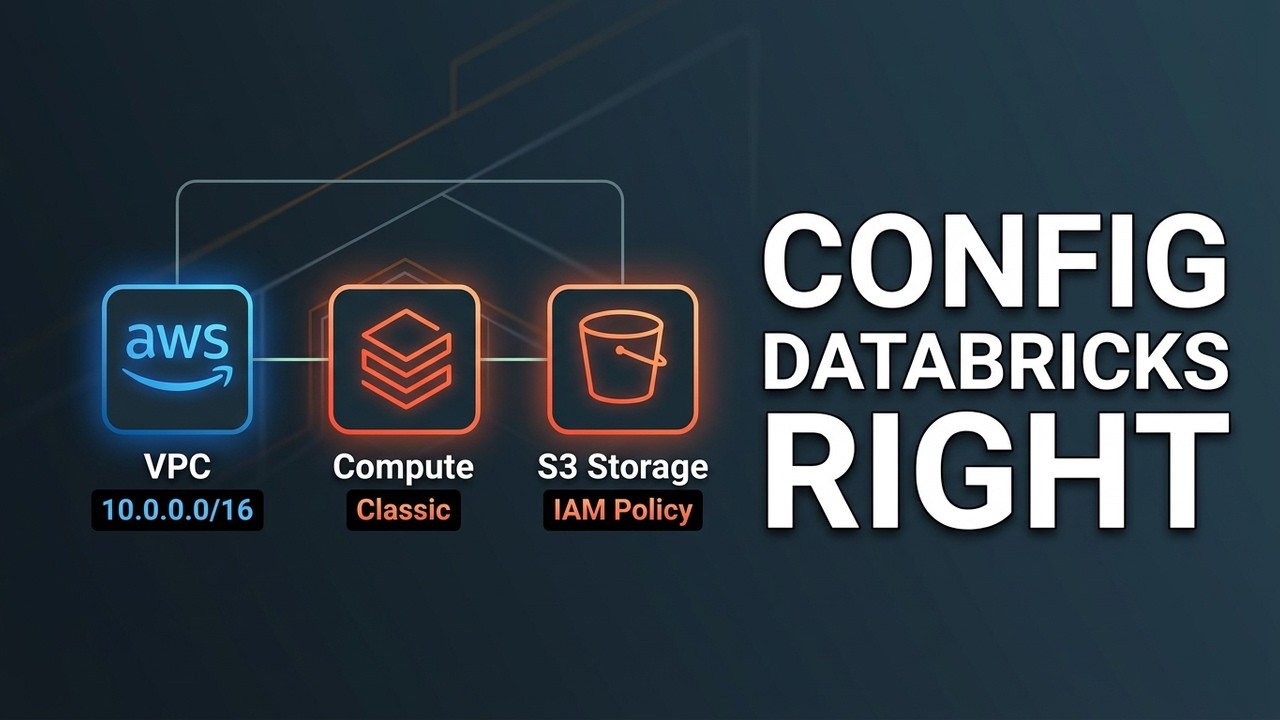
The Right Way to Configure Databricks on AWS (Step-by-Step)
Deploying a Databricks workspace on AWS requires creating a cross-account IAM role, VPC with security groups, S3 bucket, and a read/write IAM role to enable the Databricks control plane to provision compute resources in your AWS account. The process involves configuring each AWS resource with specific settings in both the AWS console and Databricks console, then provisioning the workspace which activates within minutes.
 Tutorials
Deploy an Azure Databricks Serverless Workspace in Under 2 Minutes | Step-by-Step Tutorial
Deploy an Azure Databricks serverless workspace through the Azure portal by selecting your subscription and resource group, configuring the workspace name, choosing your region and premium pricing tier, then reviewing and creating the deployment. The entire process takes approximately 2 minutes to complete.
 Tutorials
Connect VS Code to Databricks: The SSH Tunnel Guide
Databricks' SSH tunnel feature lets you connect local IDEs and coding agents directly to your workspace, enabling you to edit and run code on Databricks compute while keeping files automatically synced. The connection supports multiple IDEs through either CLI commands or an extension, with options for serverless compute, GPU acceleration, and base environment management to avoid reinstalling dependencies.