Everything across the Databricks world, ordered for you.
News, releases, videos, GitHub projects, and community Q&A merged into one feed. Pick a role below to reorder it for your work.
Reorder for your role
databricks/databricks-sdk-go — v0.145.0
This release fixes an issue where tag policy and assignment operations failed for hierarchical tag keys containing slashes. It also introduces a breaking change by making the `ResourceId` field optional in `bundledeployments.Operation` and adds support for Dynamics365 connection types and `Endpoint…
databricks/databricks-sql-python
Databricks SQL Connector for Python
★ 231 · Python
Introducing Omnigent: A Meta-Harness to Combine, Control and Share Your Agents
Omnigent, an open source meta-harness, is now available to combine, control, and share your AI agents across various models and interfaces. It enables building agent teams, controlling them with policies, and sharing live sessions with teammates.
Databricks News: CLI v 1.0.0, AI-tools, Docker, DABs UI sync, mutators
The video demonstrates new Databricks features, including the GA release of CLI 1.0.0, UI sync for DABs, Python mutators for bundle extension, and new Docker image options for custom runtimes. It also covers serverless pipeline orchestration, enhanced autoscaling for Lakebase and apps, serverless interactive execution timeout, and auto-scoping for access tokens.
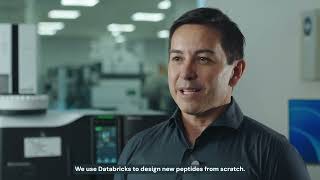
From Wall Street to Data Platforms
Databricks values deep industry expertise, as shown by Kim Hatton’s transition from finance to helping financial institutions solve modern data challenges. Our collaborative environment encourages employees to grow beyond their core roles and contribute to industry innovation, building practical tools that turn complex data tasks into streamlined successes.
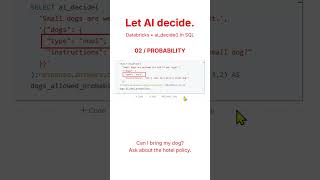
The Hidden Logic: How AI Transforms Your Data 🧐
AI models implicitly convert string-based categorical data, like sentiment (positive, negative, mixed), into numerical representations. This conversion is essential for performing mathematical operations, such as calculating an average sentiment.
AI-Powered Data Cleaning in Databricks! 📊🤖
Databricks demonstrates using an AI assistant to clean data by providing an image of desired output. The AI transforms the existing data to match the structure and content shown in the attached image.
Is Your Azure Databricks Storage Exposed? (Enable Firewall now)
The video demonstrates how to enable firewall support for an Azure Databricks workspace storage account, preventing public network access. It walks through creating private endpoints, an access connector, and then executing a PowerShell command to configure the firewall and network security perimeter.
Databricks: Future of Storage Security Revealed!
Databricks is onboarding existing workspace storage accounts with enabled firewalls to Network Security Perimeter (NSP). This allows users of Databricks serverless to leverage enhanced storage security.
Import Local Files to Databricks Easily! ✨
Databricks Lake Designer now allows users to easily import local files by dragging and dropping them onto the canvas. This feature simplifies bringing personal datasets into Databricks for analysis, addressing the common need to use data not yet stored in the platform.
Pro Tip: Add Multiple Tables Fast! 🚀
Users can quickly add multiple tables to a canvas by dragging them directly from the Catalog Explorer left panel. This method streamlines the process of adding several tables from the same schema or catalog, avoiding the need to create individual source nodes.
Enabling Evolutionary Database Development: Database branching with Lakebase, the conclusion
Lakebase now supports database branching, enabling evolutionary database development. This concludes the series on Lakebase's operationalization of evolutionary database design.
Data + AI Summit - AI Recap + Q&A
If you couldn't make it to San Fran, or keep up with four days of announcements, demos, and deep-dive sessions from across the pond, then don't worry, we’ve got you covered. Join Gavi and James for a no-nonsense recap of the key highlights, and more importantly, what they actually mean for your org…
Building Real AI Agents (Fast!) | Microsoft Agent Framework Foundations | Part 2
The video demonstrates building AI agents using the Microsoft Agent Framework, covering basic agent setup, tool integration for external data, and managing conversation context and personalized interactions. It highlights the framework's simplified development, built-in telemetry, and modular design for creating robust AI agents.
Talk to all your data, wherever it lives
Lakehouse Federation is now available, allowing you to query data across all sources without migration delays. Unity Catalog serves as the single source of truth for both federated and managed data, enabling secure AI workloads and natural language querying.
What is customer segmentation?
Customer segmentation combines multiple types and methods, from rule-based to AI/ML-driven models, but its success hinges on unifying fragmented customer data into a governed Customer 360. Databricks' CustomerLake, an Agentic CDP, builds segments directly on governed data with AI-driven identity resolution and natural-language audience creation, eliminating data copies and extra vendors.
Unlocking semantics for AI: How Mercedes-Benz Korea built trusted “Talk to Data” at scale
Mercedes-Benz Korea built a trusted "Talk to Data" solution at scale by making 500+ KPI definitions available in an AI-ready semantic layer on Unity Catalog metric views, accelerating the transition with an automated DAX-to-Metric-View transpiler. This governed semantic layer supports both existing BI and new "Talk to Data" experiences, with Genie and Agent Bricks providing consistent answers and shaping a playbook for persona-based AI agents across markets.
Forward Deployed Engineering: Delivering Business Outcomes with AI
Databricks is launching its Forward Deployed Engineering (FDE) organization to accelerate customer business outcomes with AI, pairing the Lakehouse platform with embedded, engineering-led delivery. This new approach moves beyond migration and pipeline building to solve business problems with production AI agents, as demonstrated by customers like Fox, JPMC, and Qualcomm.
Ingesting the Milky Way: Petabyte-Scale with Zerobus Ingest
Zerobus Ingest, a new serverless streaming API, enables instant deployment of petabyte-scale data pipelines on Databricks without manual infrastructure management. Its dynamic partitioning architecture automatically scales compute and sustains over 12 GB/s throughput to a single table, efficiently handling unpredictable data volumes.
How ERGO Hestia reduced time-to-market with Lakebase and Mosaic AI Model Serving
ERGO Hestia modernized its real-time pricing engine with Databricks Lakebase and Mosaic AI Model Serving, reducing time-to-market by unifying data, features, and decisions for millisecond pricing. This eliminated extraction overhead and fragmented governance from their previous multi-hop architecture, enabling faster model deployment and instant market response.
Stop Leaving Your Azure Storage Open to the Public!
The video demonstrates how to enable firewall support for an Azure Databricks workspace storage account, preventing public network access. It walks through creating private endpoints, an access connector, and using a PowerShell command to configure the firewall.
databricks/databricks-sdk-py — v0.117.0
The `resource_id` field in `bundledeployments.Operation` is no longer required, which is a breaking change. Several bug fixes improve performance and stability, including caching OIDC tokens, making `WorkspaceClient.dbutils` lazy, and better handling of Spark Connect runtimes.
Welcoming the first cohort of Databricks student fellows
Databricks launched its inaugural Student Fellows cohort, selecting a diverse group of students to bridge academic theory and real-world data and AI practice. These fellows will host workshops, hackathons, and mentorship programs at their universities, with five standout individuals from top schools already making significant contributions.
Deploying Azure Databricks with Terraform? Watch this first!
This video demonstrates how to deploy an Azure Databricks workspace using Terraform by cloning a provided script, configuring variables, and executing Terraform commands. It walks through setting up prerequisites, authenticating Azure CLI, and populating a Terraform variables file to successfully provision the workspace.
Geospatial Unbounded: Spatial SQL GA with AI/BI Maps, Delta Sharing, and Iceberg v3
Spatial SQL is now Generally Available on Databricks, bringing native geospatial data types, 90+ ST_* functions, and AI/BI Dashboards that render maps natively. This release also includes major performance improvements, open lakehouse support via Delta Sharing and Iceberg v3, and Apache Spark 4.2 compatibility for geo columns.
Azure Databricks at Data + AI Summit 2026 featuring Industry Leaders and Partners
Azure Databricks at Data + AI Summit 2026 featured new joint product announcements and integrations, alongside key sessions on zero-copy federated analytics and ecosystem co-engineering. Learn how joint customers are modernizing data estates, scaling AI, and unlocking business value with Azure Databricks.
Empower your healthcare agents with ready-to-use MCP on Databricks Marketplace
Databricks Marketplace now offers ready-to-use biomedical and clinical Model Context Protocol (MCP) servers from partners like Climb and Atropos Health, empowering healthcare agents. Easily build and deploy bespoke agents to production, leveraging a securely governed, centralized MCP Catalog that also supports your own custom MCP servers or data.
How Ecolab rebuilt retail intelligence on Databricks and Anthropic Claude
Ecolab rebuilt retail intelligence on Databricks and Anthropic Claude, converting 700-page FDA manuals into real-time answers for frontline staff using Foundation Model APIs and cutting compliance report compilation from two weeks to under two minutes. The solution, a native Databricks App with Lakebase Postgres and Unity Catalog, unifies nine siloed data sources and employs a multi-agent orchestration framework with Judge LLMs and MLflow tracing for personalized, continuously refined intelligence.
databricks/databricks-sdk-go — v0.144.0
The Databricks SDK for Go now includes a TypeOverrides field for database.SyncedTableSpec and postgres.SyncedTableSyncedTableSpec. This allows practitioners to specify type overrides when defining synced tables.
Stop building data products. Start building data services.
The one-product-per-use-case model breaks down under acquisition-driven growth and agentic consumption; a services layer is more adaptable to what comes next. Moving data mastering and quality checks closer to ingestion makes integration cycles measured in weeks possible, reducing insight lag.
databricks/cli — v1.3.0
The `direct` deployment engine is now Generally Available and the default for new deployments, with existing deployments retaining their current engine. New commands `databricks quickstart` and `databricks version --check` are added, alongside fixes for authentication and bundle deployments.
Scaling AI Through Data Fluency
Aer Lingus built a solid data foundation with governance and quality, treating data literacy as a core business skill with a custom curriculum. This enabled real-time insights for optimizing flight loads, pricing, and operations decision-making.
Announcing the Public Preview of Custom URLs
Databricks accounts can now use a single, branded custom URL like mycompany.databricks.com, replacing individual workspace URLs. This simplifies login and navigation across multiple workspaces, enabling account-wide features like Genie and Unity Catalog lineage.
AWS and Databricks at Data + AI Summit 2026: Accelerating real-world AI innovation
AWS and Databricks are accelerating real-world AI innovation, from Mastercard experimentation to production-scale AI, as showcased at Data + AI Summit 2026. Explore breakout sessions, industry forums, and hands-on demos covering agentic AI, governance, open data architectures, and multi-engine interoperability with Amazon Bedrock and Kiro.
AI Serving Platform That Adapts to Your Model
Databricks now offers a fully managed AI serving platform that automatically adapts to your model's resource needs, from scikit-learn to 70B LLMs, without manual configuration. This results in up to 90% lower infrastructure costs and <10ms p99 latency overhead for customers migrating from self-managed stacks.
Python Based Time Series Analytics on Databricks
Databricks partnered with AVL to create Impulse, an open-source Python framework for time series analytics on petabyte-scale automotive sensor data. Impulse standardizes raw sensor data into a silver layer data model, allowing engineers to query vast measurement data efficiently within the Databricks Lakehouse.
databricks/dbt-databricks — 1.12.1 (v1.12.1)
This release exposes Databricks Jobs IDs in dbt run results and adds support for SPOG vanity URLs. It also fixes issues with streaming table diffs, column-level constraints, and managed Iceberg incremental models losing clustering.
Announcing the Databricks storage ecosystem: Governing the enterprise data estate, wherever it lives
The Databricks Storage Ecosystem now natively connects hybrid and on-premises storage platforms to Databricks via OpenSharing, enabling centralized data governance and GenAI scaling across your entire hybrid infrastructure. Run Databricks Serverless Compute, Genie, and LLMs directly on your on-premises datasets with a zero-copy architecture, instantly turning isolated data into active, AI-ready assets.
databricks/databricks-sdk-go — v0.143.0
This release adds an `AcceleratedSync` field to `database.SyncedTableSpec` and `postgres.SyncedTableSyncedTableSpec`. This new field enables configuration of accelerated sync for synced tables within Databricks.
Databricks on Databricks: How Marketers Use Data 3x More with Genie, an AI Analytics Assistant
Databricks built "Marge," an AI analytics assistant powered by their Genie platform, to help its marketing team access and utilize data more efficiently. Marge provides conversational analytics by unifying marketing data in a lakehouse and offering governed, trusted insights in seconds, significantly reducing reliance on manual analyst reports.
databricks/databricks-sdk-java — v0.119.0
This release introduces new services for AI Search and Bundle Deployments, along with numerous new fields across various existing services like Catalog, MLflow, and Vector Search. It also includes breaking changes by removing the `bundle` package and its associated service.
databricks/databricks-sdk-py — v0.116.0
This release introduces new services for AI Search and Bundle Deployments, along with numerous new fields across existing services like Catalog, ML, and Vector Search. The `bundle` package and its associated workspace service have been removed.
Modern BSA/AML compliance on Databricks
Databricks now offers a unified, AI agent and ML-augmented experience for BSA/AML compliance, consolidating siloed systems and accelerating SAR report building. AML teams can expect 8-10x faster case processing, a 75% reduction in false positives, and $50-150 million in annual cost savings.
Claude Fable 5 is now available on Databricks, fully governed through Unity AI Gateway
Claude Fable 5 is now available on Databricks, accessible through Unity AI Gateway for centralized governance, cost controls, and observability. This Anthropic model offers state-of-the-art performance across enterprise workflow automation, agentic search, data reasoning, and multimodal document understanding.
Announcing the winners of the 2026 Databricks Customer Awards
The 2026 Databricks Customer Awards winners have been announced, recognizing 10 customers for excellence, innovation, transformation, social impact, and leadership. These winners span diverse industries and regions, showcasing how they leverage Databricks to solve complex data and AI challenges.
Announcing the 2026 Databricks Customer Awards Industry winners
The 2026 Databricks Customer Awards Industry winners have been announced, recognizing ten organizations across diverse sectors like financial services, healthcare, and manufacturing. These winners showcase compelling data and AI stories, demonstrating how they've leveraged Databricks to solve complex challenges and achieve measurable results.
databricks/databricks-sdk-go — v0.142.0
This release introduces new services for AI Search and Bundle Deployments, along with several new fields across various services like Catalog, ML, and Vector Search. It also includes breaking changes by removing the old Bundle package and its associated workspace-level service.
Databricks Lakehouse for Automotive Data: How AVL Modernizes Vehicle Testing
AVL uses Databricks Lakehouse for Automotive Data to modernize vehicle testing by consolidating diverse, siloed data into a single platform. This enables engineers to efficiently analyze petabytes of data, accelerate development, and leverage AI for better, safer vehicles.
Easy Migration from Postgres to Databricks Lakebase
The video demonstrates a tool for migrating existing PostgreSQL databases to Databricks Lakebase, highlighting potential compatibility issues like session state, extensions, and authentication that require architectural adjustments. It shows how to validate a PostgreSQL database for Lakebase compatibility and then perform a migration using a CLI tool, emphasizing the speed and ease of the process for straightforward databases.
Transforming solar and wind maintenance reports with Genie and AI agents
Plenitude now converts unstructured solar and wind maintenance PDFs into a unified, queryable data model using Databricks Genie and AI agents. This enables natural-language querying and visualizations across plants, accelerating multi-plant analysis and laying the groundwork for predictive maintenance.
Your AI isn't broken. Your data model is.
Databricks practitioners, your AI isn't broken; your data model is. The gap between successful AI proof of concepts and failed production deployments stems from your data model, not your AI model.
Enterprise Data Strategy Roadmap for Business Outcomes
* A robust enterprise data strategy connects organizational data assets to specific business objectives through governance, architecture, and analytics frameworks that scale with evolving business needs. * Effective data governance, data quality management, and master data management form the found…
How LLMs Understand your Prompts: Tokenization & Embeddings | Chapter 05
The video explains how Large Language Models (LLMs) understand text by converting it into numerical representations through tokenization and embeddings. It demonstrates how text is broken into tokens, assigned unique IDs, and then transformed into dense vectors (embeddings) that capture semantic meaning and positional information for LLM processing.
Anthropic's SpaceX Deal, ClawPilot, and Databricks Agent-centric Cert | AI Newsround - May 2026
Anthropic signed a deal with SpaceX for AI supercomputing infrastructure, signaling the importance of compute supply in AI development. Google and Microsoft launched personal AI agents, Gemini Spark and Microsoft Scout, emphasizing ecosystem integration, trust, and governance.
databricks/databricks-sdk-java — v0.117.0
The SDK now detects the AI_AGENT environment variable for user agent reporting and passes unrecognized agent values through. Pagination has new explicit factory methods, and a bug was fixed where token-paginated responses with empty pages and a next token would silently drop results.
databricks/databricks-sdk-py — v0.115.0
The SDK now better detects AI agents by honoring the Vercel AI_AGENT environment variable and passing through unrecognized agent names in the User-Agent header. This allows for more specific identification of AI agents beyond just "unknown".
delta-io/delta-rs — rust-v0.32.4
This release is a backport from the 0.32.x line, which will receive voluntary support for a period. Consult the full changelog for specific user-facing changes, fixes, or breaking changes.
Enabling Evolutionary Database Development: database branching with Lakebase, continued
This series revisits the methodolgy of Evolutionary Database Design, twenty years...
Data + AI Summit 2026: Insider’s Guide for Financial Services Leaders
Data + AI Summit 2026 offers a financial services executive guide to key banking, insurance, payments, and capital markets sessions. Learn how leading organizations like Morgan Stanley and JPMorganChase are approaching AI transformation, responsible AI, and operational modernization, with practical strategies for maximizing summit value.
Is This the Future of Enterprise AI? | Microsoft Agent Framework Foundations | Part 1
The Microsoft Agent Framework, now in version one, unifies Semantic Kernel and Autogen into a single robust framework for enterprise AI solutions. It offers features like long-term memory, built-in guardrails, observability via OpenTelemetry, and integrated Azure Identity for secure and efficient agent development.
Your guide to the Telecommunications Industry Experience at Data and AI Summit 2026
The Data + AI Summit 2026 will feature a Telecommunications Industry Experience, showcasing how global carriers are leveraging data and AI to address customer experience, network operations, and fraud. Attendees will gain insights into AI agents for autonomous networks, churn prevention, and Genie-powered conversational intelligence for frontline teams.
3x Faster Search: Parallel Test-Time Scaling with Instructed-Retriever-1
Instructed-Retriever-1 now delivers 3x faster search for Agent Bricks Knowledge Assistant. This parallel test-time scaling update also improves quality for Databricks practitioners.
databricks/databricks-vscode — Release: v2.11.0 (#1902) (release-v2.11.0)
This release introduces a Unity Catalog explorer and a workspace filesystem explorer, enhancing direct data and file management within VS Code. It also adds support for SPOG host URLs.
databricks/cli — v1.2.0
The experimental open command now supports opening various Databricks resource types via their workspace URLs. Databricks Bundles gain a new --select flag for partial deployments and improved retry logic for transient HTTP errors.
databricks/databricks-sdk-java — v0.116.0
The Databricks SDK for Java now correctly handles OAuth token exchanges for browser-based flows by making the client ID optional in `DatabricksOAuthTokenSource`. This fixes a `NullPointerException` when no client ID is present, allowing account-wide token federation.
Trace Any AI Agent with OTel, MLflow, and Unity Catalog
Databricks now allows sending OpenTelemetry traces from any AI agent to Unity Catalog, enabling end-to-end observability and governance within the Databricks Lakehouse. This integration facilitates cost-effective trace storage, offline analytics, production monitoring, and continuous agent evaluation using MLflow.
Apache Spark Real-Time Mode for Gaming: A Better Way to Do Real-Time Sessionization
Apache Spark Real-Time Mode now enables real-time gaming sessionization for millions of active device sessions, replacing custom applications with sub-second precision for both input processing and timer-driven output. Learn how transformWithState timers power proactive, timer-driven heartbeats, generating output on a schedule independent of incoming data.
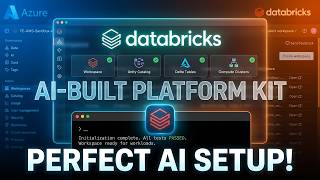
Bring Databricks into Kiro IDE with the AI Dev Kit Power
The Databricks AI Dev Kit Power now offers a one-click setup to integrate Kiro IDE with the full Databricks platform, providing AI-assisted development grounded in your workspace's Unity Catalog metadata. This new path, alongside a lighter PAT-based option, ensures your AI assistant writes SQL with actual columns and respects all row, column, and tag-based grants.
Building a data stack for trusted AI
Databricks now offers a data stack for trusted AI, providing governed, consistent, and contextual data. Learn how to build it without tying yourself down.
Scaling Enterprise Conversational Intelligence: Cross-industry Technology and Functional Solutions Powered by Databricks Genie
Databricks Genie now powers cross-industry conversational intelligence solutions from leading partners, offering ready-to-deploy offerings for sales, marketing, HR, finance, and other enterprise functions. These innovative solutions accelerate AI transformation by addressing technology and function-specific use cases across the enterprise.
databricks/terraform-provider-databricks — v1.117.0
Creating an external location with file events disabled now correctly applies this setting instead of silently defaulting to enabled. Previously, the `enable_file_events = false` configuration was ignored, leading to file events being enabled by default.
Beyond parsing X12: Closing the gap for revenue cycle workflows in healthcare
Healthcare billers now have an operational workbench built on Unity Catalog gold views, providing a purpose-built UI with a denials queue, remittance drawer, and timely-filing age alerts directly on their fully parsed 835/834/837 EDI data. This solution integrates GenAI via Databricks Foundation Model APIs to auto-draft appeal letters, moving billers beyond manual spreadsheet and SQL work to review and approve instead of writing from scratch.
dbt Labs Named Snowflake Data Integration Product Partner of the Year
dbt Labs was named Snowflake Data Integration Product Partner of the Year. This post details dbt Labs' two Snowflake Partner honors, including the CoCo Adoption Award.
Safe AI-Driven Development with Lakebase Branches
Databricks Lakebase branches enable instant, cost-efficient database branching using copy-on-write, allowing developers to test features in isolated environments without affecting production data. The video demonstrates creating and managing these branches via the Lakebase console and Databricks CLI, and shows how to integrate them into an agentic development workflow for safe AI-driven development.
Agentic BI: A Practical Guide for BI Teams and Business Users
Agentic BI, which embeds autonomous AI agents into analytics workflows, automates data prep, query execution, and insight delivery to replace static dashboards and address dissatisfaction with current insight generation. A governed semantic layer is critical for trustworthy agentic analytics, and adoption can be incremental, starting with a pilot and expanding based on documented outcomes.
Data Science vs Data Analytics: Compare Careers, Skills, and Degrees
Data analytics explains what already happened using SQL and Power BI, while data science builds ML models to automate future decisions. Choosing between them depends on your appetite for technical depth, comfort with unstructured data, and preference for stakeholder communication vs. system deployment.
AI in Defense: How Artificial Intelligence Is Reshaping National Security
AI is rapidly reshaping national security as nations accelerate military AI development, creating a global race with strategic consequences. Responsible AI governance, model validation, and human oversight are essential safeguards as defense organizations deploy autonomous systems and machine learning in combat operations.
Data Governance Architecture: A Complete Blueprint for Modern Organizations
This blueprint details a complete data governance architecture, outlining the policies, roles, and technologies needed to manage data assets. It emphasizes a modern strategy combining automated lineage, RBAC, and federated models to ensure data quality and regulatory compliance at scale.
Query Tags: The Context Your Warehouse Queries Have Been Missing
Databricks SQL warehouses now support query tags, enabling cost attribution by team or project and automatic tagging for dbt, PowerBI, and Tableau. Tag queries from any source, including the SQL Editor, Notebooks, Dashboards, APIs, connectors, and drivers.
databricks/databricks-sdk-go — v0.141.0
Databricks Asset Bundles now support a DeploymentMode field for both deployments and versions. Workspace settings include new fields for CollaborationPlatformConnectivity and EffectiveCollaborationPlatformConnectivity.
databricks/databricks-sdk-java — v0.115.0
This release adds new `deploymentMode` fields to bundle deployment and version objects. It also introduces `collaborationPlatformConnectivity` and `effectiveCollaborationPlatformConnectivity` fields to the settings API.
databricks/databricks-sdk-py — v0.114.0
This release adds new `deployment_mode` fields to the bundle deployment and version services. It also introduces `collaboration_platform_connectivity` and `effective_collaboration_platform_connectivity` fields to the settings service.
Introducing Cross-Engine ABAC
Unity Catalog now enforces attribute-based access controls (ABAC) on external engines, allowing you to define tag-based row filters and column masks once for enforcement from any engine. This centralized governance at the catalog layer, built on Iceberg REST Catalog scan APIs, ensures policies are enforced before data reaches the engine.
Beyond the Alert Queue: Modern AML Operations with Multi-Agent AI on Databricks
Databricks demonstrates a multi-agent AI solution for Anti-Money Laundering (AML) operations, significantly reducing false positives and accelerating investigation cycles from hours to minutes. The platform unifies siloed systems, employs specialized AI agents for analysis and recommendations, and offers AI-assisted SAR generation and executive-level reporting with natural language chat.
Personalizing Genie Code with instructions, skills, memory, and MCP
Genie Code now personalizes to your conventions with Instructions, Skills, and MCP Servers, allowing reuse of team workflows, internal docs, and external tools without repeated pasting. Leverage personal skills for individual work, workspace skills for shared team workflows, and admin-approved MCP servers for scalable external context in agent mode.
mlflow/mlflow — v3.13.0
MLflow 3.13.0 introduces a new Role-Based Access Control system with an Admin UI for managing users and permissions, alongside trace retention and auto-archival to object storage. This release also includes one-click observability for coding agents via the AI Gateway, new engines for MLflow Assista…
Debunking 8 data layout myths: why Liquid Clustering outperforms partitioning
Liquid Clustering is the data layout for open table formats that outperforms partitioning, and this post debunks 8 common myths keeping teams tied to partitioning. Customers using Liquid Clustering report dramatic improvements in query latency, write throughput, storage efficiency, and data freshness, with the largest gains compounding at petabyte scale.
When to choose CPU vs GPU: Databricks AI Runtime Explained
CPUs are best for data work like ETL, feature engineering, SQL, and classical machine learning, while GPUs are designed for deep learning workloads such as fine-tuning LLMs and training neural networks. Databricks AI Runtime simplifies GPU usage by providing serverless Nvidia GPUs, removing the need for manual infrastructure setup and allowing seamless transitions between CPU for data prep and GPU for model training within the Databricks environment.
How Large Language Models (LLMs) Work - Full Explanation | Chapter 04
Large Language Models (LLMs) are text-based neural networks trained on massive data to predict the next word (token), operating through tokenization, vector embeddings, and a transformer architecture. LLMs undergo pre-training, supervised fine-tuning, and reinforcement learning from human feedback to become helpful, safe, and aligned, with concepts like context length, knowledge cut-off, and hallucination defining their capabilities and limitations.
Fivetran and dbt are one company now. Here's what that means.
Fivetran and dbt Labs are officially one company, delivering data infrastructure for agents you trust. This post explores what this means for practitioners.
Fivetran + dbt Labs Complete Merger to Create the Data Infrastructure for Trusted AI Agents
Fivetran and dbt Labs have completed their merger, creating a unified company focused on building the data infrastructure for trusted AI agents. This new entity aims to provide the foundational data layer necessary for the agentic AI era.
What we announced at Snowflake Summit and why it matters
dbt State, dbt Wizard, dbt Core v2.0, and the Fivetran merger
databricks/databricks-sdk-go — v0.140.0
The SDK now supports a discovery flow that lands users on the account selector and includes a new method for updating workspace-level token management. Additional fields for job deployments, pipeline deployments, and token information have been added.
databricks/databricks-sdk-java — v0.114.0
The SDK now uses `X-Databricks-Workspace-Id` instead of `X-Databricks-Org-Id` for workspace-scoped API calls, accepting various workspace identifier formats. Several new fields and a `updateTokenManagement()` method have been added across various services, including job and pipeline deployments, an…
databricks/databricks-sdk-py — v0.113.0
This release adds comprehensive CRUD operations for feature engineering streams and a method to update token management settings. It also introduces breaking changes by removing `catalog_id` from `CatalogCatalogStatus` and `synced_table_id` from `SyncedTableSyncedTableStatus`.
Enabling Evolutionary Database Development: database branching with Lakebase
Why this series existsThe methodology described in Evolutionary Database Design and...
AI Doesn't Scale Until You Stop Calling It Innovation
Schneider Electric solutions leveraging Databricks can reduce energy costs by up to 20 percent, demonstrating that scaling AI requires focusing on business value and customer need over technology selection. The fastest-scaling companies combine domain expertise with AI knowledge through dedicated, end-to-end teams.
Databricks at SIGMOD 2026
Spark Declarative Pipelines (SDP) are simplifying complex ETL and streaming workloads, pioneering the next generation of data engineering. Get a deep dive into Enzyme, our incremental view maintenance engine, which won an honorable mention at SIGMOD.
Winning under CMS TEAM: Building the learning health system to realize success in VBC today and tomorrow
Databricks helps healthcare providers succeed under the mandatory CMS TEAM program by building an AI-enabled data foundation for proactive, data-driven intervention. This enables a unified view across clinical and claims data, embedding predictive insights into care workflows to reduce SNF costs by 15% and readmissions by 12%.
How enterprise leaders are scaling AI agents across their organization
Databricks practitioners can learn five key practices for scaling agentic AI responsibly across enterprise core workflows like HR, finance, and fraud detection. This post helps leaders deliver rapid gains from AI agents while maintaining governance, trust, and cost control.
Advancing Apache Iceberg on Databricks: Iceberg v3 GA, Open Sharing, and Unified Governance
Unity Catalog now offers GA support for Managed Iceberg, Iceberg v3, and Foreign Iceberg, making it the most comprehensive and production-ready Apache Iceberg catalog with open APIs, catalog federation, and secure sharing. Future versions of Iceberg and Delta will converge on a unified metadata structure, eliminating the tradeoff between interoperability and performance.
databricks/terraform-provider-databricks — v1.116.0
You can now manage Git credentials for service principals and permissions for Agent Bricks resources. Key fixes include proper updates for Metastore external access, improved handling of UC object destruction, and configurable timeouts for Vector Search Index creation.
The New Databricks Lakeflow Designer Is a Game Changer!
Databricks Lakeflow Designer is a visual data preparation tool that allows users to create, add, and transform data using a no-code drag-and-drop UI or AI-powered Genie Code. The video demonstrates how to import data from various sources, profile data, perform complex transformations like data type conversions and sentiment analysis, and then deploy the resulting production-ready PySpark code for scheduling or integration into existing pipelines.
databricks/databricks-sdk-go — v0.139.0
This release adds new methods for managing feature engineering streams and introduces `Parameters` fields for Databricks Jobs and Pipelines. It also includes breaking changes by removing `CatalogId` and `SyncedTableId` fields from PostgreSQL catalog status objects.
databricks/databricks-sdk-java — v0.113.0
This release adds comprehensive CRUD operations for feature engineering streams and introduces a `parameters` field across various Jobs and Pipelines API objects. It also includes breaking changes by removing `catalogId` and `syncedTableId` fields from specific Postgres service objects.
Reliable LLM Inference at Scale
Databricks now offers model units, a VM-like abstraction for allocating and scaling GPU resources per customer, enabling cost-aware load balancing and autoscaling that saved over 80% in GPU costs. Runtime reliability mechanisms like black-box health checks and multimodal bottleneck profiling further improve throughput and recover from silent failures automatically.
BI Serving Pointers; Maximizing for Performance and TCO
Databricks now offers Unity Catalog Metric Views for a headless semantic layer, enabling governed business metrics across all BI tools and AI agents. Maximize performance and TCO by structuring your physical layer with star schemas, liquid clustering, and Predictive Optimization, and leverage aggregate-aware materialization for OLAP-style performance.
databricks/cli — v1.1.0
Bundle users now receive a suggestion to set `bundle.engine: direct` in `databricks.yml` when encountering direct-only resource errors with the Terraform engine. The CLI also adds support for managing `vector_search_indexes` as a direct-engine bundle resource, including UC grants and destructive op…
How the lakebase architecture stays resilient to cloud failures
Lakebase's architecture is built for resilience to cloud failures, not patched for it, by using stateless Postgres compute on zone-redundant storage and separating hot-path control-plane operations. This approach, validated through chaos testing and per-database availability tracking, addresses the unique reliability demands of agent workloads that start tens of millions of databases daily.
Introducing Always-On pricing: automatic savings for Databricks Lakebase
Databricks Lakebase now offers Always-On pricing, providing serverless flexibility with a 25% lower price on baseline capacity for established production workloads. Activate with a single toggle to disable scale-to-zero and set an autoscaling range, then after 24 hours of continuous use, baseline capacity bills at the Always-On rate while spikes bill at standard Autoscaling rates.
Announcing Lakebase Change Data Feed (CDF)
Lakebase Change Data Feed (CDF) is now in Public Preview, eliminating pipeline sprawl from operational databases by exposing every table's changes through Unity Catalog Managed Tables. This enables native CDC governed end-to-end without sidecar infrastructure, allowing operational data to function as the native Bronze layer in the medallion architecture.
databricks/databricks-sdk-go — v0.138.0
The config-file loader now correctly sets the profile name to "DEFAULT" when using the legacy fallback, ensuring consistent profile identification. This fixes issues where consumers deriving identifiers from the profile name, like the Databricks CLI's OAuth cache, could not match login and read flo…
databricks/databricks-sdk-py — v0.112.0
This release switches the SDK's internal formatter and linter to Ruff, aligning with Databricks' internal Python formatting guidelines. This change has no behavioral impact on the published SDK for users.
Building a FHIR-native health data platform on Databricks Lakebase
Health Samurai's Aidbox now runs natively on Databricks Lakebase, providing a FHIR-native health data platform that standardizes clinical data at ingestion and makes it instantly available for Spark, ML, and AI. This architecture inherently delivers compliance with CMS-0057 and ONC mandates, eliminating the need for separate compliance workstreams.
AI readiness in telecommunications
Telco AI initiatives stall at production scale due to data debt, not model quality; Databricks Unity Catalog provides the semantic layer and governance needed to bridge this gap. It unifies disparate systems via Lakehouse Federation, offering AI agents rich context and enabling end-to-end governance for regulatory compliance and accurate operational tasks.
Terraform AWS Databricks Deployment Guide!
The video demonstrates how to deploy an AWS Databricks workspace using a provided Terraform script. It covers prerequisites, AWS and Databricks authentication, variable configuration, and executing the Terraform commands to create the workspace.
Secure Serverless: Azure Private Link Service Direct Connect
The video demonstrates how to set up Azure Private Link Service Direct Connect to enable secure, private connectivity from Databricks serverless compute to any private IP address, such as an on-premises database. It details the architecture, prerequisites, and a step-by-step demo of configuring the Private Link Service and a Databricks Network Connectivity Configuration (NCC) to connect to a MySQL instance.
The Future of Finance Operations Starts Here
The video demonstrates how Databricks' financial lakehouse solution addresses common finance data challenges like fragmentation and slow analysis. It showcases features like Unity Catalog for data governance, Lake Flow for pipeline management, and Genie Spaces for natural language querying of financial data.
databricks/databricks-sdk-go — v0.137.0
The SDK now supports Vercel's AI_AGENT environment variable for user-agent detection and passes unrecognized agent names as-is. New API fields were added for Lakeview dashboards, apps, ML materialized features, and Postgres synced tables.
databricks/databricks-sdk-java — v0.112.0
This release introduces new methods for Lakeview and Postgres services, including `revert()` for Lakeview and `undeleteBranch()` for Postgres, alongside new fields for Jobs, IAM, and ML services. Several breaking changes require `actionType` and `resourceId` for bundle operations, `cliVersion` for …
databricks/databricks-sdk-py — v0.111.0
This release introduces a new bundle service and adds `revert()` for Lakeview dashboards and `undelete_branch()` for Postgres. It also includes breaking changes to the `tags` field in Marketplace listings and pagination for Cluster events.
Route Claude Code Through MLflow AI Gateway
MLflow AI Gateway now supports routing Claude Code, providing full observability, budget controls, and guardrails for all your coding agent sessions. This integration requires no changes to your existing Claude Code usage.
How Neural Network works | Weights and Bias #dataengineering #neuralnetworks #genai
A neural network's neuron processes input signals by assigning weights to each, reflecting its importance (e.g., monthly income has a high positive weight, outstanding debts a negative weight). These weighted inputs are summed with a bias, and the result is passed through an activation function to produce an output decision.
Pharma launch analytics: How to compress the first 90 days and win the three years that follow
Databricks Genie for Commercial Launch Intelligence helps pharma companies compress 90 days of launch analytics into immediate insights. This enables commercial leaders to quickly interrogate launch data, make weekly decisions, and drive long-term growth.
Scaling for MHHS: how Octopus Energy achieved a 50x cost reduction in margin data engineering
Octopus Energy achieved a 50x cost reduction in their margin data engineering pipelines by re-architecting on Databricks for UK MHHS regulation. They leveraged Delta Lake Change Data Feed and Databricks Serverless to process 48x more data at a fraction of the original cost, improving freshness from weekly to daily.
Accelerating LLM Inference with Prompt Caching for Open‑Source Models on Databricks
Databricks now supports prompt caching for open-source models across all workloads, automatically accelerating LLM inference by reusing repeated prompt prefixes. This feature boosts throughput by 2.5x and reduces P50 latency by 3x for models like GPT-OSS, with no setup required.
Observability for any agent, anywhere: Production-ready tracing with OpenTelemetry & Unity Catalog on Databricks
Databricks now supports writing OpenTelemetry traces directly to Unity Catalog tables via a fully managed, serverless ingestion path. This enables governed, analytics-ready observability data with long-term retention and unified evaluation workflows, without operating OTel infrastructure.
Building Trustworthy, High-Quality AI Agents with MLflow
Databricks' MLflow platform helps developers build trustworthy, high-quality AI agents by providing tools for end-to-end observability, evaluation, prompt management, and AI gateway governance. It demonstrates how MLflow facilitates tracing, expert feedback collection, automated issue detection with LLM judges, prompt optimization, and continuous monitoring throughout the agent development lifecycle.
Building Enterprise-Ready Agents using Agent Bricks
Databricks Agent Bricks is a unified platform designed to help enterprises build and manage AI agents, addressing challenges like low-quality reasoning on proprietary data, lack of governance, and fragmented toolchains. It demonstrates how to create knowledge assistants for unstructured data and AI Genies for structured data, integrating with Unity Catalog for governance and MLflow for observability and evaluation.
How World Bank Group uses databricks to eradicate poverty through shared knowledge
The World Bank Group built a unified data and AI platform on Databricks, leveraging Unity Catalog, Volumes, Genie, and AI Gateway to connect structured operational data with unstructured documents. This eliminated manual research bottlenecks, enabled natural language access to trusted insights, and now supports millions of document downloads monthly to accelerate global knowledge sharing for poverty reduction.
Neural Networks Explained - How They Work & Are Trained | Chapter 03
This video explains how artificial neural networks (ANNs) work, detailing the components of a neuron (inputs, weights, bias, activation function) and how they form layers in a network. It also covers the training process, including forward propagation, loss calculation, and backpropagation using gradient descent to adjust weights and biases.
Using observability data to prevent incidents
Databricks Genie enables natural language querying of telemetry data, allowing leaders to proactively identify risks and shift from reactive firefighting to reliability intelligence. This helps engineering teams move beyond optimizing for response time (MTTR) to prevent incidents by surfacing upstream reliability risks that impact revenue, roadmap velocity, and customer trust.
How Databricks Genie democratizes data access in financial services
Databricks Genie now democratizes data access for financial services business leaders by enabling natural language querying of governed data. This eliminates the "Last Mile of Data Democratization" by removing the need for SQL skills or BI tool training.
mlflow/mlflow — v3.13.0rc0
MLflow now features a major overhaul of Role-Based Access Control with a new Admin UI and unified permission APIs, alongside new capabilities for GenAI agent observability including coding-agent tracing plugins and automated stress-testing. Databricks practitioners can also leverage new trace archi…
How security teams can report cyber risk to boards
Databricks Genie now enables real-time, data-driven cyber risk quantification, linking security posture to business impact for better governance. This helps security teams translate technical signals into financial risk insights, providing boards with unified visibility beyond fragmented legacy tools.
Transforming industries with conversational AI: Partner solutions built on Databricks Genie
Databricks Genie now powers innovative, industry-specific conversational AI solutions from leading consulting and SI partners. These ready-to-deploy offerings accelerate enterprise AI transformation across financial services, healthcare, retail, and other key sectors.
From emissions reporting to decarbonization decisions
Databricks Genie for Decarbonization Intelligence is now available to help sustainability leaders move beyond backward-looking emissions reporting. It enables natural language querying across operational and emissions data for instant answers, transforming sustainability from compliance to competitive advantage.
You’ve built the media products, now make them personalized
Databricks Genie for Digital Product Intelligence is here to help media companies personalize their products and close the "Digital Product Intelligence Gap." Learn how to use real-time behavioral data to drive 4x engagement lifts and empower product teams with instant answers to complex questions.
From "What Happened?" to "What Will Happen?"
Conversational BI now delivers predictive answers in seconds, not days, by fusing Genie for dynamic feature engineering with TabPFN for zero-training prediction, orchestrated by Agent Bricks. This self-assembling pipeline eliminates data science bottlenecks for business users, providing a governed experience backed by Unity Catalog and MLflow.
databricks/databricks-sdk-go — v0.136.0
This release introduces new fields for IAM user attributes, job trigger state, and enhanced branch management capabilities including undelete and purge options. Several breaking changes require `ActionType`, `ResourceId`, and `CliVersion` fields in bundle operations and versions, and modify marketp…
databricks/cli — v1.0.0
OAuth tokens for interactive logins are now stored in OS-native secure stores by default, requiring re-authentication after upgrade. A new `databricks aitools` command group is added for installing Databricks skills into coding agents.
Apache Iceberg V3 on Databricks: From Ingestion to Analytics
The video demonstrates Apache Iceberg v3 on Databricks, showcasing how its new variant column type natively handles semi-structured data and how row-level concurrency enables simultaneous data ingestion and corrections. It also highlights cross-platform data accessibility from open-source Spark via the Iceberg REST catalog, ensuring no vendor lock-in.
Are you ready for the dbt Fusion engine?
The dbt Fusion engine is here, and this post helps Databricks practitioners assess their readiness for migration. Learn how Brooklyn Data’s Fusion Readiness Assessment can help your team plan a confident transition.
Get dbt certified. Stay certified. Stay ahead.
Learn why dbt certification matters for your career and how to earn it. This post also covers how to stay certified and ahead.
Unlock seamless and cost-effective marketing campaigns with Lakebase
Lakebase Postgres, a serverless OLTP database, now scales to zero between marketing campaign spikes, eliminating underutilized database costs for personalization workloads. Native Synced Tables remove Lakehouse-to-OLTP pipeline burdens, letting marketing teams ship new customer segments to platforms like SAP Engagement Cloud in just a few clicks.
databricks/databricks-vscode — Release: v2.10.8 (#1899) (release-v2.10.8)
Governing AI agents at scale with Unity Catalog
Unity Catalog now governs AI agents at scale, providing a unified layer for identity-aware access, runtime policies, and full auditability across all agent interactions. This extends data governance to AI systems, improving observability, compliance, and trust for models, servers, and data within the lakehouse.
How telecom CFOs can make smarter network capex decisions with AI
Databricks Genie for Telecom Financial Intelligence helps telecom CFOs make smarter network capex decisions by bridging the "Financial Intelligence Gap" in capital planning. It enables finance leaders to query across financial, network, and commercial data using natural language to instantly probe the actual ROI history of comparable network investments.
databricks/databricks-sdk-go — v0.135.0
This release introduces a new bundle package and workspace-level service for managing Databricks Asset Bundles. It also adds an MtlsConfig field to ml.AuthConfig for mTLS authentication configurations.
How Databricks Genie improves retail personalization
Databricks Genie for Customer Intelligence now enables CX leaders to conversationally query their full customer data environment for instant answers on segment behavior, churn risk, and and loyalty program performance. This direct access to insights helps retailers turn data into actionable personalization quickly enough to act on it, addressing a key "data access opportunity."
Databricks for Good and Virtue Foundation: Partnering to Connect Medical Volunteers to Critical Health Services in 72 Countries
Databricks for Good partnered with Virtue Foundation to use AI for matching medical volunteers to critical health services in 72 countries. This collaboration provides updated core datasets in an accessible format, enabling better clinician skill-to-opportunity matching in developing countries.
Databricks Genie for Marketing
Databricks' AI BI Genie allows non-technical marketers to converse with their Customer 360 data using natural language, enabling quick insights into marketing performance and campaign optimization. It helps identify issues like audience saturation and recommends budget reallocation by analyzing data and providing reasoning for its suggestions.
AI-ready data in practice: What dbt Semantic Layer and dbt's MCP server and agent skills do for your team
dbt's Semantic Layer, MCP server, and agent skills now provide AI with essential business context. This enables your team to move beyond just clean data to truly AI-ready data in practice.
Automate Data & KPI Monitoring with SQL Alerts
In many organizations, data monitoring is still a manual, repetitive routine: open...
How to Build Real-Time Fraud Detection using Spark Real-Time Mode and Lakebase
Build real-time fraud detection with sub-second intervention using Spark Real-Time Mode and Lakebase. This unified platform processes high-throughput data streams, executes low-latency ML models, and serves explainable fraud scores to reduce detection lag and operational complexity.
How Databricks Genie improves supply chain visibility with real-time AI analytics
Databricks Genie now offers a conversational AI layer for real-time production intelligence, giving manufacturing VPs of Operations direct access to unified operational data. This eliminates data access bottlenecks, allowing leaders to ask context-aware questions and accelerate decision-making without complex analyst requests or BI tool training.
A CFO’s guide to managing value-based care financial performance
Databricks Genie for Value-Based Financial Intelligence helps CFOs bridge the VBC Financial Intelligence Gap by enabling conversational querying of integrated clinical-financial data. This allows healthcare finance leaders to quickly monitor patient utilization, track per-member-per-month costs, and identify clinical outliers essential for managing value-based care financial performance.
Stop rogue AI: How Unity Catalog secures your agent actions
The risks of agentic AI are no longer theoretical. Agents connected to external tools...
delta-io/delta-rs — rust-v0.32.3
This release adds support for the VARIANT type. No other user-facing features, fixes, or breaking changes are included.
Why AI Security Infrastructure is Now a CMO Priority
Databricks launched Lakewatch, an open, agentic SIEM built on the Lakehouse, to bring security detection to where enterprise data already lives. CMOs must now prioritize AI security infrastructure and engage in enterprise data and platform decisions to scale AI safely, as marketing teams are increasingly targeted by agentic cyberattacks.
Databricks context engineer associate: the industry’s first certification for reliable AI agent systems
Databricks launched the industry's first certification for reliable AI agent systems: the Databricks Context Engineer Associate. This new certification validates skills in designing, managing, and governing AI context effectively.
What's shipped in dbt — May 2026
May 2026 brings a roundup of dbt shipments since January, covering agents, Fusion, security, developer experience, dbt Core, and more. This post details all the product changes relevant to your Databricks workflows.
Introducing AI spend controls with Unity AI Gateway
Unity AI Gateway now includes AI Spend Controls, offering proactive budget alerts across users, workspaces, and accounts to monitor and contain AI costs. These controls integrate with Unity Catalog system tables and Databricks budgets for unified governance of AI usage, cost visibility, and operational accountability.
How to safeguard AI workloads with Unity AI Gateway Guardrails
Unity AI Gateway now ships with pre-built and custom guardrails to protect sensitive information and ensure secure, compliant AI outputs. These guardrails are integrated with the Databricks lakehouse for simplified observability, monitoring, and evaluation of your AI workloads.
What’s new in Unity AI Gateway: service policies, guardrails, observability, and cost controls for AI agents and MCPs
Unity AI Gateway now includes service policies, guardrails, observability, and cost controls for AI agents and MCPs. This enables Databricks practitioners to govern model calls and agent actions with consistent policies, full visibility, and enforceable cost controls for production AI.
delta-io/delta-rs — python-v1.6.0
This release fixes several regressions, including issues with MERGE operations, schema overwrites with predicates, and partition column changes. It also enables passing non-string datatypes in custom commit metadata and updates the minimum PyArrow version to 21.0.0 for preliminary variant type supp…
databricks/databricks-sdk-go — v0.134.0
Databricks SDK for Go now supports new fields for configuring pipeline refresh selections within jobs. Additionally, new fields for operational email custom recipients are available in settings.
databricks/databricks-sdk-java — v0.110.0
The Databricks SDK for Java now includes new fields for pipeline refresh selection within job parameters and tasks. Additionally, new fields for operational email custom recipients are available in the settings service.
databricks/databricks-sdk-py — v0.110.0
This release adds new fields for pipeline refresh and checkpoint selection within Databricks Jobs, enhancing control over DLT pipeline execution. It also introduces new fields for custom operational email recipients in Databricks settings.
How I Mastered System Design Interviews
This video teaches a six-step framework for mastering data engineering system design interviews, covering requirements gathering, pipeline design, data modeling, storage and file formats, data quality and observability, and pipeline resilience. It demonstrates how to apply this framework with practical examples and back-of-the-envelope calculations to justify design choices.
How Deutsche Börse built a generative AI tool to tackle the large-scale migration of Zeppelin notebooks to Databricks
Deutsche Börse built a Databricks App to automate the migration of Zeppelin notebooks, reducing redevelopment time from hours to minutes. This solution tackles a large-scale migration challenge by handling structural conversion and generating AI-assisted prompts for reconstructing notebook logic.
AI Agents That Remember: Building Stateful Systems with Lakebase
AI agents require four types of memory (working, episodic, entity, procedural) to be truly intelligent and stateful, which traditional databases struggle to provide. Databricks Lakebase, built on Postgres, offers a unified OLTP and OLAP solution with features like serverless auto-scaling and Git-style branching to manage these complex memory needs for AI agents.
Announcing the Databricks analytics engineer learning pathway
A new learning pathway for Databricks SQL practitioners is now available on Databricks Academy, covering skills to use the full SQL ETL toolkit for data modeling, pipelines, semantic layers, and conversational agents. Courses are offered in self-paced and instructor-led formats, and are included with any active Databricks Learning Subscription.
Databricks News: Lakeflow Designer, UV package manager, DABs templates, Genie scheduled tasks
Databricks introduces Lakeflow Designer for visual data preparation, though its generated code is messy; a workaround uses Genie to convert the visual workflow into clean PySpark/SQL notebooks. The UV package manager significantly speeds up package installations on Databricks serverless runtimes, and DABs templates allow for standardized, customizable Databricks Asset Bundles.
AI-assisted analytics engineering: Docusign’s framework for scaling dbt unit testing
Docusign reduced dbt unit test authoring from 5 hours to 30 minutes. Learn their AI-assisted framework for scaling dbt unit testing.
How NASDAQ built a governed intelligence layer with dbt and Databricks
NASDAQ built a governed intelligence layer using dbt and Databricks to process up to a trillion messages daily across 26 business lines. Learn why they chose this combination for their data architecture.
Ship smarter agents in production with dbt Agent Skills
Just like humans, autonomous agents need faster feedback loops. Here’s how to develop them.
The question your commercial data should already be able to answer
Databricks and Veeva now embed Genie AI agents and AI/BI dashboards directly into Veeva Vault CRM, enabling life sciences commercial teams to get real-time answers to their questions without leaving their workflow. This unified Databricks lakehouse with Unity Catalog delivers governed commercial data to every persona, from sales reps to MSLs, in the format and depth their role requires.
databricks/databricks-sdk-py — v0.109.0
This release adds new methods for managing IAMv2 workspace assignments at both account and workspace levels, and introduces new fields for ML features, disaster recovery stable URLs, and customer-facing ingress network policies. It includes breaking changes to the `list_features()` method and `List…
delta-io/delta-rs — rust-v0.32.2
This release fixes a bug preventing partition column changes when overwriting tables and addresses a regression in MERGE operations that caused high memory usage. It also adds support for passing non-string datatypes in custom commit metadata and includes nanosecond timestamp support.
Govern MCP servers in Databricks #databricks #mcp #aigovernance
Databricks Unity AI Gateway now governs MCP servers, centralizing their management alongside built-in foundation models and LLMs. This integration allows for easier governance and orchestration of various AI components and agents within Databricks.
How Suntory Turns Data into Faster Decisions with Databricks
Suntory uses Databricks to integrate diverse datasets, including internal sales, macroeconomic factors, and consumer behavior, into "Project Brain" for faster decision-making and product launches. The company also implements an all-employee upskilling program, "Manabi no Michi," to empower its workforce to leverage AI for improved performance and efficiency.
AIA Group x Databricks: Turning Regulated Data into Real-Time Intelligence
AIA Group leverages Databricks to manage regulated data across 18 markets, addressing challenges like data residency and varying tech maturity with features like Unity Catalog for governance. The platform enables real-time intelligence for investment decisions, fraud detection, and personalized agent coaching, with future plans for conversational analytics and autonomous AI.
Connect Google Sheets to Databricks
The Databricks Google Sheets add-in allows users to explore, import, and refresh governed data from the Databricks Lakehouse directly within Google Sheets. It demonstrates how to browse Unity Catalog, select tables or metric views, apply filters, schedule data refreshes, and use direct SQL queries with parameters.
PipelineIQ: Forward‑Looking Sales Intelligence That Drives Action
PipelineIQ is a new AI solution that provides prescriptive "Next Best Actions" for sales reps and managers, shifting focus from retrospective forecasting to immediate, forward-looking guidance. It's built to work with imperfect CRM data, extracting signals like champion strength and procurement stalls to deliver clear outcomes: Walk, Pivot, or Accelerate for every opportunity.
No More Table Locks for Multi Statement Transactions #databricks #dataengineering #sql
Databricks now supports multi-table transactions, allowing changes to multiple tables within a single atomic transaction that rolls back all changes if any part fails. This feature, managed by Unity Catalog, prevents table locking during updates and supports up to 100 tables per transaction using a simple "BEGIN ATOMIC...END" syntax.
May 2026 Databricks Updates: No Code ETL, New GPUs and Death of the Dashboard
Databricks announced several updates including AI Prep Search for document chunking and vector database preparation, SQL vector functions for embedding mathematics, and the general availability of multi-table transactions. They also introduced Lakeflow Designer for visual, no-code data pipeline creation and updated their serverless GPU offerings to include H100s.
AI for Data Intelligence Demo: Real-time fraud Detection with Databricks
Databricks demonstrates a real-time fraud detection solution for identifying mule accounts in banking, leveraging a unified data architecture, advanced AI/ML, and graph analytics to uncover complex fraud networks. The solution provides investigators with a single pane of glass application and AI-powered querying (Genie) to analyze risk scores, transaction patterns, and shared device access for efficient fraud investigation and reporting.
How to use Meta Conversions API on Databricks to activate first-party data
The Databricks Meta Conversions API app enables users to send conversion events from the Databricks Lakehouse directly to Meta Ads Manager. It provides a guided setup to connect Databricks to Meta using a pixel ID and access token, allowing for quick testing with sample data, deploying customizable notebooks, or setting up automated jobs for continuous data flow.
Making AI Feel Personal: User-Delegated Actions in MCP Agent Systems
The video demonstrates how to build an AI agent in Databricks that provides personalized responses by integrating user-delegated actions through Model Context Protocol (MCP) servers. It walks through setting up Unity Catalog functions, external MCP tools like web search, and custom MCP servers to access internal APIs, all while maintaining user context for relevant information retrieval.
How to Build an AI Security Governance Hub with Agent Bricks
Databricks Agent Bricks enables building an AI Security Governance Hub by transforming static security playbooks into adaptive multi-agent systems. The video demonstrates combining a knowledge assistant for unstructured documents and a Genie space for structured data into a supervisor agent, then details how to tune and monitor these agents for improved performance and data privacy.
Data + AI Executive Series: Fast 5 — Scaling Real-Time Ops with Databricks at Aer Lingus
Aer Lingus uses Databricks to scale real-time operations, particularly for making critical decisions in their operation control center regarding flight delays and cancellations. They are also exploring using "Agentic" to automate business case creation and review, aiming for a single, governed platform for reusable agents.
databricks/cli — v0.299.2
The `vector_search_endpoints` configuration and commands now use `target_qps` instead of `min_qps`, requiring updates to `databricks.yml` and CLI invocations. Authentication commands received several usability improvements, including better keyring handling and interactive profile selection.
Data + Semantic Context = AI Ready | How TK Elevator Built It on Databricks
TK Elevator built an AI-ready data platform on Databricks Lakehouse, centralizing fragmented elevator data at scale. This platform integrates semantic context and expert knowledge, using Unity Catalog for governance and a medallion architecture to prepare data for AI applications.
databricks/databricks-sdk-py — v0.108.0
Job tasks can now be marked as disabled in both run and submit requests. Catalog connection types gained new enum values for HubSpot, GitHub, Outlook, and Smartsheet, while the `unspecified_resource_name` field was removed from `RequestedResource` in the Postgres service.
databricks/terraform-provider-databricks — v1.115.0
This release fixes state decoding errors for databricks_library, databricks_share, and databricks_quality_monitor after upgrading from v1.113.0 to v1.114.0. It also resolves issues where several account-level data sources and settings failed due to workspace ID resolution errors, now supporting acc…
Building Trustworthy, High-Quality AI Agents with MLflow
MLflow provides a comprehensive platform for building, evaluating, and deploying high-quality AI agents, offering tools for observability, automated evaluation, prompt optimization, and production monitoring. It enables developers to streamline the agent development lifecycle, from prototyping and testing with human and AI judges to fixing issues and ensuring reliable, governed deployment.
Evaluating AI in Production: A Practical Guide
The video provides a practical guide to evaluating AI in production, emphasizing that evaluation is a continuous process, not a one-time task. It details common evaluation processes, including developing hypotheses, gathering improvement signals, defining success criteria, and utilizing various scoring methods like code-based, LLM-as-judge, and human review.
databricks/databricks-sdk-java — v0.107.0
This release fixes an issue where the Databricks CLI `--profile` fallback was broken. It also introduces new API methods for `workspaceClient.supervisorAgents()` and `workspaceClient.vectorSearchEndpoints()`, along with several breaking changes related to `Example` and `Tool` fields, and `minQps` i…
databricks/databricks-sdk-py — v0.107.0
This release introduces new methods for managing supervisor agents and vector search endpoints, along with several new fields for connector options, ingestion sources, and customer-managed keys. Breaking changes include the removal of `min_qps` fields from vector search endpoint configurations and …
Enhancing your Skills with Databricks Genie Code
Databricks Genie Code is an agentic coding system that allows users to build custom "skills" using markdown files, enabling it to generate code and perform tasks according to specific in-house standards and conventions. These skills provide context-on-demand, ensuring repeatable and consistent output for various engineering tasks like schema documentation or metric view creation.
databricks/dbt-databricks — v1.11.8
The default query comment now includes the invocation_id. This release also fixes several issues, including enforcing the 255-character identifier limit for Databricks relations and suppressing various spurious warnings.
2026 & Beyond: Agentic Future in Finance
Databricks emphasizes that an "agentic future" in finance requires organizations to leverage their unique, proprietary data to provide context to AI models, which is the true competitive advantage. The video demonstrates how Databricks' platform centralizes and governs enterprise data, enabling AI agents to make informed, secure, and differentiated business decisions.
Introducing Databricks Document Intelligence
Databricks Document Intelligence is a new solution for extracting, processing, and analyzing unstructured data from documents using large language models. It offers a unified platform for document processing, including data extraction, summarization, and question answering, with a focus on accuracy and scalability.
Databricks Genie, Unity AI Gateway, Project Glasswing, and Model Mania | AI Newsround - April 2026
Databricks Genie is now the business user home screen for Databricks, offering a unified chat interface, external knowledge store connections, and a mobile app. The Unity AI Gateway, integrated with Unity Catalog, provides comprehensive governance for agentic AI, including permissions, auditing, and policy controls for models and tools.
Databricks in 3 minutes. The unified data and AI platform, explained.
Databricks unifies diverse data sources into a single data lake, providing a governed platform for analytics and AI. It offers capabilities like fine-grained access control, natural language querying with AI, and company-wide intelligent agents.
databricks/databricks-vscode — Release: v2.10.7 (#1895) (release-v2.10.7)
This release adds initial compatibility for Remote Development and renames "Databricks Asset Bundles" to "Declarative Automation Bundles." It also includes fixes for profile management, such as preserving profile names during CLI authentication and correctly listing profiles with account IDs.
databricks/cli — v0.299.1
The `databricks api` command now supports unified hosts, allowing `--account` and `--workspace-id` flags or `?o=<workspace-id>` URL parameters for routing. JSON output for single objects now uses standard key-value spacing.
databricks/databricks-vscode — Nightly - unity-catalog (nightly-unity-catalog)
Machine Learning Explained - END to END | Chapter 02
The video explains core machine learning concepts, including supervised, unsupervised, and reinforcement learning, along with the workflow for building and evaluating models. It details classification and regression models, their applications, and essential data preparation techniques like feature engineering and handling the curse of dimensionality.
mlflow/mlflow — v3.12.0
MLflow 3.12.0 introduces multimodal tracing, allowing users to store and render PDFs, audio, and images as artifact attachments in tracing spans, along with new support for Codex, Gemini, and Qwen coding agent tracing. Additionally, it enables setting guardrails on gateway endpoints to prevent unsa…
Databricks News: watermark-based incremental ingestion, MCP in AI gateway, Genie, Vector Search
Databricks now offers watermark-based incremental ingestion from SQL databases without change data feed, allowing for efficient data updates and soft deletion handling. The AI Gateway supports custom MCP servers, enabling integration with external APIs like GitHub for enhanced AI application development.
databricks/databricks-vscode — Nightly - fix-new-profile-sign-in (nightly-fix-new-profile-sign-in)
Easy hack to optimize Scala and Java in Databricks
Databricks now supports running Java and Scala on Serverless Jobs using JAR files, eliminating the need to learn new languages for existing workloads. Users build a JAR with matching Databricks versions, add it as a job task, configure the main class and compute, and then run it.
Step-by-Step: Using the Databricks Excel Add-in to Analyze Governed Lakehouse Data
How to import governed Databricks data into Excel. Discover how business users can easily bring Unity Catalog tables, Metric Views, and shared queries into Excel as refreshable, governed data—no SQL or complex setup required. 0:00 - Intro 0:40 - Opening the add-in 0:47 - Select compute 1:01 - Brows…
How To Build Data Apps with Databricks, Power Apps, and Power Automate
The video demonstrates how to connect Power Apps, Power Automate, and Databricks to build data-driven applications. It shows how to add a Power Automate flow to a Power App and trigger a Databricks job using a button within the app.
databricks/terraform-provider-databricks — v1.114.2
You can now adopt pre-existing Databricks Postgres branch and endpoint resources using the replace_existing argument. A change to databricks_external_location prevents Terraform drift related to the effective_file_event_queue field.
databricks/databricks-sdk-java — v0.106.0
This release introduces new services for disaster recovery and temporary volume credentials, alongside extensive new methods for knowledge assistants. It also adds support for various new fields and enum values across several services, while making the `description` field optional for `SupervisorAg…
Zerobus Ingest, Lakebase and Databricks Apps in Action: Data Streaming with Databricks
The video demonstrates a real-time IoT data streaming application built with Zerobus for ingestion, Lakebase for low-latency serving, and Databricks Apps for the front and back ends. This architecture processes thousands of concurrent IoT events from mobile phone sensors globally without using Kafka or traditional complex pipelines.
databricks/cli — v0.299.0
The `--experimental-is-unified-host` flag and related configuration options are removed; unified hosts are now detected automatically. List commands now support interactive pagination, displaying 50 rows at a time with options to view more or quit. An experimental opt-in for OS-native secure token …
databricks/terraform-provider-databricks — v1.114.1
Talkdesk Powers AI-Driven CX with Databricks on AWS
Talkdesk uses Databricks on AWS as a unified data platform to power its AI-driven customer experience (CX) platform, which automates and accelerates customer interactions. Databricks centralizes data storage, provides consistent data modeling, and unifies data processing pipelines, enabling Talkdesk to manage both unstructured and structured data in Iceberg format and leverage generative AI capabilities.
How To Connect Power Apps to Databricks for Secure, Zero‑Copy Data Access
The video demonstrates how to connect Microsoft Power Apps to Azure Databricks for secure, zero-copy data access. It shows how to create a connection, load data into a Power App, and perform create, read, update, and delete operations directly on Databricks data, with auditing capabilities.
From AI to Agents| Fundamentals of AI | ML | DL | LLM & GenAI | Chapter 01
The video explains the fundamental concepts of AI, ML, DL, LLMs, and GenAI, illustrating their hierarchical relationship as subsets of each other. It also defines what models are (mathematical formulas trained on data) and how agents combine LLMs with tools and optional memory to perform autonomous tasks.
Apache Spark Streaming Real-Time Mode - Latency Demo
The video demonstrates how to deploy and run Apache Spark Streaming in Real-Time Mode (RTM) using a declarative automation bundle. It shows that RTM significantly reduces P50 and P95 latencies compared to microbatch mode, achieving 26ms and 50ms respectively in a simplified setup without an external messaging bus.
Air Traffic Control with Apache Spark Structured Streaming Real-Time Mode
The video demonstrates building a real-time air traffic control application using Apache Spark Structured Streaming Real-Time Mode, Lakehouse, and Databricks Apps. This system processes live flight telemetry, detects congestion, and generates alerts with sub-second end-to-end latency, all within a single Databricks platform.
databricks/terraform-provider-databricks — v1.114.0
This release introduces new resources and data sources for managing disaster recovery failover groups, stable URLs, supervisor agents, and UC secrets. It also enables adopting pre-existing Postgres branch and endpoint resources using the `replace_existing = true` argument.
mlflow/mlflow — v3.12.0rc0
MLflow 3.12.0rc0 introduces enhanced AI agent development features, including automatic tracing for various AI coding assistants and OpenClaw, along with new AI Gateway Guardrails for safety checks. It also adds multimodal trace attachments for viewing images, audio, and files directly in the MLflo…
Step-by-Step: Connecting Databricks to Excel Using the Databricks Excel Add-In
The Databricks Excel add-in provides governed access to Databricks lakehouse data directly within Excel, enabling business users to query data without SQL. The video demonstrates how to self-service install the add-in by editing and uploading its manifest XML file into Excel web.
databricks/databricks-sdk-go — v0.131.0
This release introduces a new disaster recovery package and adds methods for managing knowledge assistant examples. It also includes breaking changes related to the `supervisoragents.Connection` and `supervisoragents.Tool` fields.
Lakebase and PG Vector: Vector Search of the Future?
The video demonstrates how to implement vector search using Lakebase and PG Vector within Databricks, focusing on two patterns: Lakebase native and reverse ETL from the lakehouse. It walks through setting up a maintenance co-pilot application that leverages PG Vector for semantic search, joins, and filtering on maintenance logs, showcasing the process from data embedding to app deployment and job scheduling for continuous updates.
Lovable now integrates with Databricks
Lovable now integrates with Databricks, allowing users to build data applications and tools using plain English prompts to access and write data to their Databricks Lakehouse. This connector enables rapid development of dashboards and applications while maintaining data governance and controlled access to specific catalogs, schemas, and tables.
How OpenAI and Databricks are working together
Databricks and OpenAI are partnering to help enterprises deploy and adopt AI, with Databricks focusing on secure data access and management for AI applications through products like Genie and AI Gateway. The video highlights GPT 5.5's enhanced planning capabilities and its leading performance in office knowledge work benchmarks, demonstrating its impact beyond coding to automate internal business processes.
unitycatalog/unitycatalog — Unity Catalog AI 0.4.0 (ai-v0.4.0)
DatabricksFunctionClient now supports an optional warehouse_id for function execution, enabling use in workspaces without serverless compute. Python 3.10+ is now required, and several bug fixes address issues with Gemini toolkit, LangGraph, and OSS client function creation.
Making AI understand your data - part 2 #databricks #data #ai
Databricks metric views allow for advanced data definitions using joins, including nested joins with runtime 17.1+, and complex calculations with windowing for time-based analysis. Materialization can precompute popular metric views with incremental updates, and semantics can be added for non-technical users using runtime 17.2+.
How Techcombank Scales AI Banking to 16M Customers with Databricks
Techcombank uses Databricks to power its AI banking platform, serving 16.2 million customers and processing 8 billion daily transactions with a 12,000-plus feature store. This enables the bank to make data-driven decisions, automate lead allocation with over 8,000 features, and achieve a 3x conversion uplift, improving both productivity and customer experience.
Are You Drowning in a Sea of Data Requests? #DataAnalytics #Help
The video uses a restaurant metaphor to explain why Business Intelligence (BI) teams become overloaded. It likens IT to kitchen staff, data to ingredients, analysts to waiters, and the business to customers, highlighting the bottleneck created when too many customer requests overwhelm the limited number of analysts.
databricks/databricks-sdk-go — v0.130.0
Unified host detection is now automatic, removing the `Experimental_IsUnifiedHost` field and enabling a single configuration profile for both account and workspace operations. The file-based OAuth token cache has been removed, defaulting to an in-memory cache unless a persistent cache is explicitly…
databricks/databricks-sdk-java — v0.105.0
The SDK now automatically detects AI coding agents and appends agent information to HTTP request headers, while also removing the unused `experimentalIsUnifiedHost` field from `DatabricksConfig`. A bug fix addresses `X-Databricks-Org-Id` header issues for `SharesExtImpl.list()` on SPOG hosts, and s…
databricks/databricks-sdk-py — v0.105.0
This release introduces new workspace-level services for secrets_uc and supervisor_agents, along with an update method for tokens. Several breaking changes occurred, primarily due to method path changes for data classification, environments, knowledge assistants, postgres, and warehouses services.
databricks/databricks-sdk-py — v0.104.0
WorkspaceExt upload/download and SharesExt list now include the X-Databricks-Org-Id header for SPOG host compatibility. WorkspaceClient.get_workspace_id avoids an API call when the workspace ID is already known, fixing a SPOG host failure.
Git-Style Database Branching (But Actually Fast) #database #lakebase
LakeBase enables Git-style database branching by creating metadata-only branches instead of full data copies. This allows users to create dev, QA, and prod branches that point to the main branch without duplicating the entire dataset.
From Notebook to Production: MLOps Quickstart
The video demonstrates how to apply MLOps best practices on Databricks using a quickstart repository, covering data ingestion, feature preprocessing, model training, deployment, and inference. It showcases Databricks tools like MLflow and Unity Catalog for managing the ML lifecycle, including version control, experiment tracking, model governance, and automated deployment across development and production environments.
Governed Tags & Data Classification in Databricks | ABAC Foundations
Databricks now offers governed tags and automated data classification to identify sensitive information like PII. This enables Attribute-Based Access Control (ABAC) policies for masking or hiding data based on user roles, without altering query patterns.
GenAI - For Data Engineers Agenda & Introduction | LLM & Agentic AI | LangChain & LangGraph | Claude
This video introduces a new course, "GenAI for Data Engineers," designed to teach data engineers how to leverage generative AI, LLMs, and agentic AI. The course covers basics of LLMs, building agents with LangChain and LangGraph, using Cloud Code, and applying agentic AI within Databricks and data engineering workflows.
databricks/cli — v0.298.0
The CLI now supports a --limit flag for paginated list commands and caches host metadata lookups for faster repeated invocations. Bundles gain support for Vector Search Endpoints and prompt for confirmation before destroying Lakebase resources.
delta-io/delta-rs — rust-v0.32.0
This release enhances the new Datafusion TableProvider and improves log parsing performance. It also fixes numerous bugs, including issues with DeltaScan schema handling, streamed merges, and incorrect row counts for DELETE operations.
databricks/databricks-sdk-go — v0.129.0
This release introduces new workspace-level services for supervisor agents and Unity Catalog secrets, along with an update method for tokens. Several existing API methods for data classification, environments, knowledge assistants, Postgres, and warehouses have breaking changes due to path modifica…
Reverse ETL: Exposing Gold Layer Data to Lakebase!
Reverse ETL allows exposing gold layer tables from a medallion architecture to Lakebase. This enables applications to read and write to these exposed tables, such as a dim customer table.
Real-Time ML Lookups: Lakebase for Zero Latency!
Lakebase enables real-time ML lookups by syncing data from Delta tables, offering a low-latency alternative to querying large gold tables directly. This reverse ETL process allows ML models to access necessary data quickly for real-time predictions.
Databricks AI Dev Toolkit: 10x Your Development
The Databricks AI Dev Toolkit is a repository created by the field engineering team to enable MCP tools and skills for building on Databricks. It can be attached to a coding agent to accelerate development on Databricks tenfold.
databricks/databricks-sdk-java — v0.104.0
This release adds Azure MSI authentication support and improves `.databrickscfg` default profile resolution. It also fixes issues with non-JSON error responses and Databricks CLI token scope mismatches, alongside several API additions and two breaking changes.
databricks/databricks-sdk-go — v0.128.0
The SDK now supports a default host metadata resolver for easier shared configuration and improved SPOG host compatibility for Workspace and Shares API calls. WorkspaceClient.CurrentWorkspaceID() directly uses the configured WorkspaceID, eliminating an API call and fixing SPOG host authentication i…
databricks/databricks-vscode — Nightly - fix/replace-softprops-action (nightly-fix/replace-softprops-action)
How Agentic AI is Rewriting Healthcare | NVIDIA x Databricks
Agentic AI is profoundly changing healthcare by automating administrative tasks for professionals and accelerating scientific research, such as drug discovery. Databricks and NVIDIA are collaborating to build an AI-ready data layer and open-source platforms to unlock insights from digitized medical data, enabling these agentic systems.
databricks/databricks-sdk-py — v0.103.0
This release automatically detects unified hosts for account and workspace operations, and accepts DATABRICKS_OIDC_TOKEN_FILEPATH for OIDC token files. Python 3.8 and 3.9 are no longer supported, requiring Python 3.10 or newer.
databricks/dbt-databricks — v1.11.7
This release adds support for Notebook-scoped packages when submitting commands or running notebook jobs. It also includes fixes for workflow job creation, preventing duplicate aliases in empty mode, and enabling insert-by-name for microbatch and replace_where strategies.
databricks/cli — v0.296.1
This release fixes an error where bundle commands failed due to an expired key when downloading Terraform. Users will no longer encounter the "unable to verify checksums signature: openpgp: key expired" error.
databricks/cli — v0.295.1
This release fixes an error that prevented bundle commands from running due to an expired key when downloading Terraform. Users can now execute bundle commands without encountering checksum signature verification failures.
databricks/cli — v0.294.1
This release fixes an error where bundle commands failed due to an expired key when downloading Terraform. Users can now run bundle commands without encountering checksum signature verification issues.